Full-time and part-time workers also see very different access to paid leave. A single average hides that gap.
This guide uses current US labor data to show typical paid vacation by tenure, how access differs across workers, and how to judge an offer. It also covers the basic PTO accrual math and how employers can present PTO as part of total compensation.
Key Takeaways
- Private-industry workers average 11 vacation days after one year and 20 after 20 years.
- Access and amount differ: 93% of full-time workers get paid vacation vs. 38% of part-timers.
- Averages aren't legal minimums; holidays, sick leave, rollover, and payout rules change real value.
- A total compensation statement puts PTO next to salary and other benefits.
How Much Paid Time Off Is Normal in the US?
Start with the right definition of "average PTO"
"PTO" means different things at different employers. Compare like with like:
- Vacation: leave provided annually, normally taken in blocks of days or weeks.
- Consolidated PTO: vacation, sick, and personal time in one bank.
- Sick leave: paid absence for non-work-related illness or injury.
- Paid holidays: days when work ordinarily stops, often with full pay.
- Personal days and shutdowns: extra categories some employers add.
SHRM's 2025 survey found 68% of responding organizations consolidate vacation and sick leave. A 15-day combined bank is not the same as 15 vacation-only days.
Current benchmarks from the BLS
The Bureau of Labor Statistics' March 2026 release covers private-industry workers. Access to paid vacation stands at 80%, paid sick leave at 81%, and paid holidays at 81%. Private-industry paid holidays average about 8 days a year.
Vacation averages apply to workers who actually receive the benefit. They don't describe the people with none.
Access differs by worker group
BLS access data shows large gaps in who gets paid vacation:
| Group | Paid vacation access |
|---|---|
| Full-time | 93% |
| Part-time | 38% |
| Lowest-paid 25% | 55% |
| Highest-paid 25% | 91% |
| Establishments with 1-99 workers | 72% |
| Establishments with 100+ workers | 89% |
| Service occupations | 57% |
These are shares of workers, not days granted or used. Establishment size also isn't always total company size.
How PTO changes with tenure
Employers raise vacation as people stay, which rewards loyalty and discourages turnover. The BLS service-requirement chart shows the pattern for private industry:
| Completed service | Average vacation days |
|---|---|
| 1 year | 11 |
| 5 years | 16 |
| 10 years | 18 |
| 20 years | 20 |
The BLS also reports that 32% of workers get 10-14 vacation days after one year, and 30% get 15-19 days after ten years. Early-career workers should expect roughly two weeks. Long-tenure workers can expect three to four.

Put the number in practical terms
Convert days to weeks using the employee's normal schedule. Fifteen days on a five-day week is three workweeks. On a 4x10 schedule, 15 days is 150 hours, or nearly four weeks.
The same count can be worth more or less depending on holidays, sick leave, and how freely you can schedule time.
Is 15 Days of PTO Good? How to Judge an Offer
Fifteen vacation days beat the one-year average of 11 but fall short of the five-year average of 16. There's no universal "good" line. Industry, job level, and employer size all move the benchmark.
Check the real time off behind the number
Ask whether the bank is vacation only, includes sick time, or sits on top of holidays. Consider two offers of "15 days":
- Offer A: 15 vacation days plus 8 paid holidays plus separate sick leave. That's 23 paid days off before any sick time.
- Offer B: 15 PTO days that must also cover sick days, with holidays included. Real vacation might be 5 to 7 days.

A big number means little if you can't use it. Look for:
- Approval rules and blackout periods
- Minimum increments (for example, half-days only)
- Waiting periods before you can take time
- Carryover limits and accrual caps
- Leave-friendly culture that encourages people to take time
Questions to ask before accepting
- How many PTO hours or days do I get per year?
- When does accrual start, and when can I use it?
- How does the amount rise with tenure?
- Are holidays and sick leave separate?
- Does unused time roll over or get paid at separation?
- Are part-time employees eligible?
- If PTO is "unlimited," how is it approved and how much do people really take?
On that last point, WTW's 2026 survey found 15% of employers offer unlimited PTO to exempt employees. SHRM puts paid open leave at 6% of organizations.
What PTO Policy Details Affect Its Real Value?
Traditional leave versus consolidated PTO
Separate vacation, sick, and personal banks protect sick leave from being spent on a beach vacation. One PTO bank is simpler to track and lets you use time for any need, including surprises. It also means a bad flu season can eat your vacation.
The US legal baseline
The Department of Labor says the FLSA doesn't require payment for time not worked, including vacation, sick leave, or holidays. These benefits generally arise from employer-employee agreements.
Other rules can still apply:
- State and local paid sick leave laws. A Congressional Research Service report counts 18 states plus D.C..
- Federal contractor rules under Executive Order 13706, which require at least 1 hour of sick leave per 30 hours worked on covered work.
- Employment agreements and state payout rules.
California and Colorado protect earned vacation from forfeiture. In California, "use it or lose it" is unlawful, though reasonable accrual caps are allowed.
Accrual, rollover, and payout
These provisions change what a benefit is worth:
- Front-loaded plans give the full annual amount up front.
- Hourly accrual builds time gradually, so new hires have little early on.
- Caps stop accrual at a set balance.
- Carryover limits and forfeiture rules can erase unused time where state law allows.
- Payout at separation depends on state law and written policy.
Read your employer's written policy and check your state labor department's guidance.
How to Calculate PTO Accrual per Hour
The basic formula
Accrual rate = annual PTO hours ÷ annual work hours
Annual PTO hours are the total the employee is eligible to earn. Annual work hours are the basis your employer uses, commonly 2,080 (52 weeks x 40 hours).
Example: 80 PTO hours ÷ 2,080 hours = 0.0385 hours of PTO per hour worked. That's about 1 hour of PTO for every 26 hours worked.
Convert to a pay-period rate
Multiply the hourly accrual rate by hours paid per period, or divide annual PTO by the number of periods:
- Weekly: 80 ÷ 52 = 1.538 hours per week (California's own agency example)
- Biweekly: 80 ÷ 26 = 3.08 hours
- Semimonthly: 80 ÷ 24 = 3.33 hours
- Monthly: 80 ÷ 12 = 6.67 hours

The federal government uses 2,087 as the divisor for hourly pay conversion. That figure is a federal pay convention, not a private PTO rule.
Convert hours into days
Divide PTO hours by scheduled hours per workday. At 8 hours a day, 80 hours equals 10 days. On 10-hour shifts, it's 8 days. For part-time and variable schedules, use the employee's typical shift length.
Eligibility and schedule rules
The employer's written policy can change what's actually earned:
- Waiting or probationary periods
- Start dates partway through a year
- Part-time proration
- Whether overtime hours count
- Unpaid leave periods
- Maximum accrual caps
Track balances accurately
Keep a running record of:
- Opening balance
- Hours earned
- Hours used
- Carryover
- Adjustments
- Remaining balance
Employers should reconcile payroll records against the written policy regularly, since small mismatches compound across a workforce.
How Employers Can Show PTO as Total Compensation
Why PTO belongs in the conversation
Paid time off has real dollar value, but it never shows up in base pay. Employees who see only an hourly rate tend to undervalue it.
The BLS employer cost data puts paid leave at $3.54 per hour worked, or 7.5% of private-industry compensation. Vacation alone is $1.76 of that.
Present it clearly
"Generous PTO" tells a candidate nothing. A personalized summary should list:
- Annual PTO amount
- Accrual method
- Paid holidays
- Separate leave categories
- Eligibility rules
- Key restrictions
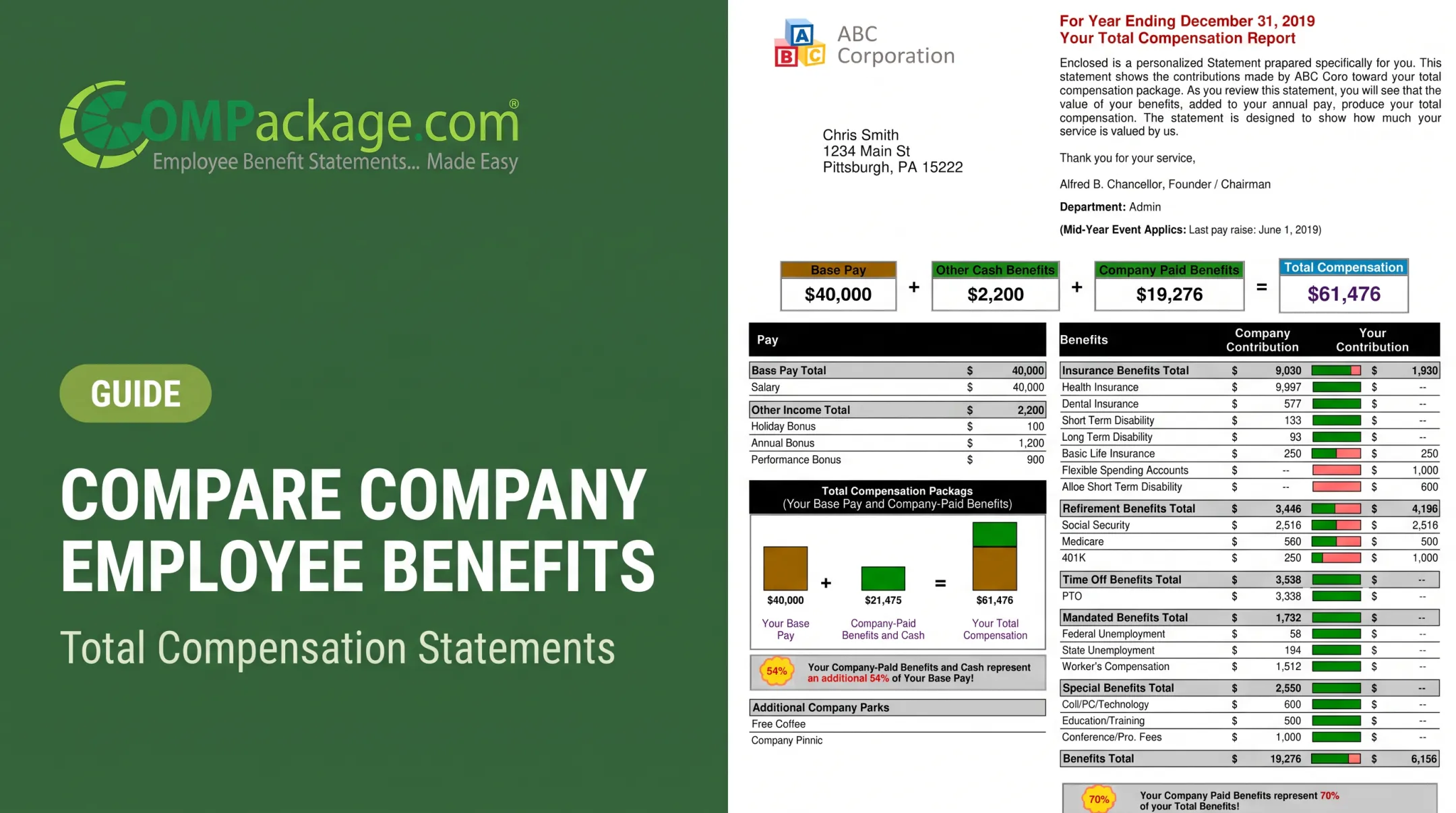
One sample benefits statement puts real dollars on each category:
- Holiday time: $1,723
- Sick time: $1,077
- Vacation: $3,231
- Total employer contribution: $6,031

A reporting option: COMPackage
COMPackage is self-service software that lets employers build customized total compensation reports in-house. Each report shows only the benefits specific to that employee, including PTO, next to salary, insurance, and retirement. Employers can use the same reports to show candidates the full offer, not just base pay.
Frequently Asked Questions
How do you calculate PTO accrual per hour?
Divide annual PTO hours by annual work hours. For 80 hours over 2,080, that's about 0.0385 hours per hour worked. Your employer's policy controls eligibility, proration, and accrual limits.
How many days is 80 hours of paid time off?
Divide by scheduled hours per day. At 8 hours, it's 10 days. On 10-hour shifts it's 8 days, and part-time or variable schedules need their own conversion.
How much PTO do most jobs have?
BLS data shows private-industry workers average 11 vacation days after one year and 20 after 20 years. Access, holidays, sick leave, and employer policy all affect the comparison.
Is 15 days of PTO good?
It depends. It beats the one-year vacation average of 11 but trails the five-year average of 16. Holidays, separate sick leave, and whether you can actually use the time matter just as much.