That's how good employees start quietly job-hunting.
Pay is one of the clearest signals a company sends about how much it values its people. Get it wrong, or fail to explain it clearly, and even loyal employees start looking elsewhere. Compensation management is the discipline that prevents this. It's not just picking a salary number — it's the strategic system behind pay, benefits, and communication that shapes retention, engagement, and legal compliance.
This guide breaks down what compensation management actually means, the different types and strategies involved, and how small and mid-sized businesses can build a solid program without an enterprise-sized budget.
Key Takeaways
- Compensation management covers pay decisions, benchmarking, and communication — not just the paycheck
- Employees who feel underpaid are 45% more likely to job hunt, even when pay is competitive
- Benefits make up roughly 30% of total compensation costs, yet employees often undervalue them
- Most SMBs succeed by matching market pay and clearly communicating total compensation
- Replacing an employee costs 40% to 200% of their salary, depending on the role
What Is Compensation Management?
Compensation management is the ongoing, strategic process organizations use to plan, administer, and communicate employee pay. That includes salary, bonuses, benefits, and equity, all structured to support business goals and stay within legal requirements.
It's easy to confuse this with simply "what employees get paid." But compensation management is really about the decisions behind that number: how pay is benchmarked against the market, how raises get approved, and how clearly the value of a total package gets explained to the workforce.
That last piece matters more than most businesses realize. According to Payscale's 2025 Fair Pay Impact Report, employees who believed they were paid unfairly were 45% more likely to look for a new job, regardless of whether their pay was actually below market. Employees at organizations with high pay transparency were 59% less likely to leave than those without it.
Perception drives retention almost as much as the actual dollar amount.
Compensation Management vs. Payroll
These two terms get used interchangeably, but they're not the same thing.
Payroll is the operational task: calculating hours, withholding taxes, and distributing paychecks on schedule. Compensation management is the strategic layer above it: deciding pay structures, setting equity policies, and choosing which benefits to offer in the first place.
Think of payroll as execution and compensation management as the planning that makes execution possible.
Key Components of a Compensation Program
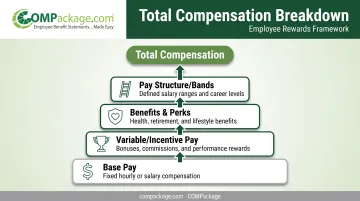
A well-built compensation program rests on four building blocks:
- Base pay: the guaranteed salary or hourly wage for the work performed
- Variable/incentive pay: bonuses, commissions, or performance-based rewards tied to results
- Benefits and perks: health insurance, retirement contributions, paid leave, and similar offerings
- Pay structure/bands: the defined salary range for each role or job level, keeping pay consistent and defensible
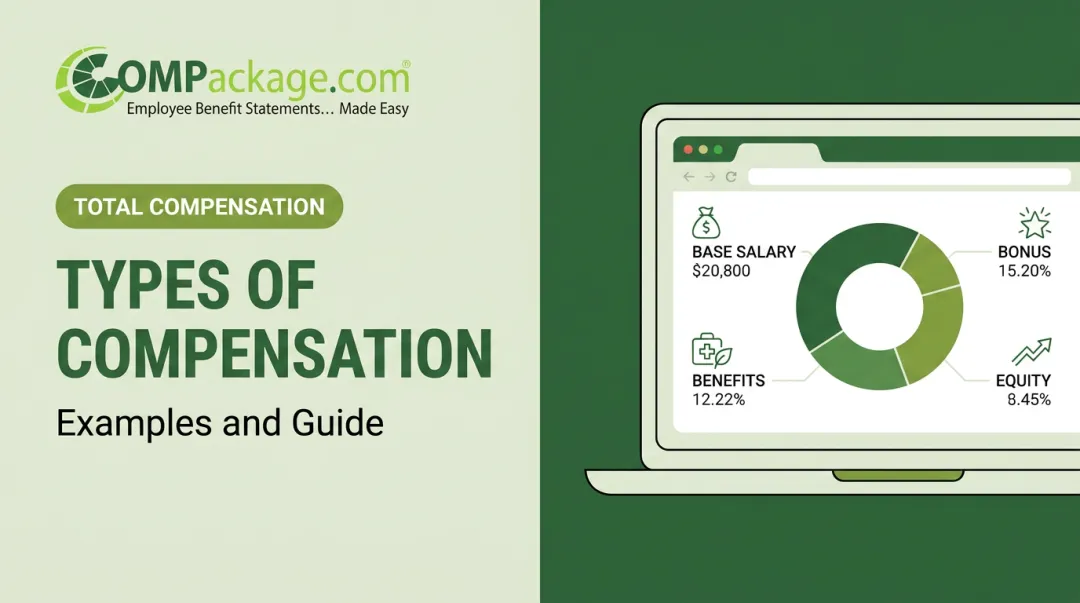
Together, these four pieces make up what's often called "total compensation", and it's almost always larger than the number on a paycheck.
Types of Compensation Management
Compensation generally splits into two broad categories: direct and indirect. Understanding both is essential if you want to build offers that actually compete for talent.
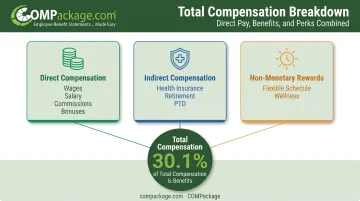
Direct Compensation
This is the cash employees see directly:
- Hourly wages — typical for non-exempt positions where pay is tied to time worked
- Salary — a fixed annual amount, common for exempt and salaried roles
- Commissions — usually reserved for sales roles, tied directly to revenue generated
- Bonuses — one-time or periodic payouts tied to performance, tenure, or company results
Indirect (Benefit-Based) Compensation
Indirect compensation is everything that adds value without landing in a paycheck:
- Health insurance (medical, dental, vision)
- Retirement plans, such as 401(k) matching
- Paid time off and holidays
- Profit-sharing arrangements
- Stock options or equity grants
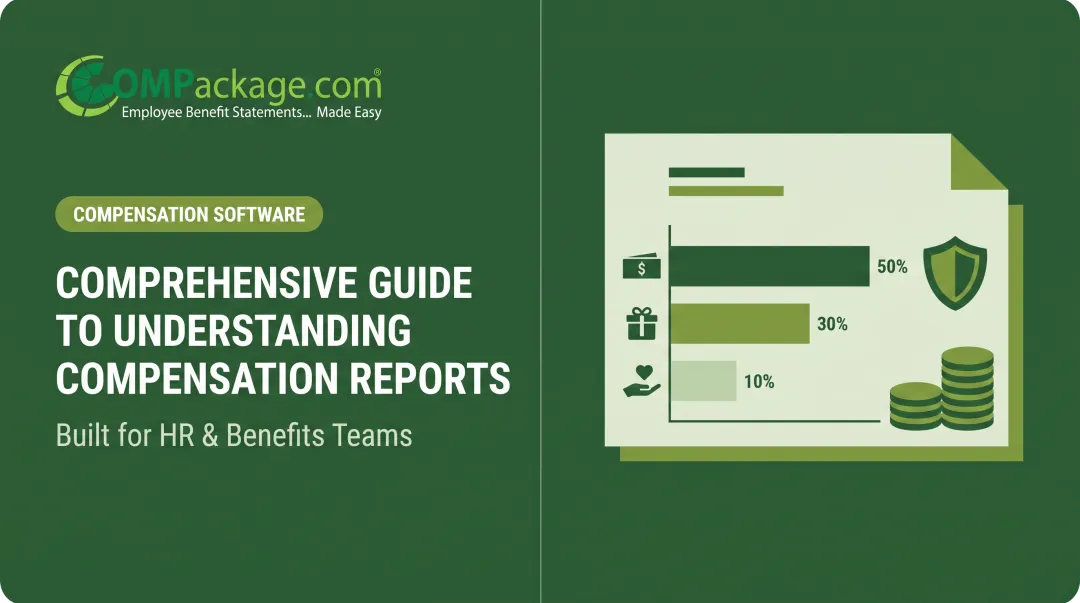
This category carries more weight than most employees assume. Per Bureau of Labor Statistics data, benefits accounted for 30.1% of total employer compensation costs in private industry, averaging $14.01 per hour against $32.60 in wages. That's nearly a third of an employee's total value sitting outside their base pay.
Non-Monetary and Total Compensation
Not everything valuable comes with a price tag. Non-monetary rewards still add real value:
- Flexible schedules and remote work options
- Tuition assistance
- Wellness programs
Employees routinely undervalue these because nobody spells out what they're worth. Someone who never sees the dollar value of their 401(k) match, health coverage, and PTO tends to treat "pay" as the number on their paycheck alone.
That figure then gets stacked against a competing offer that looks bigger on paper but may not be better once benefits are included. Total compensation pulls direct pay, benefits, and non-monetary rewards into one picture so employees can see what the full package is actually worth.
The Three Basic Compensation Strategies
Every organization, knowingly or not, picks a position relative to the market. SHRM identifies three standard approaches, and WorldatWork ties each to specific percentile targets.
| Strategy | Market Position | Best For |
|---|---|---|
| Lead the market | Above median (often 75th–90th percentile) | Competitive fields with scarce talent; startups needing to attract despite risk |
| Match the market | At the median (50th percentile) | Most SMBs seeking to stay competitive without overspending |
| Lag the market | Below competitive levels (around 40th percentile) | Stable, tenured teams; offset with strong benefits or flexibility |
Lead the market means paying above the median to win the best candidates in a tight talent pool. It works, but it costs more, and it only pays off if the higher salaries translate into better hires and lower turnover.
Match the market keeps pay aligned with the 50th percentile. It's the most common approach for small and mid-sized businesses because it stays competitive without straining the budget.
Lag the market sets pay below median, typically balanced with equity, flexible schedules, or other non-monetary perks. It can work for stable teams with low turnover risk, but it's risky if employees don't clearly see the value of what's replacing the missing salary dollars.
Why Compensation Management Matters: Key Benefits
A structured approach to compensation pays off in ways that go well beyond payroll accuracy.
- Reduces turnover costs. Gallup estimates replacing an employee costs around 40% of salary for frontline staff, 80% for technical roles, and 200% for managers and leaders, so retention is far cheaper than replacement (Gallup workplace research).
- Builds trust and engagement. Transparent, well-explained pay decisions boost morale and motivation. Employees who understand why they're paid what they're paid trust leadership more.
- Supports pay equity and compliance. Structured pay bands and documented criteria reduce legal exposure tied to wage discrimination laws, which now carry real teeth in states like California and New York.
- Strengthens employer brand. Job seekers expect clarity on pay and benefits upfront. Vague listings without compensation details often lose candidates before they apply.
- Improves budget forecasting. HR and finance teams planning raises, bonuses, and new hires work far more accurately when compensation decisions follow a consistent structure instead of ad-hoc approvals.
Building an Effective Compensation Management Strategy
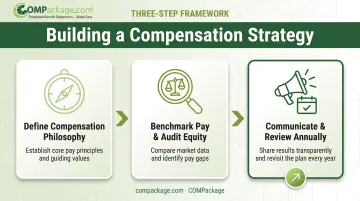
You don't need a massive HR department to build this properly. Three steps cover most of the groundwork.
- Define your compensation philosophy. Decide whether you're leading, matching, or lagging the market, and make sure that choice actually aligns with your budget and business goals — not just what sounds appealing.
- Benchmark pay and audit for equity. Use current market salary data to set your bands, then run an internal pay equity audit to catch gaps between similar roles before they turn into legal or morale problems.
- Communicate clearly and review annually. Explain pay decisions in plain terms, ideally with total compensation breakdowns so employees see the full package, and revisit your strategy at least once a year as the market and your business shift.
That third step is where most companies fall short. Pay structures can be perfectly fair on paper and still fail if nobody explains them—employees undervalue what they don't understand.
Technology's Role: Compensation Software and Total Compensation Statements
Larger organizations often lean on full HRIS platforms to automate benchmarking, budgeting, and compliance tracking across thousands of employees. Those systems make sense at scale, but they come with enterprise pricing and implementation timelines that most small and mid-sized businesses don't need.
For companies focused specifically on showing employees the full value of their pay (base salary plus every benefit attached to it), a lighter, self-service tool can accomplish the core goal without the enterprise price tag.
That's the gap COMPackage fills. It's built specifically around total compensation statements, not full HR administration, which keeps it focused and affordable:
- Tiered annual pricing from $149 (1–5 employees) to $2,599 (unlimited), plus a $2,999 Professional tier for multi-client consultants
- 80+ benefit categories, with room to add custom perks like parking or holiday bonuses
- 12 auto calculators that speed entry for 401(k), time-off, and insurance benefits
- Bulk import through Employee LOADER: load 100 or 1,000 records from Excel in minutes
- Free report updates all year for year-end statements, quarterly reviews, and performance cycles
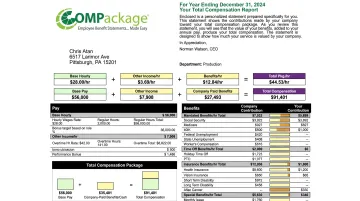
Businesses using a focused statement tool typically generate full-census reports in under 90 minutes, versus the days or weeks manual processes often take.
The right choice depends on your size and needs. A 3,000-employee enterprise juggling multi-state compliance probably needs a full HRIS. A 40-person company that mainly wants employees to see what they're really earning may only need a focused reporting tool.
Either way, update statements regularly. Pay and benefits change throughout the year, and stale numbers undercut the point of showing total value.
Frequently Asked Questions
What is compensation management?
Compensation management is the strategic process of planning, administering, and communicating employee pay and benefits. The goal is retention, motivation, and legal compliance, not just calculating a paycheck.
What are the different types of compensation?
Direct compensation includes salary, hourly wages, commissions, and bonuses. Indirect compensation covers benefits like health insurance, retirement plans, and equity or stock options.
What are the three basic compensation strategies?
The three approaches are lead-the-market (paying above median), match-the-market (paying at the median), and lag-the-market (paying below median, usually offset with strong benefits).
What is a compensation management system?
A compensation management system is software that helps plan, track, and communicate pay and benefits. Options range from full HRIS platforms for large enterprises to focused, self-service reporting tools for smaller businesses.
How is employee compensation typically determined?
Employers weigh role requirements, market benchmarking data, internal pay equity, and available budget. Most organizations combine all four factors rather than relying on just one.
What's the difference between compensation management and payroll?
Compensation management is the strategic planning layer: deciding pay structures and benefit offerings. Payroll is the operational task of calculating and distributing that pay on schedule.