Here's the problem: many employees have no idea what their benefits are actually worth. When indirect compensation stays invisible, people compare job offers on salary alone, and companies lose good talent over a gap that doesn't really exist. This article breaks down direct versus indirect compensation, compares them side by side, and shows how to build a mix that fits your workforce.
Key Takeaways
- Direct compensation is cash pay: salary, bonuses, and commissions.
- Indirect compensation is non-cash value: health insurance, PTO, and retirement contributions.
- Per a Harris Poll/Glassdoor survey, 79% of employees would choose new benefits over a raise.
- A balanced mix of direct and indirect pay reduces turnover and strengthens recruiting.
- Total compensation statements help employees see what they're truly earning, beyond the base number.
Direct vs Indirect Compensation: Quick Comparison
Before digging into definitions, here's how the two stack up across the factors HR teams actually manage day to day.
| Factor | Direct Compensation | Indirect Compensation |
|---|---|---|
| Nature of Payment | Cash paid directly to the employee (salary, bonus, commission) | Non-cash value provided on the employee's behalf (insurance, retirement match, PTO) |
| Tax Treatment | Generally taxable wages, subject to federal income tax withholding, Social Security, and Medicare | Often partially or fully excluded from taxable income, depending on the benefit type |
| Visibility to Employees | Highly visible; shows up on every paycheck | Often invisible or underappreciated unless actively communicated |
| Impact on Retention & Recruiting | Drives offer acceptance and short-term satisfaction | Drives long-term loyalty and reduces turnover risk |
On tax treatment specifically, the IRS Publication 15-B confirms that employer contributions to qualified health plans and retirement accounts are generally excluded from wages, while bonuses and commissions are taxed like regular pay. That distinction matters when HR is explaining "total pay" to a candidate weighing two offers.
What is Direct Compensation?
Direct compensation covers every monetary payment made straight to an employee for work performed. Think base salary, hourly wages, overtime, bonuses, commissions, and stock options. HR must track this separately from benefits, not just for reporting purposes, but for budgeting, compliance, and pay equity audits.
Why it matters operationally:
- Predictable and easy to benchmark against market salary data
- Directly tied to performance, which makes it a strong motivator for results-driven roles
- Simple to communicate since it appears on every pay stub
Common subtypes HR manages include:
- Base salary and hourly wages
- Overtime pay
- Performance bonuses
- Sales commissions
- Stock options or equity grants
Use Cases of Direct Compensation
Direct pay drives most of HR's core compensation planning work: salary bands, merit increase cycles, incentive plan design, and pay equity audits all start here.
Some roles lean almost entirely on direct pay:
- Sales positions, where commission structures reward output
- Executive leadership, where base salary plus bonus targets align pay with company performance
- Commission-based roles in real estate, insurance, and financial services
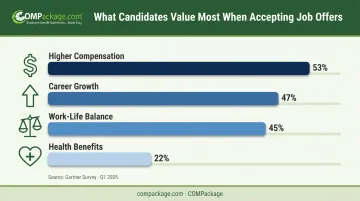
Direct pay also drives whether candidates say yes. A Gartner survey of nearly 3,000 job candidates found that 53% identified higher compensation as the main factor in accepting an offer in Q1 2025 — an 11-point jump from the year before.
Career growth (47%) and work-life balance (45%) followed, with health benefits trailing at 22%. That gap is worth remembering: candidates notice salary first, but benefits still tip close decisions.
What is Indirect Compensation?
Indirect compensation includes every non-monetary benefit an employer provides beyond wages. It's the health plan, the 401(k) match, the PTO bank, and the wellness stipend. But offering these benefits isn't enough. HR must also track their cost and communicate their value clearly. Skip that last step, and employees will undervalue what they're getting.
The operational payoff is real:
- Stronger retention among employees who understand their full package
- Higher satisfaction even when base pay stays flat
- Competitive differentiation in a labor market where candidates compare offers line by line
Common subtypes include:
- Health, dental, and vision insurance
- Retirement plan contributions
- Paid time off and holidays
- Wellness programs
- Tuition reimbursement
- Flexible scheduling and remote work options
Use Cases of Indirect Compensation
Indirect compensation sits at the center of a total rewards strategy. It shapes benefits design, drives open enrollment decisions, and forms a core part of your employer value proposition.
Fortune's 2025 100 Best Companies to Work For list highlighted Synchrony for its tuition assistance and skill-certification reimbursement programs, exactly the kind of indirect benefit that shows up as a line item on employee statements rather than in a paycheck. Companies known for strong indirect packages tend to share one habit: they make the value visible instead of assuming employees will figure it out.
That's the gap a self-service total compensation report tool closes. COMPackage lets HR teams build statements covering over 80 benefit categories, from standard items like health insurance and retirement matches to fringe perks like parking or company phones. Reports pull in each employee's specific benefits automatically, so nobody sees line items that don't apply to them.
HR can also include non-quantifiable benefits such as flexible scheduling, remote work, and professional development — items that add real value but don't fit neatly into a dollar figure. That combination gives employees a complete picture, not just the numbers that are easy to calculate.
Building the Right Compensation Mix for Your Organization
There's no formula that works for every company. The right mix depends on a handful of factors HR needs to weigh together:
- Budget constraints: cash is finite; benefits often stretch further per dollar spent
- Industry norms: tech and finance skew toward direct pay; healthcare and education often lean on indirect benefits
- Workforce demographics: younger employees may prioritize flexibility; employees with families often value health coverage and retirement contributions more heavily
- Competitive labor market pressure: tight talent markets push companies to differentiate somewhere other than base salary
Situational guidance:
- Lean toward direct pay for performance-driven roles (sales, executive teams) or when cost control is the priority
- Lean toward indirect pay when retention and long-term loyalty matter more than short-term motivation
- Blend both when you need to stay competitive on pay while also building loyalty through benefits
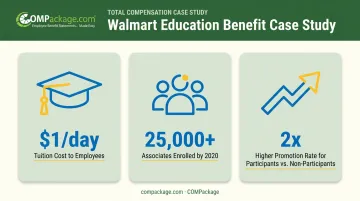
Walmart offers a useful case study here. In 2018, the company launched an education benefit letting associates access online degree programs for $1 a day, with Walmart covering the rest of tuition and books.
By 2020, the program expanded to include skilled-trade and digital-skills training, and more than 25,000 associates had used it. Walmart later told HR Dive that promotion rates doubled among employees participating in the education program, with associates in the program also showing notably higher retention.
A practical tactic: run a total compensation report during recruiting and again at annual reviews. Instead of seeing only a base salary number, candidates see the full picture: insurance, retirement contributions, PTO value, and any fringe perks, all itemized.
COMPackage's report builder lets HR customize these statements with company branding and rerun them throughout the year at no extra charge, so the numbers stay current as benefits or salaries change.
Start by mapping your current mix against these factors, then adjust incrementally as your budget, industry, and workforce needs shift.
Conclusion
Direct and indirect compensation work together as two halves of the same total rewards strategy. HR's job is to design both intentionally and communicate both clearly. When employees understand what they're earning beyond the paycheck, retention improves and recruiting gets easier, without necessarily costing more in base pay. Tools like COMPackage's total compensation statement software make that full picture easy to show.
Frequently Asked Questions
What is the difference between direct and indirect compensation?
Direct compensation is cash-based pay employees receive directly, like salary, bonuses, and commissions. Indirect compensation covers non-cash benefits, such as health insurance, retirement plans, and PTO, that add value beyond the paycheck.
What is an example of indirect compensation?
Common examples include employer-sponsored health insurance, 401(k) matching contributions, paid time off, and tuition reimbursement programs.
What are the three types of compensation?
There are three types of compensation: direct (cash and equity), indirect (employer-funded benefits like insurance and retirement plans), and nonfinancial (intangibles like flexible schedules, recognition, and career development).
Is indirect compensation taxable?
It depends on the benefit. Qualified health plan contributions are generally excluded from taxable income, while other fringe benefits may be partially or fully taxable under IRS rules.
How can HR effectively communicate the value of indirect compensation to employees?
Use total compensation statement software, like COMPackage, to itemize both direct and indirect elements in one document. This gives employees a complete earnings picture instead of forcing them to piece it together themselves.
What is the ideal ratio of direct to indirect compensation?
There's no universal ratio. The right balance depends on your industry, budget, and workforce priorities, so benchmark against industry data and employee feedback rather than a fixed formula.