Introduction
Building a benefits package that attracts and retains employees is harder than it looks. Many HR teams end up with packages that check compliance boxes but fail to move the needle on satisfaction or turnover.
The stakes are real. According to BLS data from March 2026, benefits represent 30.1% of total private-industry compensation costs — averaging $14.01 per hour worked. That's a substantial investment most employees never fully appreciate.
This guide covers everything HR teams need to build and communicate a package worth offering:
- What a staff benefits package actually includes
- How mandatory and voluntary benefits differ
- The main benefit categories to consider
- How to design a competitive package
- How to make sure employees understand what they're receiving
Key Takeaways
- Benefits average 30.1% of total compensation costs — make sure employees know what they're actually receiving
- Auto-enrollment boosts 401(k) participation from 64% to 94% — plan design decisions matter enormously
- 67% of employees spend 30 minutes or less reviewing benefits during open enrollment
- Flexible work is a retention lever: 54% of fully remote workers would job-search if it disappeared
- Personalized total compensation statements help employees recognize the full value of what they earn
What Is a Staff Benefits Package?
A staff benefits package is the full set of non-wage compensation an employer provides beyond base salary. This includes health insurance, retirement plans, paid time off, life and disability coverage, and discretionary perks.
Together, these benefits form a significant share of what employees actually earn — even if most employees only think about their paycheck. Understanding that gap is where HR's real leverage begins.
Why It Matters for Both Sides
For employees, a well-designed package provides:
- Financial protection against illness, injury, or unexpected costs
- Work-life support through paid leave and flexible arrangements
- Career resources through professional development and learning benefits
- A sense of security that base salary alone can't deliver
For employers, the returns are equally concrete:
- A competitive edge in recruiting
- Lower voluntary turnover
- A more engaged, productive workforce
MetLife's research found employees who feel cared for are 1.3x more likely to be loyal and 1.2x more likely to be productive.
The Perception Problem HR Teams Need to Solve
There's a persistent gap between what employers spend on benefits and what employees believe they receive. Employer contributions to health insurance alone averaged $7,885 for single coverage and $20,143 for family coverage in 2025 — costs most employees never see on a paycheck.
Factor in retirement matching, payroll taxes, PTO value, and other perks, and most employees are underestimating their total compensation by thousands of dollars. Making that full picture visible — through total compensation statements or similar tools — is one of the most direct ways HR can improve satisfaction without changing a single line item in the budget.
Mandatory vs. Voluntary Benefits: Knowing the Difference
Knowing which benefits are legally required — and which are discretionary — shapes every benefits design decision, particularly for smaller employers working within tighter budgets.
Mandatory (Legally Required) Benefits
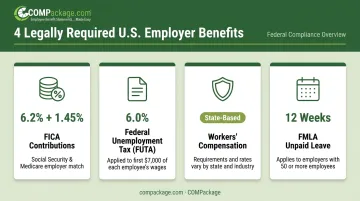
Every U.S. employer must provide these regardless of size:
- FICA contributions — Employers match 6.2% Social Security (on wages up to $184,500 in 2026) and 1.45% Medicare for every employee
- Federal unemployment tax (FUTA) — 6.0% on the first $7,000 of wages, with potential state tax credits up to 5.4%
- Workers' compensation — Required under state law; rules and exemptions vary by state
- FMLA unpaid leave — Employers with 50+ employees in 20+ workweeks must provide up to 12 weeks of job-protected unpaid leave for eligible employees
Voluntary Benefits (and When They Become Required)
Most other benefits are employer-discretionary — but some carry size-based requirements:
- Health insurance — Voluntary for most employers, but Applicable Large Employers (50+ full-time equivalents) must offer affordable, minimum-value coverage under the ACA or face shared-responsibility payments
- Retirement plans — Entirely voluntary at the federal level, though some states are introducing auto-enrollment mandates
- PTO, dental, vision, life insurance, and perks — All optional, though most industries treat them as table stakes
For small businesses, this framework keeps priorities clear: cover the mandatory floor first, then layer in voluntary benefits as budget allows. There's no obligation to offer everything at once — and no advantage in doing so before you're financially ready.
The Main Types of Staff Benefits
Health and Insurance Benefits
Medical coverage remains the cornerstone of any competitive package. Most employees expect access to plan options — typically HMO, PPO, or HDHP — along with dental and vision coverage.
FSAs and HSAs help employees manage out-of-pocket costs, and 61% of employers offered an HSA in 2025, according to SHRM data.
Mental health coverage has moved from optional to expected. 82% of employers now offer an Employee Assistance Program, and among large employers, nearly half expanded mental health counseling resources in 2024.
Supplemental insurance — life, short-term disability, long-term disability — completes the health protection picture. Employer-paid basic life coverage costs relatively little but carries real perceived value for employees.
Retirement and Financial Security Benefits
Employer-sponsored retirement plans (401(k), SIMPLE IRA, SEP plans) are among the most impactful retention tools available. The design decision that matters most: auto-enrollment drives participation to 94%, compared to 64% under voluntary enrollment.
Beyond retirement, financial wellness benefits address shorter-term employee stress:
- Student loan repayment assistance (offered by 9% of organizations in 2024, up from 7% in 2022)
- Tuition reimbursement and education assistance
- Financial planning resources and emergency savings programs
This matters more than many HR teams realize. 40% of employees report trouble paying bills, and more than one-third say financial stress makes them less productive.
Time Off, Leave, and Flexibility Benefits
The spectrum of time-off benefits includes:
- PTO (accrual-based, lump sum, or unlimited)
- Paid sick leave
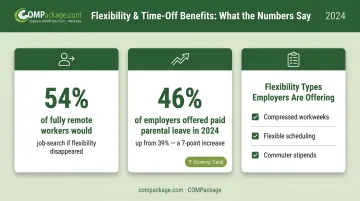
- Parental leave — 46% of employers offered paid parental leave in 2024, up from 39% the prior year
- Bereavement leave and sabbaticals
Clear, consistent leave policies matter as much as the number of days offered. A culture that actively supports using leave is what separates a policy on paper from a benefit employees actually value.
Flexibility is its own category now. Gallup research found 54% of fully remote workers would likely look for another job if remote flexibility disappeared. Compressed workweeks, flexible scheduling, and commuter or home office stipends often cost little but deliver outsized impact on satisfaction.
Professional Development and Lifestyle Perks
65% of employers rated professional development opportunities as "very important" or "extremely important" in 2024 SHRM data. The most common offerings include:
- Tuition reimbursement and online learning subscriptions
- Certification support and conference budgets
- Mentorship programs
Lifestyle perks — wellness stipends, employee discounts, pet insurance, childcare assistance — don't need to be universal, just relevant to the workforce they serve and clearly communicated.
How to Design a Staff Benefits Package for Your Organization
Start with Budget and Legal Requirements
Benefits costs vary meaningfully by industry. The BLS reports a range from 23.7% of compensation in leisure and hospitality to 36.0% in information, with manufacturing at 33.5% and financial activities at 35.0%. Use your industry benchmark as a planning anchor before deciding where to invest.
Account for both direct costs (premiums, plan fees, retirement contributions) and indirect costs (administration, compliance, software).
Survey Employees Before Making Decisions
Anonymous surveys and focus groups surface what employees actually value versus what HR assumes they want. A multigenerational workforce will have genuinely different priorities:
- Early-career employees often prioritize student loan repayment and flexibility
- Mid-career employees with families focus on health coverage and parental leave
- Pre-retirees care most about retirement matching and financial planning resources
One-size-fits-all packages frequently overspend on unused benefits while underfunding what employees actually want.
Build a Core-Plus-Flex Structure
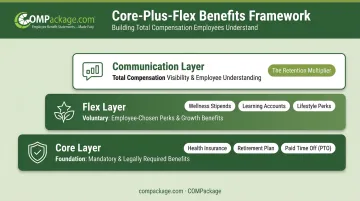
Structure the package in two layers:
- Core layer — Mandatory benefits, health insurance, retirement plan, and PTO that every employee receives
- Flex layer — Voluntary options employees personalize: wellness stipends, learning accounts, lifestyle perks
- Communication layer — How you present the full package so employees understand what they're actually receiving
This approach creates a solid foundation while giving employees meaningful ownership over their experience.
Benchmark and Review Regularly
Compare your package against industry peers and local market data at least annually. Use enrollment data, utilization rates, and employee feedback to:
- Retire underused benefits
- Adjust contribution levels
- Add offerings that reflect changing workforce needs
Annual reviews typically surface 1-2 benefits with low utilization — redeploying that spend toward higher-demand offerings is where real retention value gets created.
Making Sure Employees Understand and Value Their Benefits
Generous packages underdeliver when employees don't understand them. The data on this is clear: 67% of benefits-eligible employees spend 30 minutes or less reviewing their choices during open enrollment, and about 90% simply re-select the same benefits as the prior year.
Move Beyond Open Enrollment-Only Communication
HR teams that communicate benefits once a year are missing most of the year. Build a calendar of touchpoints:
- January — Remind employees of FSA/HSA balances and deadlines
- Spring — Highlight wellness benefits and EAP resources
- Summer — Share retirement matching progress and financial wellness resources
- Fall — Open enrollment prep, with clear comparison guides
- Year-round — Life-event triggers (new hire, promotion, new parent, approaching retirement)
Use Total Compensation Statements to Close the Perception Gap
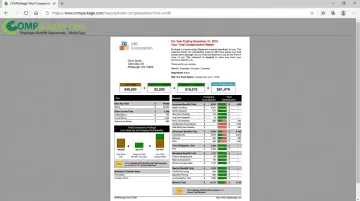
When employees can see an itemized breakdown of everything their employer contributes — salary, health premiums, retirement match, paid leave value, perks — they develop a far more accurate picture of what they're actually earning.
COMPackage is built for exactly this purpose. HR teams can generate personalized total compensation reports for every employee, showing the full dollar value of their package beyond the paycheck.
The platform covers over 80 benefit and perk categories — including employer health premium contributions, 401(k) match, PTO value, payroll tax contributions, and workers' compensation costs — with auto-calculators that quantify these figures without manual computation per employee. Reports can be updated and reissued at any point in the year at no extra charge, so HR teams aren't locked into a single annual cycle.
Reach Every Employee Through the Right Channel
No single communication channel reaches everyone:
- Email summaries for employees who prefer self-service
- Manager talking points for team-level conversations
- Intranet resources as an always-available reference
- One-on-one HR conversations for complex situations or life transitions
Tailor messaging by life stage where possible:
- New parents: parental leave policies and dependent care benefits
- Early-career staff: student loan assistance and retirement basics
- Employees nearing retirement: vesting schedules and matching contribution timelines
Measure What's Working
Track benefits utilization rates, enrollment percentages, and satisfaction scores tied specifically to benefits. Low utilization on a benefit often signals poor communication, not disinterest. Use the data to refine both the package and how it's presented.
Frequently Asked Questions
What is a staff benefits package?
A staff benefits package is the full set of non-wage compensation an employer provides beyond base salary, covering health insurance, retirement plans, paid time off, and additional perks. Benefits represent a significant share of total compensation — averaging 30.1% of private-industry costs, according to the Bureau of Labor Statistics.
What is included in a staff benefits package?
Common inclusions are health, dental, and vision insurance; employer-sponsored retirement plans; paid time off and leave policies; life and disability insurance; and voluntary perks such as wellness stipends, flexible work arrangements, and professional development support.
What are the main types of staff benefits?
The major categories are health and insurance benefits, retirement and financial security benefits, time off and leave, flexibility benefits, professional development, and lifestyle perks.
Are small businesses required to offer a benefits package?
U.S. employers of all sizes must provide legally required benefits — Social Security, Medicare, unemployment insurance, and workers' compensation. Most other benefits are voluntary unless specific thresholds apply, such as the ACA's 50+ full-time equivalent rule for health insurance.
How can HR teams communicate benefits more effectively?
Year-round multi-channel communication, life-event-triggered reminders, and personalized total compensation statements are the highest-impact approaches. When employees see the full dollar value of their package alongside base salary, they consistently rate their compensation as fairer and more competitive.
How often should a company review its benefits package?
At a minimum, annually — using enrollment data, utilization rates, and employee feedback. Reviews should identify underused benefits to retire, contribution levels to adjust, and new offerings that reflect evolving workforce needs and market benchmarks.