Introduction
Compensation questions don't follow a schedule. They come up during onboarding, after a performance review, mid-year when a competitor posts a job listing, and sometimes out of nowhere when a long-term employee walks into your office saying they feel underpaid.
For small and mid-sized businesses, there's rarely a clean playbook. You're managing pay decisions without a dedicated compensation analyst, balancing fairness with budget constraints, and navigating an increasingly complex web of transparency laws.
This article answers seven of the most common compensation questions employers face. Here's what's covered:
- How to benchmark pay against your market
- When (and how) to build salary ranges
- How to handle pay transparency requirements
- What to do when an employee thinks their pay is unfair
- How to communicate total compensation in a way that actually improves retention
Key Takeaways
- Total compensation includes base salary plus the full dollar value of benefits, retirement contributions, PTO, and perks — often 30%+ above base pay
- Benchmarking requires more than matching job titles — role scope, experience, and geography all affect where a position should land
- Pay transparency is now a legal requirement in at least 12 states — and employees in all states increasingly expect it
- When an employee challenges their pay, a structured, data-backed response outperforms a quick raise every time
- Total compensation statements are among the most underused retention tools available — yet most employers only pull them out during recruiting
What Does "Total Compensation" Actually Mean?
Total compensation is the complete value of what an employee receives in exchange for their work. That includes far more than what shows up in a paycheck.
Direct compensation covers:
- Base salary or hourly wages
- Bonuses and commissions
- Overtime pay
Indirect compensation covers:
- Employer-paid health insurance premiums
- Retirement plan contributions and matches
- Paid time off (calculated as dollar value)
- Life and disability insurance
- Tuition reimbursement, wellness benefits, and other perks
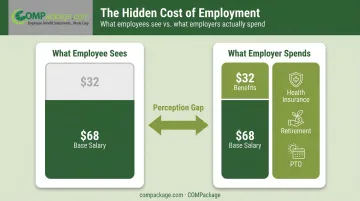
The gap between what employers spend and what employees perceive is significant. According to the Bureau of Labor Statistics, benefits represent 31.6% of total civilian compensation costs as of March 2026 — meaning for every $100 an employer spends on an employee, roughly $32 goes toward benefits the employee may never consciously attribute to their employer.
That disconnect matters for retention. An employee comparing their current salary to a competitor's offer is often comparing $68 to $100 — without realizing their current employer is already spending the full $100. Closing that perception gap starts with showing employees the full picture — something a total compensation statement does directly.
Setting Competitive Pay: Two Questions Employers Always Ask
Q1: How Do We Know If Our Pay Is Competitive?
Competitiveness is determined through benchmarking — comparing your pay rates against credible external market data for the same role, in the same region, at a similar company size.
The three most accessible sources for SMBs:
| Source | What It Provides | Cost |
|---|---|---|
| BLS Occupational Employment & Wage Statistics | National, state, and metro wage data for ~830 occupations | Free |
| SHRM Compensation Data Center | HR-reported benchmarks across 15,000 job titles with industry/geography filters | Paid |
| Payscale | Market pricing data with SMB-size comparisons and compensation practices research | Paid |
Watch out for one common mistake: matching on job title alone. A "Marketing Manager" at a 20-person manufacturer looks nothing like a "Marketing Manager" at a 500-person SaaS company.
Always match on actual role responsibilities, industry, geography, and company size — not just the title.
Q2: Should We Create Formal Salary Ranges?
Once you have that market data, the next step is putting it to work in a formal structure. A salary range defines a minimum, midpoint, and maximum for a role — built from market data and your company's pay philosophy.
Payscale's 2025 Compensation Best Practices Report found that only 47% of organizations with 1–99 employees have a formal compensation strategy, compared to higher rates at larger companies. That gap creates real risk as small businesses grow.
Ranges become necessary when:
- You're adding locations or hiring across multiple states
- Pay transparency laws require posted ranges on job listings
- You're experiencing salary compression (newer hires earning close to what tenured employees earn)
- You're making individual pay decisions without a consistent framework
Beyond compliance, formal ranges solve pay equity problems before they become legal exposure — and they make internal pay conversations far easier to manage.
Navigating Pay Transparency and Employee Concerns
Q3: How Should We Handle Pay Transparency?
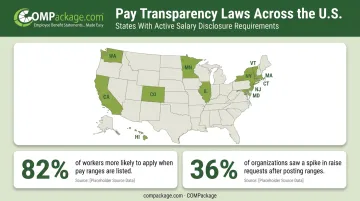
Pay transparency has moved from trend to legal requirement faster than most employers expected. As of 2025, at least 12 states require pay range disclosures in job postings — including California, Colorado, New York, Washington, Hawaii, and Maryland. (Littler, 2025)
Five more states joined that list in 2025 alone: Illinois, Minnesota, New Jersey, Vermont, and Massachusetts.
Beyond legal compliance, the employee expectations are clear. SHRM research found that 82% of workers are more likely to apply for a job when pay ranges are listed, and 73% say they trust employers more when ranges are shared upfront.
The risk of doing nothing is concrete: SHRM found that 36% of organizations that began posting pay ranges saw a spike in current employees asking about raises — most of whom discovered the ranges on their own before HR said anything.
For SMBs, pay transparency doesn't mean publishing everyone's salary. It means employees understand how pay is determined. A clear framework typically covers:
- The factors weighed: skills, experience, performance, and market data
- What data sources the company uses for benchmarking
- That a consistent, documented process exists
That framing prevents resentment without requiring full salary disclosure.
Q4: An Employee Says Their Pay Is Unfair — What Do We Do?
Most complaints come down to two drivers:
- Communication gaps — the employee doesn't know how their pay was determined or what factors were weighed
- Unreliable external data — salary aggregator sites like Glassdoor or Reddit forums, which often don't account for role scope, geography, or company size
A structured response matters more than a quick fix. Here's a practical sequence:
- Pull a market check from credible sources for that specific role — not the employee's Glassdoor screenshot
- Walk through your compensation philosophy: what factors drive pay decisions and why
- Show how benchmarks are applied — which data sources, what peer comparisons, and how the role maps to them
- Provide a total compensation statement so the employee sees the full picture beyond base salary
If the review confirms a genuine market gap and the employee is a strong performer in a critical role, a phased adjustment with a clear explanation is the right response. Delays signal that the concern wasn't taken seriously.
Managing Benefits Costs and Compensation Review Cadence
Q5: How Do Rising Benefits Costs Factor Into Total Rewards?
According to KFF's 2025 Employer Health Benefits Survey, the average employer-sponsored family health premium hit $26,993 in 2025 — up 26% over five years. Most employees never see that cost, which means employers absorb significant increases without gaining any goodwill. The fix is communication: show employees the dollar value of what you cover alongside their pay, not separately.
Q6: How Often Should We Review Compensation?
For most SMBs, annually or every 18–24 months is a reasonable baseline. Review immediately if voluntary turnover is rising, candidates are citing pay when declining offers, a pay transparency law has taken effect in your hiring states, or you haven't reviewed compensation since before 2022. Market conditions don't wait for your calendar.
Q7: How Do We Clearly Communicate Total Compensation to Employees?
Most companies do this well during recruiting. A recruiter will walk a candidate through the full package — base salary, health insurance contribution, 401(k) match, PTO, flexibility — and it's genuinely compelling.
Then the employee starts. And for the next several years, the only compensation communication they receive is a paycheck showing their base wages.
The gap between what employers invest and what employees perceive builds quietly until an employee gets a recruiter message, visits a salary comparison site, and concludes they're underpaid — even if their total compensation is competitive.
What a Total Compensation Statement Does
A total compensation statement (sometimes called a total rewards statement) is a personalized document that shows each employee the full dollar value of what their employer provides — not just salary. Every component gets a line:
- Employer health, dental, and vision insurance contributions
- 401(k) or retirement plan match
- Paid time off (calculated as a dollar value)
- Life and disability insurance premiums
- Bonuses, profit sharing, or incentive pay
- Any other employer-paid benefits or measurable perks
The statement answers a question most employees have never actually done the math on: What does my employer actually spend on me each year?
Making It Practical for SMBs
This is where COMPackage is worth knowing about. It's a self-service total compensation statement platform designed specifically for businesses that need to generate personalized statements in-house, without consulting fees or complex software to install.
The platform covers more than 80 benefit categories, supports bulk employee data import from Excel, and lets employers include non-quantifiable benefits like remote work flexibility or professional development alongside standard financial line items. Reports can be updated throughout the year at no additional charge.
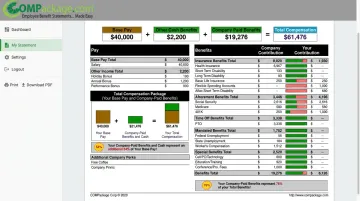
For small and mid-sized businesses that have never sent a formal total compensation statement, it's the simplest place to start.
The retention logic is straightforward. An employee who can clearly see their employer spends $52,000 per year on their total package — not just $38,000 in base salary — makes a far more informed decision when a recruiter calls with a "$42,000 base salary" offer.
Frequently Asked Questions
What are some examples of compensation?
Compensation falls into two categories. Direct compensation includes base salary, bonuses, and commissions. Indirect compensation includes health insurance, retirement contributions, PTO, tuition reimbursement, and perks like remote work. Together, these make up an employee's total compensation package.
How should I answer compensation questions in an interview?
Prepare to share your compensation philosophy, the salary range for the role, and what the total package includes. Candidates increasingly expect this transparency upfront. Vague or evasive answers often cost you strong applicants before the second conversation.
What compensation questions should I ask as an employer?
Four questions worth reviewing regularly:
- Is our pay competitive with the current market?
- Do employees understand the full value of their compensation?
- Are we reviewing pay on a consistent schedule?
- Do we have a documented compensation philosophy guiding our decisions?
What is the difference between compensation and total compensation?
Compensation typically refers to direct pay — salary and bonuses. Total compensation includes all direct pay plus the dollar value of every employer-provided benefit and perk: health insurance, retirement contributions, PTO, and more.
How do total compensation statements help with employee retention?
When employees see the full dollar value their employer provides — beyond base pay — they're better positioned to evaluate outside offers accurately. A "higher salary" offer often doesn't represent higher total value once benefits are factored in.
What should be included in a total compensation statement?
Key components include:
- Base salary and bonus or incentive pay
- Employer health, dental, and vision premium contributions
- Retirement plan match
- Paid time off value
- Life and disability insurance
- Any other measurable employer-paid benefits or perks