Introduction
Most employees check one number when evaluating their pay: what hits their bank account. But that figure often represents only 70 cents of every dollar an employer actually spends on them. The rest disappears into benefits, insurance premiums, retirement contributions, and paid leave that never appear on a pay stub.
That gap creates real problems. Employees undervalue their packages and leave for marginally higher salaries elsewhere. Employers overspend on benefits nobody notices. Turnover costs mount fast: Gallup estimates replacement costs at roughly 40% of salary for frontline workers and up to 200% for managers.
This article breaks down exactly what direct and indirect compensation include, how they function together in a pay mix, and what employers can do to make the full picture visible. Act before a good employee starts shopping around.
Key Takeaways
- Direct compensation covers all cash payments: base salary, wages, bonuses, commissions, and overtime
- Indirect compensation includes non-cash benefits such as health insurance, retirement contributions, PTO, and flexible work arrangements
- Per the latest BLS Employer Costs for Employee Compensation data, wages make up 69.9% of total compensation; benefits account for 30.1%
- The right direct-to-indirect ratio varies by company size, industry, and workforce demographics
- Communicating the full value of both categories is one of the most cost-effective retention moves available
What Is Direct Compensation?
Direct compensation is every cash-equivalent payment made to an employee in exchange for their work. It's what shows up as spendable funds: the paycheck, bank transfer, or brokerage deposit.
Base Pay and Wages
The foundation of most compensation structures is either a fixed annual salary or an hourly wage. These two forms are distinct beyond just how pay is calculated:
- Salaried employees: set annual amount regardless of hours worked (within certain limits)
- Hourly employees: paid for each hour worked, which affects pay variability and overtime eligibility
- Overtime pay: typically 1.5× the regular rate for non-exempt hourly workers under the Fair Labor Standards Act
Variable and Performance Pay
Beyond base pay, most employers layer in forms of variable compensation tied to performance or output:
- Performance bonuses: one-time payments tied to individual or company goals
- Commission: a percentage of revenue generated, standard in sales roles
- Profit sharing: distributions tied to company-wide financial results
- Signing bonuses: one-time recruitment incentives
- Merit increases: permanent base salary raises tied to performance reviews
In practice, 50% of private-industry workers have access to some form of nonproduction bonus. Access varies sharply by industry, from 75% in information services down to 28% in leisure and hospitality. A 2024 WorldatWork survey also found 80% of organizations use signing bonuses.
Equity Compensation
Equity awards (stock options, restricted stock units (RSUs), and employee stock purchase plans) count as direct compensation because they convert to spendable value, even if not immediately. 93% of public companies and 57% of private companies report long-term incentive plans. Among private companies, RSUs and stock options are each used by 14%.
Most employees receive more than one type of direct pay at once. A base salary plus an annual bonus is the most common mix, and together those pieces make up total direct compensation.
What Does Indirect Compensation Typically Include in a Pay Mix?
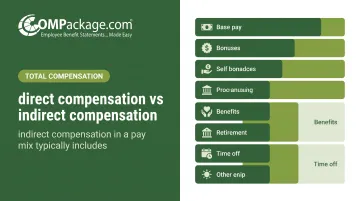
Indirect compensation is non-cash benefits that carry real financial value but aren't paid out as funds employees can spend directly. These are typically offered to all or most employees and represent a meaningful share of total employment cost: 30.1% of compensation for the average US private-sector employer.
Health and Insurance Benefits
Employer-sponsored health coverage is usually the largest single indirect benefit by dollar value:
- Medical, dental, and vision insurance — the most common package, with most employers covering the majority of premiums
- Life insurance — typically employer-paid group coverage
- Short- and long-term disability insurance — income protection if an employee can't work
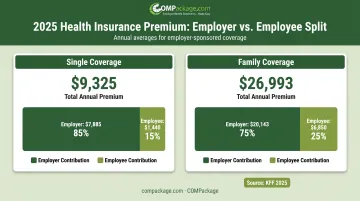
The dollar figures here are substantial. KFF's 2025 survey found average annual health premiums of $9,325 for single coverage and $26,993 for family coverage, with workers paying only $1,440 and $6,850 of those amounts, respectively. The employer absorbs the rest: value most employees never see itemized anywhere.
Retirement and Financial Benefits
Retirement contributions build long-term employee wealth without appearing in take-home pay:
- 401(k) matching — the most common form; Vanguard's 2025 data shows an average employer match of 4.6% of pay
- Pension plans — more common in public-sector and unionized environments
- Employee stock purchase plans (ESPPs) — allow employees to buy company stock at a discount, straddling direct and indirect categories
A 4% match on a $60,000 salary equals $2,400 per year in employer contributions. Most employees couldn't tell you that figure off the top of their head.
Time-Off and Leave Policies
Paid leave has economic value. It's compensation for time not worked:
- Paid time off (PTO) and paid holidays
- Paid sick leave
- Paid parental leave (offered by 46% of employers as of 2026, up from 39% in 2025 per SHRM)
- Bereavement leave
More generous leave policies are increasingly used as a competitive differentiator, particularly by mid-sized businesses that can't match large-company base salaries.
Workplace Flexibility and Remote Work
Flexible and remote work arrangements have dollar-equivalent value that rarely shows up in a pay mix:
- Remote/hybrid work eliminates commuting costs (transportation, time, clothing)
- Flexible scheduling allows childcare cost savings
- Compressed workweeks can reduce weekly expenses significantly
Research from Harvard Business School found that 40% of workers in remote-eligible jobs would accept a pay cut of at least 5% to avoid a full return to office — a clear signal that flexibility has dollar-equivalent value to employees.
Learning, Wellness, and Supplemental Benefits
These smaller line items still add up, and they show the employer is investing beyond base pay:
- Tuition reimbursement (offered by 48% of employers; average maximum of $4,764 per SHRM 2023)
- Professional development stipends
- Gym, wellness, and mental health programs
- Commuter benefits and home office budgets
- Childcare assistance
None of these appear on a pay stub. That invisibility is why total compensation statements matter: they put dollar figures on benefits employees otherwise overlook.
Direct vs. Indirect Compensation: Key Differences
| Dimension | Direct Compensation | Indirect Compensation |
|---|---|---|
| Form | Cash, paycheck, deposits | Non-cash benefits, employer-paid costs |
| Visibility | Appears on pay stub | Often invisible to employees |
| Tax treatment | Taxed as ordinary income | Many benefits are tax-advantaged (IRS Pub. 15-B) |
| Retention impact | Drives offer acceptance | Drives long-term satisfaction and loyalty |
These two categories aren't interchangeable. A below-market salary can't be fixed by adding more gym memberships. But when two job offers are financially comparable, a stronger indirect package often tips the decision.
Industry norms shape the mix significantly:
- Tech and finance companies weight direct compensation higher, especially equity
- Public-sector and manufacturing employers compete more on indirect benefits: pensions, healthcare, job security
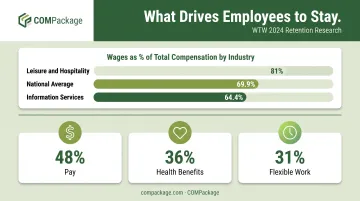
- Leisure and hospitality runs the most cash-heavy mix: BLS data shows wages at 81% of total compensation in that sector, versus 64.4% in information services
On retention specifically: WTW's 2024 survey of 10,000 US employees found pay cited by 48% as a reason to stay, health benefits by 36%, and flexible work by 31%. Direct pay often wins the offer; indirect pay is what keeps people after they start.
How to Build the Right Pay Mix for Your Business
The optimal direct-to-indirect ratio depends on company size, industry, and workforce demographics.
Benchmarks by Employer Size
| Employer Size | Wages | Benefits | Total Cost/Hour |
|---|---|---|---|
| 1–99 workers | 73.7% | 26.3% | $37.97 |
| 100–499 workers | 69.5% | 30.5% | $47.78 |
| 500+ workers | 64.8% | 35.2% | $68.03 |
Smaller employers run more cash-heavy mixes, partly by design and partly by cost constraint. When you benchmark, compare against employers your size—not national averages alone.
Practical Guidance by Company Profile
- Cash-constrained startups: Lean on equity, flexible work, and generous PTO when base pay can't match larger companies
- Established SMBs: Use health benefits, retirement matching, and remote flexibility to close salary gaps without raising payroll
- Older workforces: Prioritize retirement matching and robust healthcare over wellness stipends or development budgets
Don't Skip the Audit
Before finalizing your pay mix, benchmark what competitors in your region and industry offer in both direct and indirect categories. A common mistake: overspending on benefits employees don't value while underspending on the ones that actually drive retention. A structured audit (even once a year) flags that mismatch before it turns into a turnover problem.
Helping Employees See the Full Value of Their Compensation
Here's the core irony of most compensation programs: employers spend real money on benefits, and employees have no idea how much.
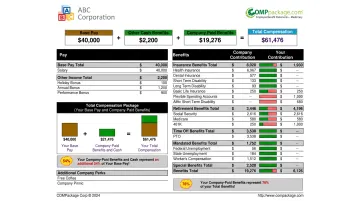
A total compensation statement solves this by presenting both direct and indirect compensation in one document (base salary, bonuses, employer-paid insurance premiums, 401(k) contributions, PTO value, and other benefits) with a single annual dollar total. When an employee sees that their $65,000 salary is actually a $91,000 total compensation package, a competing offer looks far less compelling.
These statements are most effective during:
- Annual performance reviews
- Onboarding for new hires
- Open enrollment periods
- Any moment when an employee might be weighing other offers
For small and mid-sized businesses, generating these reports used to mean hiring an HR consultant or investing in enterprise software. COMPackage is a self-service alternative: a cloud-based platform that lets businesses with as few as one employee generate individualized total compensation reports across more than 80 benefit categories.
With the Employee LOADER bulk-import feature, an entire employee census can typically be completed in under 90 minutes.
Customers including Coca-Cola, Harley-Davidson, and the Frank Lloyd Wright Foundation use it. Annual plans start at $149 for up to five employees and scale to $2,999 for unlimited employees — a fraction of what traditional consultants charge.
The underlying logic is straightforward: employees who understand what their employer actually spends on them are less likely to leave over a marginally higher salary offer elsewhere.
Frequently Asked Questions
What is direct compensation?
Direct compensation is any monetary payment made to an employee for their work: base salary, hourly wages, bonuses, commissions, overtime pay, and equity awards. It is the cash-equivalent pay that shows up as spendable income.
What are the five types of compensation?
The five commonly recognized types are: base salary or hourly wages, variable pay (bonuses and commissions), benefits (indirect compensation), equity compensation, and non-financial perks. Direct and indirect compensation together cover the first four; some frameworks group them differently.
What are some examples of indirect compensation?
Common examples include employer-sponsored health, dental, and vision insurance; 401(k) matching contributions; paid time off and holidays; life and disability insurance; remote and flexible work arrangements; tuition reimbursement; and wellness programs.
How does indirect compensation affect employee retention?
Direct pay often drives offer acceptance, but indirect benefits such as health coverage, retirement matching, and flexible work heavily influence long-term satisfaction and whether people stay. That impact is strongest when employees understand what those benefits are worth.
What is total compensation, and how is it different from direct compensation?
Total compensation is the full dollar value of direct pay plus indirect benefits. Direct compensation is only the cash-equivalent portion. Total pay often runs 25–40% above base salary, so the gap between what employees “earn” and what they cost the employer is usually larger than people expect.