According to the Bureau of Labor Statistics, benefits alone account for 31.6% of total civilian worker compensation — meaning for every $1.00 in wages, employers are spending roughly $0.46 more in benefits. That gap between what employees see on their paycheck and what employers actually spend is where the direct vs. indirect cost distinction becomes essential.
Understanding this split isn't just useful for accountants. It drives accurate pricing, smarter budgeting, proper tax filing, and — when communicated well — stronger employee retention.
This guide breaks down both cost categories, explains why separating them matters, and shows how to put that knowledge to work.
Key Takeaways
- Direct costs are tied to specific work output — wages, commissions, project bonuses.
- Indirect costs cover workforce-wide expenses: benefits, payroll taxes, HR staff, and overhead.
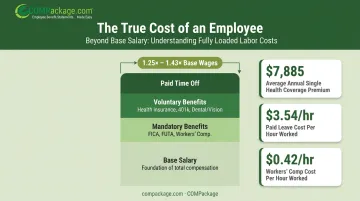
- The fully loaded cost of an employee typically runs 1.25x to 1.43x their base salary.
- Proper cost classification is required for accurate COGS reporting and IRS compliance.
- 54% of employees cite benefits as a key reason they stay — making transparent compensation communication a direct retention tool.
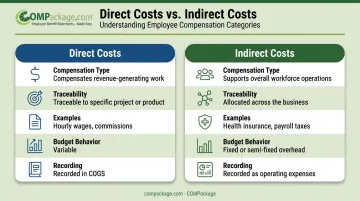
Direct vs. Indirect Employee Costs: A Quick Comparison
| Factor | Direct Costs | Indirect Costs |
|---|---|---|
| Purpose | Compensate work that generates revenue | Support operations and the workforce overall |
| Traceability | Linked to a specific project, product, or service | Allocated across the business or department |
| Examples | Hourly wages, sales commissions, project bonuses | Health insurance, payroll taxes, HR salaries |
| Budget behavior | Variable — scales with production or sales | Fixed or semi-fixed overhead |
| Financial statement | Cost of Goods Sold (COGS) | Operating expenses / overhead |
What Are Direct Employee Costs?
Direct employee costs are expenses you can trace to a specific employee's contribution to producing a product or delivering a service. If the work stopped, the cost would stop with it.
Common examples include a factory worker's hourly wage, a sales rep's commission, or a software developer's salary on a specific client project. The IRS defines direct labor as wages paid to employees working directly on a manufactured product, including a proportional share for employees splitting time between tasks (IRS Publication 334).
Key Components of Direct Costs
- Base wages and salaries: Pay for time spent on revenue-generating work — hourly for production roles, or a full salary for professionals on a defined project.
- Overtime pay: Additional compensation for hours beyond the standard workweek, directly tied to output demands.
- Commissions and performance bonuses: Pay linked to specific sales figures, project completions, or revenue milestones.
- FICA taxes on direct wages: The employer's share of Social Security (6.2% on wages up to $184,500) and Medicare (1.45% with no cap), calculated against direct labor wages.
The line between direct and indirect can shift depending on your business model. A developer's salary counts as a direct cost on a client project but becomes indirect overhead when they switch to internal tools — so the classification follows the work, not the worker.
What Are Indirect Employee Costs?
Indirect employee costs — often called "labor burden" — are the costs of maintaining a workforce, regardless of what any individual is producing on a given day. These costs exist because you have employees, not because of what they're building or selling.
They're harder to trace to a specific output, so they get allocated across the business instead.
What's Not on the Pay Stub
Most employees never see the full cost of their employment — the benefits, insurance, and compliance costs that keep them working don't appear on any pay stub, but they add up fast for employers.
Mandatory benefits:
- Employer Social Security (6.2%) and Medicare (1.45%) contributions
- Federal unemployment tax (FUTA) — 6.0% on the first $7,000 per employee, reduced to 0.6% with the standard state credit
- Workers' compensation insurance — averages $0.42 per hour worked for private industry workers
Voluntary benefits:
- Health insurance is the big one. According to the 2025 KFF Employer Health Benefits Survey, employers pay an average of $7,885 per year for single coverage and $20,143 for family coverage
- Retirement contributions — 86% of plans offer a 401(k) match, averaging around 4.6% of pay per Vanguard's 2025 data
- Dental, vision, and life insurance premiums
Paid time off:
- Private industry workers average 11 vacation days after one year, rising to 18 after ten years, plus 7 sick days — all paid time with zero productive output attached
- BLS data puts paid leave costs at $3.54 per hour worked
Recruiting, training, and overhead:
- Hiring and onboarding costs for new employees
- Company-wide training programs not tied to a specific project
- A proportional share of HR staff salaries, office rent, utilities, and supplies
The totals are significant: the SBA estimates the true cost of an employee runs 1.25x to 1.4x their base salary once all these items are factored in. BLS data for private industry workers puts that ratio at 1.43x wages as of March 2026.
Why Separating Direct vs. Indirect Costs Is Crucial for Your Business
Getting this distinction right isn't an accounting formality. It directly affects whether your business prices correctly, files taxes accurately, and allocates resources wisely.
Strategic Business Implications
Four business functions depend directly on getting this classification right:
- Job costing and pricing — You can't price a service profitably without knowing its true cost. Direct labor gives you the baseline, but indirect costs — insurance, overhead, paid leave — must be allocated into each project too. A contractor pricing labor at $50/hour who only accounts for direct wages is likely losing money on every job. With 14% of small business owners citing labor costs as their top challenge, accurate job costing isn't optional.
- Budgeting and forecasting — Direct costs scale with revenue; when you land more projects, direct labor rises proportionally. Indirect costs don't. Rent, benefits, and HR salaries stay relatively flat whether you're at 80% or 100% capacity, so separating them lets you model growth scenarios accurately and catch when overhead is outpacing revenue.
- Tax compliance — IRS Publication 334 is explicit: direct labor belongs in COGS, while indirect labor — support functions without a direct connection to the saleable product — belongs in operating expenses. Misclassifying the two can distort taxable income, trigger audit flags, and result in missed deductions.
- Operational performance — The ratio of direct to indirect costs is a concrete efficiency signal. If indirect costs are creeping up as a percentage of total labor spend, it may point to bloated administrative overhead, underutilized support staff, or facilities costs that no longer match your team's size.
One added complexity worth noting: the uniform capitalization rule (UNICAP) requires businesses to capitalize both direct costs and a portion of indirect costs for inventory production into the cost basis of property, rather than deducting them immediately.
There's an exception for businesses with average annual gross receipts of $31 million or less, but even smaller businesses should confirm their classification approach with a tax advisor.
Beyond the Books: Communicating Total Compensation to Your Team
Here's where the financial exercise becomes a retention strategy.
Most employees see their salary — and only their salary. They have no visibility into the employer-paid health insurance, retirement contributions, paid leave, and other benefits that often add up to 43% or more of their base wages. That invisibility is costly. When employees don't recognize the full value of what they're receiving, they're far more likely to leave for a competitor offering marginally better direct pay.
The data is striking: according to WTW's 2024 Global Benefits Attitudes Survey, 54% of employees stayed with their current employer specifically because of their benefits package, and 40% said they'd leave for better benefits even with no salary increase. Meanwhile, Gallup estimates replacing an employee costs between 40% and 200% of their annual salary depending on the role — and 42% of that turnover is preventable.
The solution often isn't a higher salary. It's making sure employees can see the full value of what they're already receiving.
A Total Compensation Statement does exactly that: it translates the employer's full investment into a clear, personalized report showing each employee their base pay alongside the dollar value of every benefit, contribution, and perk the company provides.
COMPackage is built specifically for this purpose. Its self-service platform lets companies of any size generate professional total compensation reports in-house, without expensive consultants or manual spreadsheet work.
The software covers over 80 benefit and perk categories, including:
- Health insurance, dental, and vision premiums
- 401(k) contributions and retirement benefits
- PTO value, workers' comp, and legally required taxes
- Non-payroll perks such as parking or company phones
Auto-calculators handle common benefit valuations automatically, and the Employee LOADER allows bulk import of data for an entire workforce in under 90 minutes.
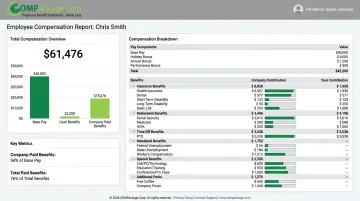
For HR teams, benefits consultants, and accounting firms looking to demonstrate the real cost of their workforce — or help clients understand theirs — it's a straightforward way to turn a complex financial breakdown into a report employees can actually act on.
Frequently Asked Questions
What are direct and indirect staff costs?
Direct staff costs are tied to specific revenue-generating work — like a production worker's hourly wage or a salesperson's commission. Indirect staff costs are shared expenses that support the workforce broadly, such as health insurance premiums, payroll taxes, and HR staff salaries.
What is an example of an indirect employee cost?
Common examples include the employer's share of health insurance (averaging $7,885 annually for single coverage), 401(k) matching contributions, workers' compensation insurance, and company-wide training costs. These expenses support all employees rather than a single project or output.
What does an indirect employee mean?
An indirect employee is someone whose work supports overall business operations rather than directly producing a product or generating revenue. HR managers, accountants, administrative assistants, and IT support staff are typical examples.
Are employee benefits a direct or indirect cost?
Employee benefits are indirect costs. Health insurance, retirement contributions, and PTO apply regardless of which project an employee is working on — they're part of the general cost of keeping someone on payroll, not tied to any specific output.
How do you calculate the total cost of an employee?
Add all direct costs (base salary, bonuses, commissions) to all indirect costs (benefits, payroll taxes, workers' comp, a share of overhead and training). The result is the employee's "fully loaded" cost, which typically runs 1.25x to 1.43x their base wages.