Pay transparency isn't a nice-to-have anymore. According to SHRM's 2023 research, 74% of U.S. workers are less interested in job postings that don't list a pay range, and 82% are more likely to apply when one is included. Employees want the full picture, not just a base number on an offer letter.
This guide covers what actually belongs in a compensation package, how to build a template that captures every dollar of value, and how turning that template into a statement can become one of HR's most underused retention tools.
Key Takeaways
- Compensation packages cover direct pay, benefits, and non-cash perks — not just salary
- Templates standardize how you document and calculate every element so nothing gets missed
- Sharing total compensation statements addresses a top reason employees quit
- Purpose-built software can cut census calculation time from days to under two hours
- Free templates handle the basics, but growing companies often outgrow spreadsheets fast
What Is a Compensation Package?
A compensation package is the complete bundle of cash and non-cash rewards an employer provides an employee — not just the number on their offer letter. It's the full financial relationship between an employer and employee, and it's almost always bigger than people assume.
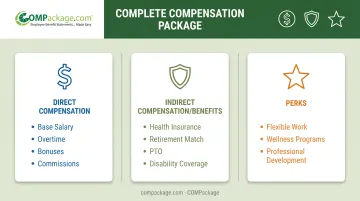
A well-built package typically combines three layers:
- Financial compensation — base pay, bonuses, commissions
- Benefits — insurance, retirement contributions, paid time off
- Perks — flexible schedules, wellness programs, professional development
These pieces should connect to your employee value proposition: the growth opportunities, culture, and work environment you offer beyond the paycheck.
Separate two terms people often use interchangeably:
- Compensation package — what a specific employee actually receives
- Compensation plan — the company's overall strategy or policy for how it pays people across roles
The package is personal. The plan is structural. One employee's package is an output of the plan, not the plan itself. Confusing the two is where a lot of pay inconsistency starts.
What Should Be Included in a Compensation Package?
A complete package splits into direct and indirect (non-cash) compensation. Both matter equally to how employees perceive their pay. Leave out either one and you get a skewed picture of what someone is actually earning.
Direct Compensation
This is the cash employees see hit their bank account:
- Base salary or hourly wage — the foundation everything else builds on
- Overtime pay — for covered, nonexempt employees, at least 1.5 times the regular rate after 40 hours in a workweek, per the Department of Labor
- Performance bonuses and commissions — tied to individual or company results
- Referral or sign-on bonuses — one-time payments used to attract talent
Overtime calculations trip up a lot of employers. The regular rate generally includes most forms of pay, not just base wages, so bonuses and commissions can factor into the math.
Indirect Compensation and Benefits
This is where most of the "hidden" value in a package lives:
- Health insurance — medical, dental, and vision
- Disability insurance — short- and long-term income protection
- Retirement contributions — 401(k) matching or profit-sharing
- Paid time off — vacation, sick leave, paid holidays
- Equity or stock options — where applicable
- Legally required benefits — Social Security and Medicare contributions, currently 6.2% and 1.45% of pay from the employer's side
Paid time off isn't federally mandated. The Fair Labor Standards Act doesn't require payment for vacation or sick time — those benefits exist purely because employers choose to offer them, which makes them worth highlighting, not burying.
Perks and Non-Quantifiable Benefits
Some value doesn't fit neatly into a dollar column:
- Flexible or remote work arrangements
- Professional development stipends
- Wellness programs and employee assistance programs
- Career growth opportunities and company culture
Career growth and culture aren't quantifiable, but employees still weigh them heavily. A complete package names them anyway, even when you can't put a dollar figure on the line.
What Is a Compensation Package Template and How Do You Build One?
A compensation package template is a standardized document or spreadsheet that lists every pay and benefit component for a role or employee. Its job is consistency: the same categories, calculations, and format across the organization so nothing appears on one person's statement and gets left off another's.
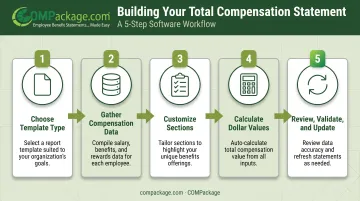
Building one takes a deliberate process. Here's how to do it.
Step 1: Choose the Right Template Type for Your Goals
Not every company needs the same structure. Pick based on your objective:
- Employee-level template: standard package for individual contributors
- Incentive/sales template: built around variable pay and commission structures
- Executive template: includes equity and long-term incentives
- Total-compensation template: the full annual statement, covering everything
Step 2: Gather Current Compensation and Benefits Data
You'll need accurate numbers before you can build anything useful:
- Salary or wage records for each employee
- Benefit costs actually paid by the employer (not list price)
- PTO accrual rates and balances
- Retirement contribution amounts
- Equity grants, if applicable
Gaps here are common. Insurance premiums especially tend to live in a different system than payroll data, which means someone usually has to go pull them manually.
Step 3: Customize Sections to Match Your Actual Offerings
A generic template will include sections you don't need and miss ones you do. Remove what doesn't apply (equity, for instance, if you're a small business that doesn't offer it).
Add what's required, including state-mandated benefits that vary by where your employees work. The template should mirror your actual offerings, not a checklist copied from somewhere else.
Step 4: Calculate the True Dollar Value of Each Component
This is the step that eats the most time. Employer-paid benefit costs (insurance premiums, retirement matches, payroll taxes) have to become a specific dollar amount per employee, not a line item that only says "provided."
Doing that manually in a spreadsheet, one employee at a time, can stretch into days or weeks for a full census. Dedicated total compensation statement software is built for this. COMPackage includes 12 automated calculators for government-mandated benefits, 401(k) contributions, time-off value, and insurance benefits, so you enter data once and the dollar values fill in without the manual slog.
Step 5: Review, Validate, and Keep It Updated
Test the template with a small group before rolling it out company-wide. Then commit to updating it:
- At least once a year, at minimum
- Immediately after raises or promotions
- Whenever benefit plans change
A template that's right on day one and stale six months later is barely better than having none.
Why a Total Compensation Statement Boosts Retention and Recruiting
Employees who only look at take-home pay are working with an incomplete picture, and that gap has real consequences. Gallup's 2024 data found that pay and benefits were the single most common reason employees gave for leaving a job, accounting for 16% of exits. Part of that turnover comes from people who never fully understood what they were earning.
A total compensation statement fixes that blind spot directly. It puts a real number next to every benefit (insurance, retirement match, PTO value, employer tax contributions) so employees see the whole package, not just the net deposit.
The recruiting impact is just as strong. Consider this scenario:
- Competitor A offers $65,000 base salary with no benefits breakdown
- Your offer is $60,000 base, plus a statement showing $18,000 in employer-paid benefits — a $78,000 total
On paper, Competitor A looks better. With a statement in hand, your offer wins.
COMPackage closes that gap for teams that want the full picture without hiring a consultant. It is self-service total compensation statement software for businesses with 5 to 5,000 employees, with no service-provider fees. Key features include:
- Bulk employee data import through the Employee LOADER, pulling census data straight from Excel
- 80+ pre-built benefit categories, from health insurance to company-provided cell phones
- Free mid-year updates when benefits change, without paying for a new report cycle
A statement generated once and forgotten loses value fast. One kept current when benefits change helps employees see the real package—and gives them fewer reasons to leave.
Types of Compensation Package Templates
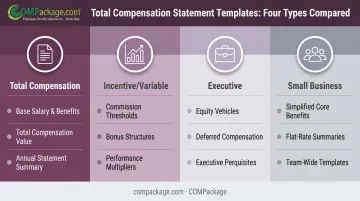
Different situations call for different template structures. Using one bloated document for every purpose usually backfires — sales teams don't need equity vesting schedules, and executives don't need an hourly overtime calculator.
| Template Type | Best For | Key Elements |
|---|---|---|
| Total compensation template | Annual employee statements | Salary, benefits, PTO, retirement, taxes: full picture |
| Incentive/variable compensation template | Sales and performance-driven roles | Commission structure, bonus thresholds, target/maximum payouts |
| Executive compensation template | Leadership roles | Base salary, STI, equity (RSUs/options), LTI vehicles |
| Small business/employee template | Small teams | Simplified core salary and benefits, no equity complexity |
The total compensation template is the one most companies reach for first, since it's the version employees actually see. The others tend to live behind the scenes, used by HR and finance to structure pay before it reaches a statement.
Frequently Asked Questions
What should be included in a compensation package?
A full package includes direct pay (salary, bonuses, commissions), indirect benefits (insurance, retirement contributions, PTO), and perks like flexible work or wellness programs. Employees weigh both the cash and non-cash pieces when they judge what their pay is really worth.
What is a compensation template?
A compensation template is a standardized document or spreadsheet used to structure and calculate every compensation element for a role. It keeps base pay, bonuses, benefits, and retirement match from getting overlooked when you build a statement.
What's the difference between a compensation package and a total compensation statement?
The package is what an employee actually receives: the salary, benefits, and perks combined. The statement is the document that reports the full dollar value of that package back to the employee.
How often should a compensation package template be updated?
Review and update it at least once a year. Update it immediately after raises, benefit plan changes, or promotions so the numbers stay accurate rather than stale.
What's the difference between direct and indirect compensation?
Direct compensation is cash paid straight to the employee, like salary and bonuses. Indirect compensation is non-cash value, including benefits, PTO, and retirement contributions.
Do small businesses really need a formal compensation package template?
Yes. Even a five-person team benefits from a standardized template. It keeps pay consistent, supports compliance with wage laws, and strengthens recruiting offers from the first hire.