Introduction
Most employees look at their offer letter, see a base salary number, and mentally file that as "what I make." Everything else (the health insurance premiums their employer pays, the 401(k) match, the PTO, the payroll taxes) stays invisible.
That perception gap is significant. According to LIMRA's 2025 research, only 42% of employees say they receive a total compensation statement, meaning 58% never see a document that shows what their employer actually spends on them.
The same research finds that employees who understand their benefits well are far more satisfied than those who don't.
An annual compensation statement fixes this. It's a once-a-year document that translates every dollar an employer spends on salary, benefits, taxes, and perks into a clear, personalized total.
This guide covers exactly what to include, walks through a realistic example you can adapt, and outlines a step-by-step process for creating statements your employees will actually read.
Key Takeaways
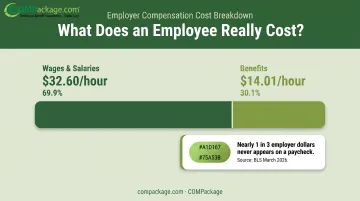
- Benefits make up 30.1% of total employer compensation costs, nearly one-third of spend that never hits a paycheck
- Cover six categories: direct pay, health/insurance, retirement, PTO value, employer-paid taxes, and perks
- Personalize every statement; generic versions lose most of their impact
- Annual distribution, ideally tied to performance reviews, maximizes engagement
- No federal law requires these statements, but issuing them is a proven HR best practice
What Is an Annual Compensation Statement?
An annual compensation statement is a personalized yearly document that summarizes every form of financial and non-financial value an employee receives from their employer. A pay stub only covers one pay period's gross pay, deductions, and net pay. A compensation statement shows the employer's total yearly investment in that person.
Total Compensation vs. Base Salary
Base pay is only one slice of what the employer actually spends.
- Base salary = fixed cash only
- Total compensation = base salary + bonuses + employer-paid insurance premiums + retirement contributions + PTO value + employer-paid taxes + perks
BLS data from March 2026 shows that for private-industry workers, benefits average $14.01 per hour worked against $32.60 in wages and salaries, so benefits make up 30.1% of total employer compensation costs. Most employees never see that hidden third of the package.
A Note on Terminology
"Annual compensation statement," "total compensation statement," and "benefits statement" are used interchangeably for the same document. A total rewards statement goes further: it also folds in non-monetary elements such as career development, recognition programs, and workplace culture. Both formats have value. This guide focuses on the compensation statement and notes where non-monetary elements can be added.
What to Include in an Annual Compensation Statement
Direct Compensation
This category covers all cash earnings:
- Base salary or hourly wages (annualized)
- Overtime pay
- Performance bonuses
- Commissions and other incentive pay
Break each out as a separate line item with year-to-date totals. Showing variable pay alongside fixed pay gives employees a clear picture of how their total cash earnings are built.
Health and Insurance Benefits
Most employees know they have health insurance. Far fewer know what their employer actually pays for it.
KFF's 2025 Employer Health Benefits Survey puts average employer contributions at $7,885 for single coverage and $20,143 for family coverage per year. Those figures (total premium minus average worker contribution) are large enough to warrant their own line items on the statement.
Include annual employer dollar amounts for:
- Medical insurance premiums
- Dental and vision coverage
- Life insurance
- Short- and long-term disability insurance
- Employee Assistance Program (EAP) costs
Retirement and Financial Benefits
Show the employer's 401(k) match or pension contribution in concrete dollar terms. For 2026, the IRS employee elective-deferral limit is $24,500, with employer and employee combined contributions capped at $72,000.
Include the matching formula (for example, 50% match on the first 6% of pay) alongside the actual dollar amount matched for the year. A simple projection of savings at the employee’s current deferral rate helps people see what the match is building over time.
Paid Time Off (PTO) Value
PTO rarely gets treated as compensation — which is exactly why it belongs on this statement.
How to calculate it:
PTO Value = (Vacation days + Sick days + Personal days + Paid holidays) × Daily pay rate
For an employee earning $75,000/year with 25 paid days off:
- Daily rate = $75,000 ÷ 260 working days = $288.46
- PTO value = 25 × $288.46 = $7,211
That's thousands of dollars most employees never mentally credit to their compensation.
Employer-Paid Taxes and Statutory Contributions
These amounts are paid entirely by the company and never appear on an employee's paycheck. They are invisible compensation unless you surface them here.
| Tax / Contribution | 2026 Rate | Notes |
|---|---|---|
| Social Security | 6.2% | On wages up to $184,500 |
| Medicare | 1.45% | No wage cap |
| FUTA | 6.0% (typically 0.6% after credit) | On first $7,000 of wages |
| Workers' Compensation | Varies by state/industry | — |
Perks, Non-Quantifiable Benefits, and Other Extras
Round out the statement with additional items:
- Tuition reimbursement
- Wellness program subsidies
- Remote-work or home-office stipends
- Commuter benefits
- Professional development funds
- Employee discounts
- Company-provided equipment (phone, laptop)
- Stock options or equity grants
Non-cash, non-quantifiable perks such as flexible scheduling, mentorship access, and team culture can go in a dedicated callout without dollar values. That extra section is often what separates a comprehensive statement from a basic pay summary.
Annual Compensation Statement Example
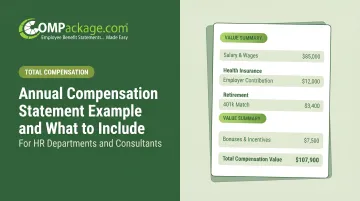
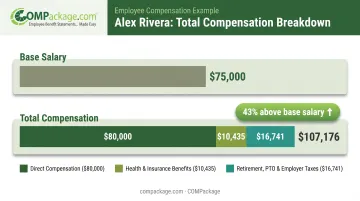
Here's a sample statement for Alex Rivera, Operations Manager at a hypothetical company. All figures are representative.
Direct Compensation
| Item | Annual Amount |
|---|---|
| Base Salary | $75,000 |
| Performance Bonus | $5,000 |
| Total Direct Compensation | $80,000 |
Indirect Compensation and Benefits
| Item | Employer Annual Contribution |
|---|---|
| Medical Insurance Premium | $7,885 |
| Dental / Vision Insurance | $1,200 |
| Life Insurance | $520 |
| Short-Term Disability | $450 |
| Long-Term Disability | $380 |
| Total Benefits | $10,435 |
Retirement, PTO, and Employer Taxes
| Item | Annual Value |
|---|---|
| 401(k) Employer Match (4% of salary) | $3,000 |
| PTO Value (25 days × $288.46/day) | $7,211 |
| Social Security (6.2% of $75,000) | $4,650 |
| Medicare (1.45% of $75,000) | $1,088 |
| Workers' Compensation (est.) | $750 |
| FUTA (est. after credit) | $42 |
| Total Retirement, PTO & Taxes | $16,741 |
Grand Total Compensation
| Category | Amount |
|---|---|
| Direct Compensation | $80,000 |
| Health & Insurance Benefits | $10,435 |
| Retirement, PTO & Employer Taxes | $16,741 |
| Total Compensation | $107,176 |
Alex's total compensation is $107,176 — nearly 43% above base salary. That gap between what Alex sees on a paycheck and what the company actually spends is exactly what this statement makes visible.
Non-Quantifiable Benefits (not included in dollar total): Flexible work schedule, professional development budget, mentorship program access, company-sponsored wellness events.
Why Annual Compensation Statements Matter
For Employers
The business case is straightforward. LIMRA's 2025 research shows that more than 6 in 10 employees say benefits make them more inclined to stay, with 41% saying much more inclined. Employees who understand their benefits well report much higher satisfaction: over 70% are very satisfied, compared with roughly 18–22% among those with no understanding.
Pay communication also has room to improve. A 2024 WTW global survey found fewer than one in four employers said they were effective at explaining how pay is determined, while 48% of employees cited pay as a top attraction and retention driver.
Compensation statements address both problems. They:
- Build trust through transparency
- Support recruiting by showing candidates the full offer value
- Encourage employees to use benefits they're already entitled to
- Reinforce the employer's investment in each person
For Employees
Seeing total compensation in one place supports real financial decisions—benefit elections, retirement contribution rates, whether to accept a competing offer. It also shifts perspective: an employee who sees $107,176 where they thought they earned $75,000 is far less likely to undervalue the job or leave over base pay alone.
Timing and Delivery
Distribute statements annually, tied to one of these natural windows:
- Performance review cycles
- Merit increase communications
- Open enrollment periods
- Start of a new benefit year
Personalization (employee name, role, specific enrolled benefits) and visual clarity (clean tables, a summary chart) make a measurable difference in how the document lands. A generic template sent to everyone has far less impact than a statement showing exactly what this employee receives.
How to Create an Annual Compensation Statement
Creating an annual compensation statement is a five-step process. Work through them in order so every figure is accurate and each employee gets a personalized view.
Step 1 — Inventory All Compensation Elements
List every form of compensation the company offers. Group items into three buckets:
- Direct: Salary, bonuses, commissions, overtime
- Indirect: Insurance premiums, retirement contributions, employer taxes, PTO
- Non-monetary: Flexible scheduling, development programs, culture perks
Step 2 — Assign Dollar Values
Calculate annual figures for each benefit using consistent methods:
- Insurance: use the employer's annual premium contribution
- PTO: daily pay rate × eligible paid days
- Retirement: employer match in dollars for the year
- Taxes: apply current federal rates (Social Security 6.2%, Medicare 1.45%)
Don't inflate figures or include benefits an employee isn't enrolled in. Accuracy is what makes the document credible.
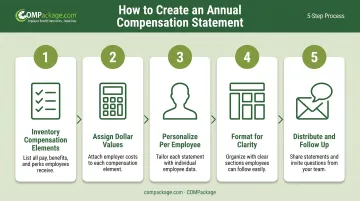
Step 3 — Personalize for Each Employee
A generic statement loses most of its value. Each employee should see only their enrolled benefits, calculated at their pay rate.
Doing that by hand does not scale. COMPackage's self-service platform is built for this step:
- Over 80 benefit category options
- Auto-calculators for government-mandated benefits and 401(k) contributions
- Employee LOADER that imports census data from Excel and maps column headings to the right fields in a few minutes
After setup, loading 100 or 1,000 employees takes minutes. Plans start at $149/year for up to 5 employees, with tiers through unlimited headcount and a Professional version for HR consultants, benefits advisors, and agencies managing multiple clients.
Step 4 — Format for Clarity
Keep the layout clean:
- Clear section headers for each compensation category
- A summary table showing the grand total
- A simple chart (pie or bar) showing direct vs. indirect split
- Plain language throughout — include short footnotes for terms like "vesting" or "imputed income"
Step 5 — Distribute, Explain, and Follow Up
Pair the statement with a brief manager conversation or a short cover note. Invite employees to ask questions. Statements delivered digitally or in print both work — the conversation around them is what drives real engagement.
Frequently Asked Questions
What is a compensation statement?
A compensation statement is a document, typically issued once a year, summarizing all forms of value an employer provides: salary, bonuses, employer-paid benefits, retirement contributions, PTO value, and perks. It gives employees a complete picture beyond their take-home pay.
What is the difference between a total compensation statement and a pay stub?
A pay stub is a payroll record tied to a single pay period showing gross pay, taxes withheld, and net pay. A compensation statement is an annual communication showing the employer's full investment, including benefits and contributions that never appear as cash in hand.
What is the difference between total compensation and base salary?
Base salary is fixed cash pay only. Total compensation adds every other form of employer investment: bonuses, insurance premiums, retirement contributions, PTO value, and employer-paid taxes, which together can add 30% or more on top of base salary.
Are employers legally required to provide annual compensation statements?
In the U.S., employers are generally not legally required to issue total compensation statements. The FLSA requires accurate wage and hours recordkeeping but does not mandate that employers provide pay stubs, let alone full compensation statements. Issuing them is a voluntary HR best practice.
How often should employers send annual compensation statements?
Once a year is standard, ideally timed to performance reviews, merit increases, or open enrollment. Connecting the statement to a moment when employees are making real decisions about their role or benefits maximizes its impact.
How do you calculate the value of benefits on a compensation statement?
Use the employer's annual premium contribution for insurance, multiply the employee's daily rate by eligible paid days for PTO, and report the 401(k) match in dollar terms. Always label your assumptions clearly, and note that equity values may fluctuate.