According to a March 2026 Bureau of Labor Statistics report, wages and salaries made up just 68.4% of total employer compensation costs, averaging $33.72 per hour. The remaining 31.6% (about $15.60 per hour) went toward benefits: retirement contributions, insurance, paid leave, and legally required programs like Social Security and Medicare.
Here's the problem: most employees never see that second number. They see gross pay, they see net pay, and that's it. The retirement match, the insurance subsidy, the paid holidays? Invisible.
This guide covers what actually belongs in a compensation and benefits package, how to calculate its true dollar value, why it matters for retention, and the practices that turn a plain paycheck into a real competitive advantage.
Key Takeaways
- Compensation splits into direct pay (salary, overtime, bonuses) and indirect benefits (insurance, retirement, PTO)
- Total compensation formula: base pay + variable pay + the monetized value of benefits
- Pay and benefits now rank as the top factor job seekers weigh before accepting an offer
- Replacing an employee can cost 50% to 200% of their annual salary
- Personalized total compensation statements help employees see the full value of what they're actually paid
What Is Included in a Total Compensation and Benefits Package?
Compensation and benefits are often used interchangeably, but they're not the same thing. Compensation is the financial, taxable side of pay, the dollars that show up on a W-2. Benefits are largely non-cash rewards: insurance, retirement contributions, time off. Together, they make up total compensation.
There's also a legal line running through benefits. Programs like Social Security, Medicare, unemployment insurance, and workers' compensation are legally required. Everything else—vacation days, holiday pay, sick leave—is discretionary. The Fair Labor Standards Act doesn't mandate any of it; employers offer these perks to stay competitive.
Direct Compensation
- Base pay – the fixed hourly, weekly, or annual rate agreed on at hire
- Overtime pay – nonexempt employees must earn at least 1.5 times their regular rate for hours beyond 40 in a workweek (hours can't be averaged across two weeks)
- Variable compensation – bonuses, commissions, and sales incentives tied to individual, team, or company performance
Indirect Compensation & Benefits
- Financial security benefits – 401(k) with employer match, life insurance, disability coverage, and equity
- Health benefits – medical, dental, vision, and wellness incentives
- Work-life benefits – paid time off, parental leave, flexible or remote work, and commuter subsidies
A U.S. Chamber of Commerce poll found that 96% of workers consider health insurance an important part of any job offer.
Not every benefit belongs on every employee's report. A single employee shouldn't see family medical coverage they never elected, and a parent shouldn't miss a dependent care benefit they actually use.
Platforms like COMPackage build statements this way by design: only benefit categories with a dollar value for that person show up on their report, not a generic company-wide list.
How Do You Calculate Employee Compensation?
The basic formula looks like this:
Total Compensation = Base Pay + Variable Pay + Monetized Value of Benefits
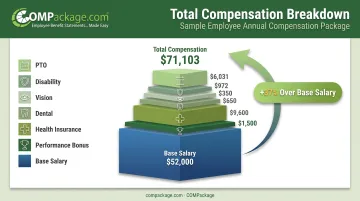
Here's what that looks like in dollars for one employee:
| Component | Annual Value |
|---|---|
| Base salary | $52,000 |
| Performance bonus | $1,500 |
| Health insurance (employer share) | $9,600 |
| Dental insurance | $650 |
| Vision insurance | $350 |
| Short-term disability | $972 |
| Paid time off (holiday, sick, vacation) | $6,031 |
| Total Compensation | $71,103 |
That's a 37% jump over base salary alone—value the employee already receives but rarely sees totaled in one place.
Benchmarking, Compa-Ratio, and Range Penetration
Setting that $52,000 base starts with benchmarking: match internal roles to external salary survey data, then filter by industry, geography, and company size. Two metrics show whether that pay lands fairly:
- Compa-ratio: employee salary ÷ range midpoint × 100
- Range penetration: (salary − range minimum) ÷ (range maximum − range minimum) × 100
Compa-ratio shows where someone sits versus the midpoint. Range penetration shows their place across the full band, minimum to maximum.
Building total compensation for one person is straightforward. Doing it accurately for 50 or 500 people—and turning it into something employees can actually read—is where most HR teams stall.
Self-service tools like COMPackage close that gap: enter salary, benefit elections, and employer contributions, and you get personalized total compensation statements for a full census in under 90 minutes.
Why Employee Compensation and Benefits Matter
Attracting Top Talent
Compensation isn't one factor among many anymore. It's increasingly the deciding one. Gallup research found that 54% of U.S. employees rated better pay and benefits as "very important" when considering a new job, up from 41% before the pandemic.
Retention and Turnover Cost
Losing an employee is expensive, and not just in recruiting fees. Gallup estimates that replacing one employee can cost 50% to 200% of their annual salary, once you account for lost productivity, hiring time, and onboarding. For a $60,000 role, that's potentially $30,000 to $120,000 walking out the door.
Productivity and Engagement
Fair, transparent pay does more than stop people from quitting. It keeps them engaged while they're still there. Employees who understand and trust their compensation are less likely to disengage, call in sick unnecessarily, or quietly job-search on company time.
Compensation and Benefits Best Practices for Employers
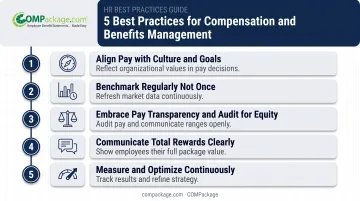
Strong compensation programs stay competitive, equitable, and easy for employees to understand. These five practices help you get there.
Align pay with culture and goals – team bonuses fit collaborative cultures; individual incentives fit high-performance ones. Pick the structure that reinforces how you actually want people to work together.
Benchmark regularly, not once – pull from multiple sources: salary surveys, job board data, and compensation software. A pay range set two years ago in a different labor market is already stale.
Embrace pay transparency and audit for equity – this isn't optional in some states anymore. Illinois (15+ employees) and Massachusetts (25+ starting October 2025) require pay scale and benefits in job postings. Payscale's research on transparency found employees at the most transparent organizations were 65% less likely to seek another job.
Communicate total rewards clearly – employees undervalue benefits when no one totals them up. MetLife found 76% of workers who understood their benefits reported being happy, and 82% said benefits improved financial stability. A branded total compensation statement from a tool like COMPackage fills that gap.
Measure and optimize continuously – track benefits utilization, satisfaction survey results, and any turnover tied to comp concerns. Adjust before people leave, not after.
HR's Role in Compensation and Benefits Management
HR carries three ongoing responsibilities here:
- Formulating a compensation philosophy – a documented approach explaining how pay decisions get made, so pay stays consistent and defensible across the organization.
- Compensation planning – building salary structures, pay grades, and ranges that balance the budget against what the market actually pays.
- Addressing equity issues – internal equity (similar roles paid similarly), external equity (market competitiveness), geographic differentials, and executive pay gaps.
Get the philosophy right first. Structures and equity fixes are much harder to build on a foundation that was never documented.
Key Compensation and Benefits Terms to Know
These terms show up often when you design or explain pay and benefits. Clear definitions keep HR teams and employees on the same page.
- Total rewards – the full portfolio of compensation, benefits, well-being, career growth, and recognition
- Gross wages vs. net pay – gross is total income before deductions; net is what employees take home after deductions
- Merit increase – a base-pay adjustment tied to individual performance, not a company-wide raise
- Pay mix – the balance between fixed base pay and variable incentive pay in a total pay package
- Gainsharing – a group incentive that shares the dollar value of productivity gains with employees
Frequently Asked Questions
What is included in compensation and benefits?
Compensation and benefits include base pay (salary or wages), bonuses, and commissions, plus indirect benefits such as health insurance, retirement contributions, and PTO. Together they make up an employee's total compensation package.
How do you calculate employee compensation?
Add base pay, variable pay (bonuses or commissions), and the dollar value of benefits such as insurance premiums and PTO. Compensation software can run this calculation across your full workforce in minutes.
What is the difference between compensation and benefits?
Compensation is the taxable cash you pay—salary, wages, bonuses, and commissions. Benefits are mostly non-cash rewards, such as insurance and retirement contributions, that still carry real financial value.
What is a total compensation statement, and why does it matter?
A total compensation statement is a personalized report that shows an employee's full pay and benefits value in dollar terms. When people see that number, they often value the role more—and turnover risk drops.
How often should companies review employee compensation and benefits?
At least annually, and more frequently in competitive or fast-changing labor markets. Waiting two or three years between reviews almost guarantees your pay ranges fall behind the market.
What is total rewards compared to total compensation?
Total rewards is the broader umbrella, covering compensation, benefits, growth opportunities, recognition, and culture. Total compensation focuses specifically on the pay and benefits dollar value.