Introduction
Most employees glance at their paycheck and think that's what they're worth to their employer. It isn't. Base pay is often just the visible tip of a much larger financial commitment your employer makes on your behalf.
Only 57% of employees fully understand what their benefits cover, according to MetLife's 2025 U.S. Employee Benefit Trends Study, which surveyed 2,500 full-time workers.
That gap creates real problems: employees undervalue their jobs, job seekers can't compare offers accurately, and employers struggle to explain what they're actually paying for.
This guide breaks down what goes into a compensation package, walks through a real dollar-based example, and shows you exactly how to calculate total compensation for any employee on your team.
Key Takeaways
- Base salary is one line item: bonuses, benefits, equity, and perks often add 30-60% more value
- A dollar-based example turns "total compensation" from a vague concept into clear, line-item dollars employees can compare
- Showing employees their full package strengthens retention, satisfaction, and recruiting outcomes
- Calculating total compensation follows a repeatable formula: direct pay + benefit costs + perk value
What Is a Compensation Package?
A compensation package is the complete set of monetary and non-monetary rewards an employer provides in exchange for an employee's time and skills. Salary is a piece of it, not the whole picture.
This distinction matters most in two moments:
- Hiring negotiations, when candidates compare offers based on base pay alone and miss differences in benefits or bonus structure
- Annual reviews, when employees judge a raise without factoring in changes to insurance contributions, retirement matching, or PTO accrual
Packages also vary widely by company size, industry, and role. A $60,000 salary at a small manufacturing firm might carry a very different benefits load than the same salary at a tech company offering equity. A generic salary figure rarely tells the full story, and employers who only advertise base pay often undersell their own offers.
Key Components of a Compensation Package
Compensation experts group everything an employer pays into two buckets: direct compensation (cash) and indirect compensation (benefits and non-cash value). You need both to build an accurate total compensation picture.
Direct Compensation
This is the cash side of the ledger:
- Base salary or hourly wages — the fixed foundation of pay
- Bonuses — annual, holiday, or performance-based
- Commissions — tied to sales or output
- Profit-sharing — a slice of company earnings distributed to staff
- Merit-based increases — raises tied to performance rather than tenure
- Merit-based increases — raises tied to performance rather than tenure
- Equity or stock options — ownership grants tied to role, tenure, or performance
Indirect Compensation & Benefits
Indirect compensation covers everything an employer pays on an employee's behalf that doesn't show up as take-home cash:
- Health, dental, and vision insurance premiums
- Life and disability insurance
- Retirement contributions, such as a 401(k) match
- Paid time off (holidays, sick days, vacation)
- Legally required costs — Social Security, Medicare, unemployment insurance, and workers' compensation
Benefits aren't a rounding error. For private-industry workers, benefits made up 30.1% of total employer compensation costs in early 2026, per the Bureau of Labor Statistics' Employer Costs for Employee Compensation report. The average employer paid $14.01 in benefits for every $32.60 in wages. That's roughly a third of what you're worth to your employer, and invisible on any paycheck stub.
Perks & Non-Monetary Extras
Beyond core benefits sit the extras that don't always carry a payroll line but still shape whether someone stays or leaves:
- Flexible scheduling and remote work options
- Professional development stipends or education reimbursement
- Wellness programs
- Child care assistance, meal benefits, and technology allowances
None of these are usually deal-breakers on their own. But stack enough of them together, and they can be the difference between an employee accepting a competing offer or staying put.
Compensation Package Example: A Step-by-Step Breakdown
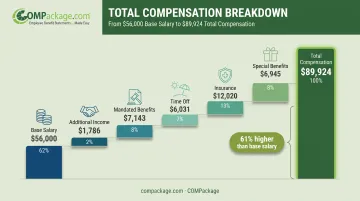
Numbers make this concept real in a way that definitions can't. Take a mid-level employee earning a $56,000 base salary (a typical customer service role) and look at what their employer actually spends across the year.
| Category | Annual Value |
|---|---|
| Base salary | $56,000 |
| Additional income (bonuses, etc.) | $1,786 |
| Mandated benefits (Social Security, Medicare, unemployment, workers' comp) | $7,143 |
| Time off (holiday, sick, vacation) | $6,031 |
| Insurance (health, dental, vision, disability) | $12,020 |
| Special benefits (wellness, education, tech, auto/parking) | $6,945 |
| Total company-paid benefits | $32,138 |
| Total compensation | $89,924 |
Break the insurance line down further. All of it is employer-paid and invisible on a paycheck:
- Health premiums: $9,600
- Dental: $650
- Vision: $350
- Short-term disability: $972
- Long-term disability: $448
Do the math: $89,924 in total compensation against a $56,000 base salary means this employee's real value is about 61% higher than their stated salary alone. Say that number out loud to an employee who's only ever seen their net pay, and the conversation about "am I paid fairly" changes instantly.
How to Calculate Your Own Package's Total Value
Use this formula once you have the inputs:
- List all direct pay: base salary, bonuses, commissions, profit-sharing
- Assign dollar values to benefits: use actual employer-paid premium amounts and contribution rates, not estimates
- Add PTO value: days of leave ÷ workdays per year × salary
- Add perks: wellness stipends, education reimbursement, technology allowances, anything with a real cost
- Sum everything for the grand total
Redo this calculation whenever salary, bonuses, or benefit costs change — totals shift year to year, and a stale number defeats the purpose.
Manually running this math for one employee is manageable. Running it for 50 or 500 employees in a spreadsheet is where most HR teams give up.
COMPackage's calculators and Employee LOADER close that gap. Bulk-import an Excel census, auto-fill mandated benefits, retirement, time-off, and insurance values, and generate a full report set in hours instead of weeks.
What Makes a Compensation Package Competitive
A competitive package doesn't start with a benefits list. It starts with base salary that matches or exceeds market rate and local cost of living. Everything else builds on top of that foundation.
From there, three elements signal long-term investment in an employee:
- Performance incentives — bonuses or commissions tied to results
- Comprehensive benefits — insurance and retirement contributions that reduce financial risk
- Equity or profit-sharing — a stake in the company's success, not just a paycheck
But contents alone aren't enough. WorldatWork's 2026 State of Rewards research found a critical misalignment: organizations often rate themselves highest on the reward pillars that matter least to employee satisfaction. Employers can spend generously on benefits and still miss what drives satisfaction if they never communicate the full package clearly.
A package is only as competitive as an employee's understanding of it. Two identical offers, one explained and one not, will land very differently.
How Employers Can Show Employees Their Full Compensation Value
Here's the core problem: employees see net pay on every paycheck and almost nothing else. Without a clear breakdown, they consistently underestimate what their employer actually invests in them each year, often assuming benefits make up 10-15% of compensation when the real figure runs 40-60% or more.
The fix is a Total Compensation Statement: a personalized document itemizing every dollar and benefit a specific employee receives, built the same way as the example above.
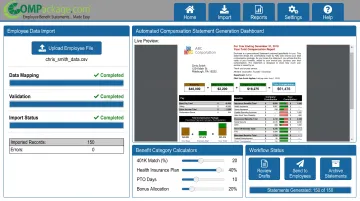
This is exactly what COMPackage was built to generate. It's self-service software designed for businesses with 5 to 5,000 employees that need to produce these reports in-house without paying consultant fees. Key features include:
- Bulk employee data import via Excel (Employee LOADER)
- 80+ pre-built benefit categories, fully customizable
- Automated calculators for mandated benefits, retirement, time off, and insurance
- Free report edits and reruns anytime during the subscription, with no extra charge
Annual pricing runs from $149 per year for 1-5 employees up to $2,599 for unlimited employees, with a Professional tier at $2,999 built for insurance agencies, benefits consultants, and accounting firms managing multiple client organizations.
The business case shows up in employee behavior, not just goodwill. LIMRA's 2025 research found only 42% of employees currently receive total compensation statements.
Employees who understand their insurance and retirement benefits well are far more likely to be satisfied with them. More than 6 in 10 employees say their benefits make them more inclined to stay with their employer.
Real customers back this up. Napa Valley Petroleum found fringe benefits added 35% to 50% to compensation for its lowest-paid workers. Ultratech Tool & Design's Bill Melang said the report gave his company "a bigger picture" of pay it had never seen before.
Best practices for rollout:
- Personalize each statement with the employee's name and tenure
- Deliver annually (year-end or start of year works best)
- Use charts and color coding so benefit value is as visible as the salary line
- Review part-time staff separately, since their benefits are often less visible and easy to undercommunicate
Frequently Asked Questions
What does a typical compensation package include?
A typical package includes base salary, bonuses or other variable pay, benefits like health insurance and retirement contributions, and perks such as PTO and flexible work arrangements. That full mix is total compensation — not just the paycheck.
What types of compensation are included in a compensation package?
Compensation splits into direct pay (salary, bonuses, and commissions) and indirect pay, which covers benefits, equity, and perks like wellness programs or education stipends. Both categories combine to form total compensation.
What is a good example of a compensation package?
A strong example lists base pay alongside itemized benefits (insurance, retirement contributions, PTO value, and perks) summed into a total compensation figure. The $56,000-salary, $89,924-total-compensation breakdown earlier in this article is a model any business can replicate.
How do you calculate the total value of a compensation package?
Add up direct pay first, then assign dollar values to each employer-paid benefit using actual premium or contribution amounts. Add perk and PTO value, then sum everything for the grand total.
Is a compensation package the same as salary?
No. Salary is one line item within a compensation package, which also includes bonuses, benefits, equity, and perks. Total compensation is almost always higher than salary alone.
How often should businesses update compensation package examples or statements for employees?
At least annually, ideally at year-end or the start of a new year. Update statements sooner if salary, benefit costs, or contribution rates change during the year.