This gap has real consequences. Employers in the U.S. spend significantly more than just base salary per employee — yet that investment goes largely unnoticed, which breeds quiet dissatisfaction and drives preventable turnover.
This article explains what a benefits statement is, why it matters for both sides of the employment relationship, and what happens when employers skip it entirely.
Key Takeaways
- A benefits statement shows full compensation (salary plus every employer-paid benefit) in one document
- Employees who see total compensation report higher satisfaction with their benefits package
- Benefits statements cut turnover risk by showing what employees forfeit if they leave
- Small and mid-sized employers can use them in recruiting to compete on total value, not just pay
- Without them, employees compare only paychecks and employers never tell their full compensation story
What Is a Benefits Statement
A benefits statement is a personalized document that itemizes every form of compensation an employee receives from their employer. It goes beyond base salary to show the full dollar value of benefits, employer-paid contributions, and perks.
Each line item appears in dollar terms, and the document rolls them into one total compensation figure. These documents also go by names like "total compensation statements," "total rewards statements," or "compensation summaries." Whatever the label, the goal is the same: show employees what non-cash benefits are actually worth.
What a Typical Benefits Statement Includes
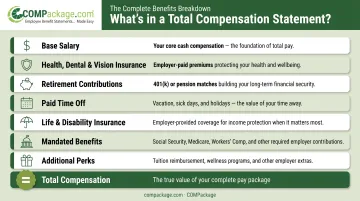
A complete statement covers:
- Base salary — the employee's annual or hourly pay
- Health, dental, and vision insurance — employer-paid premium contributions
- Retirement plan contributions — 401(k) match or other employer contributions
- Paid time off — vacation, sick days, and holidays expressed in dollar value
- Life and disability insurance — employer-paid premiums
- Mandated benefits — Social Security, Medicare, unemployment insurance, workers' compensation
- Additional perks — transportation, cell phone, meals, education, wellness programs, and more
The key distinction is framing. A pay stub shows deductions. A benefits statement shows the employer's full investment, and that number is almost always higher than employees expect.
Key Advantages of Providing a Benefits Statement
The advantages here aren't abstract. They show up in the metrics HR teams actually track: retention rates, satisfaction scores, and recruiting conversion rates. Here are the three that matter most.
Advantage 1: Closes the Compensation Perception Gap
According to the U.S. Bureau of Labor Statistics, private-industry benefits averaged $14.01 per hour in March 2026, representing 30.1% of total compensation. Put another way, employer-paid benefits equal roughly 43% of wages and salaries, a figure most employees would find surprising.
That gap between what employers spend and what employees perceive is the core problem a benefits statement solves. When an employee only sees their paycheck, the employer's investment in benefits is simply absent from their mental accounting.
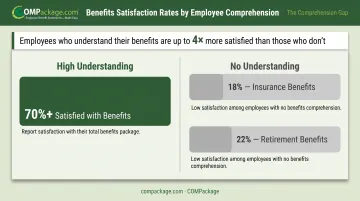
LIMRA research makes the satisfaction connection clear: more than 7 in 10 employees who understood their insurance and retirement benefits extremely well were very satisfied with those benefits. Among employees with no understanding, satisfaction dropped to 18% for insurance and 22% for retirement. That's a striking difference, and it points directly to comprehension, not generosity, as the variable.
This gap is widest for:
- Employees with rich benefit packages but modest base pay
- Workers in healthcare, nonprofits, or small businesses where benefits exceed what the salary alone suggests
- Any organization that has recently upgraded its benefits without communicating the change
Advantage 2: Reduces Turnover and Strengthens Retention
One of the most common reasons employees leave is a salary difference that, when total compensation is accounted for, may not actually exist. They compare their take-home pay to a competitor's advertised salary, and the math looks better somewhere else.
A well-timed benefits statement interrupts that pattern. When an employee can see the dollar value of their employer's retirement match, insurance premium contributions, and paid leave, the decision to leave for a $5,000 salary bump looks different.
The financial case for investing in retention is clear. SHRM reports that replacing an employee can cost 50%–200% of their annual salary, depending on their level. Even at the low end, that's a significant cost for a departure that better communication might have prevented.
LIMRA also found that more than 6 in 10 employees said their benefits made them more inclined to stay, with 41% saying much more inclined. The connection between understanding benefits and wanting to remain is consistent across studies.
KPIs most affected by improved benefits communication:
- Employee retention rate
- Voluntary turnover rate
- Cost-per-hire
- Average employee tenure
This advantage is highest during competitive labor markets, after salary freeze periods, and whenever employees are actively being recruited externally.
Advantage 3: Supports Recruiting and Strengthens Job Offers
A benefits statement isn't only useful for current employees. Sharing a total compensation breakdown during the offer stage reframes the conversation from "salary vs. salary" to "total investment vs. total investment", which is a much better conversation for employers with strong benefit packages.
EBRI's 2025 Workplace Wellness Survey found that 72% of employees cited health insurance as a top factor when deciding whether to stay at their current job or leave. Health coverage is often where small and mid-sized employers outperform on value, yet candidates making an offer comparison rarely see that value quantified.
Small businesses frequently have richer benefit packages relative to salary than larger corporations, but lose candidates who only compare headline salaries. A benefits statement corrects that by presenting the employer's true cost in a format candidates can actually evaluate.
COMPackage supports this workflow directly: employers can build a pro forma total compensation report for a candidate, present it at the offer stage, and reuse that same report for onboarding and annual reviews.
What Happens When Employees Don't Receive a Benefits Statement
The most common outcome is quiet dissatisfaction. Employees remain unaware of what their employer actually spends on their behalf, which leads them to feel underpaid, even when they aren't.
Without a benefits statement, the only reference points employees use are informal:
- Conversations with coworkers about pay
- Salary comparison sites
- Recruiter outreach from competitors
A Gartner survey of nearly 3,400 employees found that only 40% agreed their organization was transparent about the total value of their pay. Separately, Gartner found that nearly 43% of employees discussed compensation with colleagues in the same role. That means peer benchmarking is already happening. Employers just aren't participating in that conversation.
Over time, this gap compounds. Employers keep investing more in benefits. Employees keep feeling less valued. The result is higher turnover, lower morale, and a weakened employer brand. Those costs far exceed the effort of simply distributing an annual statement.
How to Get the Most Value from Benefits Statements
A benefits statement delivers maximum impact when it is personalized, timed to key moments, and put in front of employees. Don't bury it in a portal or hand it out once at onboarding and forget it.
Practical distribution guidance:
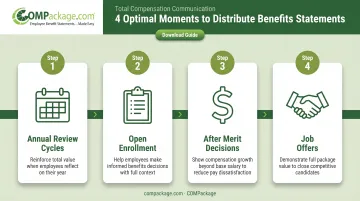
- Annual review cycles: Distribute statements alongside performance discussions to anchor compensation context
- Open enrollment: Reinforce the value of the package employees are re-electing
- After merit decisions: When raises come in smaller than expected, a total compensation view puts the full picture in context
- Job offers: Present a pro forma statement so candidates can compare your offer to a competitor's
Personalization matters. A generic summary covering "what most employees receive" is far less effective than a statement showing each person exactly what their employer contributes on their behalf.
For small and mid-sized businesses, tools like COMPackage make personalized statements practical to produce. The platform covers 80+ benefit categories and includes auto-calculators for mandated benefits, 401(k) contributions, and time-off values.
An Employee LOADER imports a full workforce from Excel in minutes. Reports support custom employer branding and can be updated and rerun all year at no extra cost, which helps when benefits change mid-year or a new hire joins. Plans start at $149 per year for teams of up to five employees.
Frequently Asked Questions
How do I get a statement of benefits?
Employees usually get benefits statements from HR during open enrollment or annual reviews. If you haven't received one, ask your HR contact or manager. Requesting one is reasonable if your employer doesn't provide them yet.
Can you provide an example of a benefits statement?
A typical statement lists base salary, employer-paid health premiums, retirement contributions, PTO valued in dollars, life insurance, and other perks. Each item appears in dollar terms, with total compensation at the bottom.
What is the difference between a benefits statement and a total compensation statement?
The terms are largely interchangeable. "Total compensation statement" is the more modern phrasing for the full employer investment, while "benefits statement" traditionally focused more narrowly on the benefits package.
How often should employees receive a benefits statement?
At minimum, annually — ideally timed with annual reviews or open enrollment. Employers should also distribute updated statements whenever significant benefit changes occur, such as a new health plan or an updated retirement match.
What information should be included in an employee benefits statement?
Include base salary, employer health/dental/vision contributions, retirement matching, PTO valued in dollars, life and disability premiums, mandated benefits like Social Security and Medicare, and any extra perks or non-cash benefits.
Can a benefits statement help with employee retention?
Yes. When employees see the full value their employer invests in them, they're less likely to leave for a slightly higher base salary elsewhere. That clarity alone strengthens retention without raising pay.