Most employees never see it that way. They look at their paycheck, see a number, and assume that number is their pay. Benefits averaged 31.6% of total compensation costs for civilian workers as of March 2026, according to the Bureau of Labor Statistics' Employer Costs for Employee Compensation report. That's $15.60 an hour in benefits on top of a $49.32 hourly total.
For private-industry workers, benefits made up 30.1% of total compensation — roughly $14.01 per hour. That's not a rounding error. It's nearly a third of an employee's earnings, hiding in places most people never check.
This article breaks down how compensation and benefits actually fit together, what counts as a benefit, how the IRS taxes different types, and how to calculate (and communicate) the real dollar value behind a compensation package.
Key Takeaways
- Benefits are indirect compensation—part of total rewards—even with no cash payout
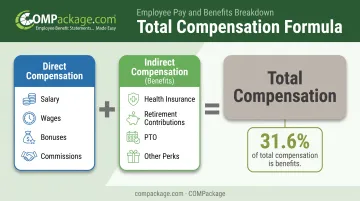
- Direct pay (salary, wages, bonuses, commissions) plus indirect pay (benefits) equals total compensation
- Some benefits are taxable; others are excluded from income entirely under IRS rules
- Employers who clearly show total compensation value retain talent and recruit more effectively
Compensation vs. Benefits: How They Fit Together
Compensation and benefits aren't competing categories. They're two halves of the same package: one visible on the pay stub, one often invisible.
What Is Considered Direct Compensation?
Direct compensation is money paid in exchange for work. It's what shows up as gross pay on a pay stub. According to SHRM's guide to total rewards strategy, direct compensation typically includes:
- Base salary — guaranteed regular pay
- Hourly wages — pay tied to hours worked
- Overtime pay — typically 1.5x the regular rate after 40 hours (FLSA)
- Bonuses — discretionary or performance-based
- Commissions — pay tied to sales or output
- Restricted stock units (RSUs) — equity that vests over time
What Is Considered a Benefit?
Benefits are the indirect, often non-monetary side of compensation. They don't show up as a line on a paycheck, but they still carry real dollar value. Common categories include:
- Health, dental, and vision insurance
- Retirement plans, including 401(k) matching
- Paid time off (PTO)
- HSA/FSA accounts
- Tuition assistance
Some benefits aren't optional. Legally required benefits include workers' compensation, unemployment insurance, FMLA leave, and Social Security/Medicare contributions. Discretionary benefits, such as wellness stipends or extra PTO, are ones the employer chooses to offer.
Why Benefits Count as Part of Total Compensation
The IRS doesn't treat benefits as optional extras. It treats them as compensation. Any fringe benefit an employer provides is taxable unless a specific law excludes it. That's the baseline assumption built into the tax code, not the exception.
Benefits cost the employer real money and deliver real value to employees through paid premiums, retirement contributions, and accrued leave. Add direct pay and indirect pay together, and you get total compensation (sometimes called "total rewards"): the complete picture of what an employee actually earns.
Common Types of Benefits Included in Compensation Packages
Benefits packages generally split into two buckets: health and financial security, and work-life and lifestyle.
Health and financial security benefits:
- Medical, dental, and vision insurance
- Life and disability insurance
- Retirement or 401(k) matching
- HSA/FSA contributions
Work-life and lifestyle benefits:
- PTO and paid leave
- Parental leave
- Flexible or remote work arrangements
- Tuition reimbursement
- Wellness programs
Not every valuable benefit fits neatly into a spreadsheet. Flexible scheduling, a four-day workweek pilot, or a supportive culture don't always come with a strict dollar figure attached.
That doesn't disqualify them. They're still part of the compensation story employers tell. They just need a different kind of communication than "here's $2,400 in health premiums."
Are Benefits Considered Taxable Income?
The default IRS position is blunt: fringe benefits are taxable unless the law specifically excludes them. That rule comes straight from IRS Publication 15-B, the Employer's Tax Guide to Fringe Benefits.
Taxable vs. Nontaxable Benefits
Common taxable benefits:
- Bonuses
- Personal use of a company vehicle
- Group-term life insurance coverage above $50,000
Common nontaxable benefits:
- Health insurance premiums
- HSA/FSA contributions (within IRS limits)
- Limited dependent care assistance
For 2026, employer HSA contributions stay tax-exempt up to $4,400 for self-only coverage or $8,750 for family coverage, with a $1,000 catch-up for employees 55 and older. Dependent-care assistance is excludable up to $7,500 ($3,750 if married filing separately).
Understanding Imputed Income
When a benefit is taxable, the fair market value of that benefit gets added to an employee's W-2 wages. This is called imputed income.
Say an employee drives a company car for personal errands. The IRS requires that personal-use value be calculated and added to wages, where it becomes subject to withholding like regular pay.
Group-term life insurance works the same way once coverage exceeds $50,000. The excess value, minus anything the employee paid toward it, lands in Box 1 of the W-2 and is subject to Social Security and Medicare taxes.
When you build total compensation figures, separate excluded benefits from amounts that will show up as imputed income on the W-2.
How to Calculate the True Value of Benefits Within Total Compensation
The basic formula looks simple on paper:
Total Compensation = Base Pay + Bonuses/Commissions + Dollar Value of All Benefits
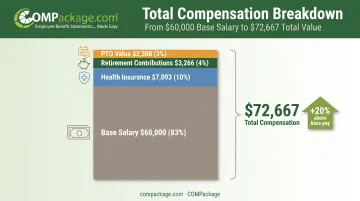
The math gets more interesting once you plug in real numbers. Take an employee earning $60,000 in base salary.
Per BLS employer cost averages, health insurance runs roughly $3.41 per hour worked, and retirement/savings contributions average around $1.57 per hour. Over a 2,080-hour work year, that's approximately:
- Health insurance: $3.41 × 2,080 = $7,093
- Retirement contributions: $1.57 × 2,080 = $3,266
Converting PTO Into a Dollar Value
PTO has real monetary value even though it's not a cash payment. The formula:
Annual Salary ÷ Total Working Hours × PTO Hours = PTO Dollar Value
For our $60,000 employee with 80 hours (10 days) of PTO:
$60,000 ÷ 2,080 × 80 = $2,308
Add it up: $60,000 base + $7,093 health + $3,266 retirement + $2,308 PTO = $72,667 in total compensation, more than 20% above base salary alone.
The Administrative Problem
Doing this math for one employee is manageable. Doing it for 150 employees, updating it every year as premiums and enrollments shift, is a different story entirely. Manual spreadsheet-based reporting inside most HR departments takes days or weeks to complete for an entire census.
COMPackage is built for that census-scale work. Instead of rebuilding the spreadsheet each year, the platform applies the same math across your full employee file in under 90 minutes.
What speeds it up:
- More than 12 automated calculators for mandated benefits, 401(k) matching, PTO, and insurance contributions
- Employee LOADER bulk import from Excel (minutes for 100 or 1,000 records, not 5–10 minutes each)
- Benefit details editable anytime during the subscription at no extra cost when premiums or contribution rates change
The payoff for doing this math at all: employees consistently underestimate what they actually earn. A Mercer-reported survey from the International Foundation of Employee Benefit Plans found employers broadly perceive low employee understanding of their own benefits. When benefits aren't itemized, they might as well not exist in an employee's mind.
Why It Matters: Communicating Total Compensation to Employees
An employee who only sees a base salary number has an incomplete picture. Incomplete pictures drive bad decisions.
Employees who understand their full compensation package, salary plus benefits, tend to report higher job satisfaction. They're also less likely to jump ship for a marginally higher base salary elsewhere, since they can see what they'd be giving up.
The recruiting angle matters just as much:
- Candidates comparing multiple offers often can't tell which package is stronger when benefits aren't quantified
- A $58,000 offer with $15,000 in benefits value can beat a $65,000 offer with thin benefits — but only if the candidate can see that math
- Presenting salary alongside a clear benefits dollar figure gives smaller employers a real edge against larger competitors with bigger base salaries
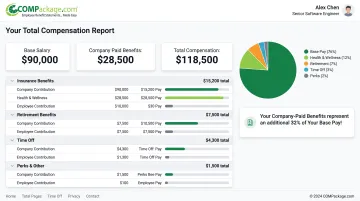
This is where COMPackage's self-service total compensation reporting fits for businesses in the 5-5,000 employee range. Each employee gets a personalized report showing only the benefits that apply to them, not a generic template listing perks they don't have access to.
For a five-person startup or a 500-person regional employer, that specificity turns a vague "great benefits" claim into something a candidate or current employee can evaluate.
Frequently Asked Questions
What is included in compensation and benefits?
Compensation includes direct pay: salary, wages, bonuses, and commissions. Benefits include indirect items like health insurance, retirement contributions, and PTO. Together, they form total compensation.
Are employer-paid benefits taxable?
Most employer-paid fringe benefits are taxable unless the IRS specifically excludes them. Common exceptions include health insurance premiums and qualifying retirement contributions.
Is PTO considered part of compensation?
Yes. PTO is indirect compensation with real monetary value. Calculate it as (salary ÷ total working hours) × PTO hours. It isn't paid in cash unless a company cashes out unused time.
What's the difference between direct and indirect compensation?
Direct compensation is cash paid for work performed, like salary and bonuses. Indirect compensation refers to non-cash benefits, such as insurance and retirement contributions, that still carry monetary value.
How do you calculate the dollar value of employee benefits?
Total the employer's costs for insurance, retirement contributions, and PTO, then add that sum to base salary. This produces a complete total compensation figure.
Do employee benefits count as income for tax purposes?
Many taxable benefits are treated as imputed income and added to W-2 wages, subject to standard withholding. Certain benefits, like health insurance premiums, are excluded from gross income by law.