This guide is for HR leaders building retention strategies, business owners setting pay structures, and employees trying to understand what they actually earn. Getting this right matters: it shapes recruiting offers, raise negotiations, and whether people stay or leave.
Below, you'll find what belongs in a total compensation package, how to calculate it step by step, and why communicating it clearly benefits both sides of the employment relationship.
Key Takeaways
- Total compensation combines direct pay, benefits, equity, and perks — not base salary alone
- A complete figure includes every recurring and periodic component paid over a full year
- Paycheck stubs show cash only, which hides a large share of an employee's real earnings
- Formal compensation statements boost retention and recruiting by making the full package visible
- Knowing your full package strengthens your position when negotiating raises or comparing offers
What Is Total Compensation?
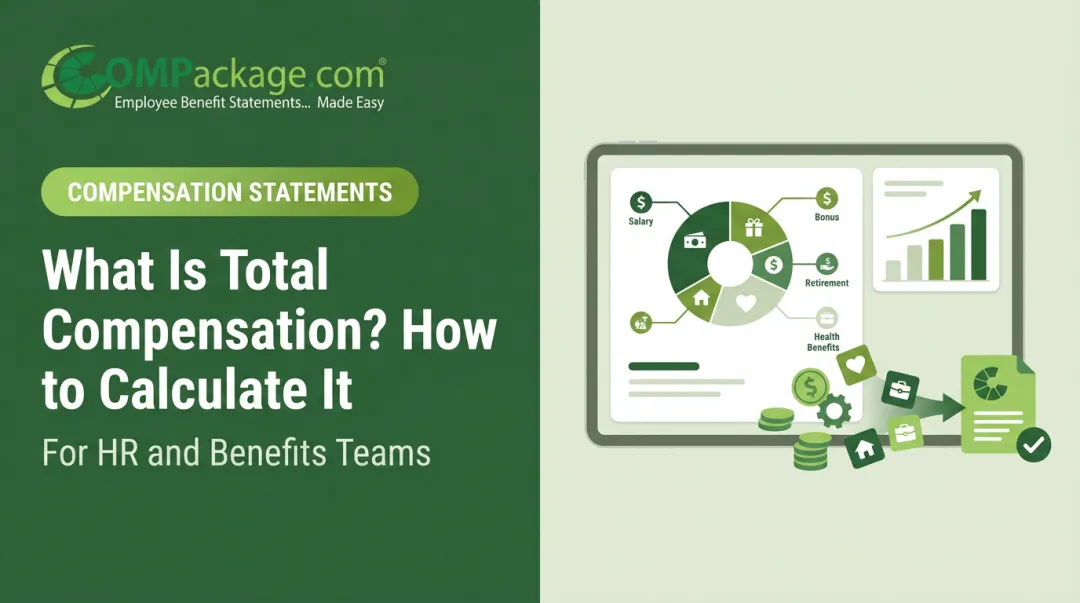
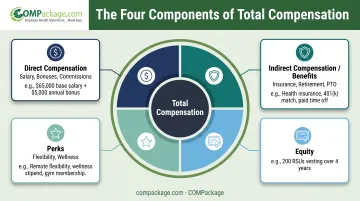
Total compensation is the sum of all direct pay, indirect benefits, equity, and perks an employee receives for their work. It's the number that answers the question, "What am I really being paid?"
For employees and employers, that full picture of employment value makes pay and career decisions much easier to get right.
Three terms get used interchangeably, but they aren't the same:
- Salary — fixed base pay only, before taxes or deductions
- Total compensation — salary plus bonuses, benefits, equity, and perks
- Total rewards — the broadest term, adding non-monetary factors like culture, career growth, and recognition
According to the Bureau of Labor Statistics' Employer Costs for Employee Compensation report, wages and salaries made up 68.4% of average U.S. civilian worker compensation as of March 2026, with benefits accounting for the remaining 31.6%. That's a national average, not a formula for any one employee's package, but it shows just how much value sits outside the base paycheck.
Direct Compensation
Direct compensation is the cash portion of pay. It includes:
- Base salary or hourly wage
- Commissions
- Bonuses (performance, signing, or retention)
- Overtime pay
This is the part employees see on every pay stub, which is exactly why it dominates how people think about their earnings.
Indirect Compensation and Benefits
Indirect compensation is non-cash value the employer provides. Common examples:
- Health, dental, and vision insurance
- Retirement contributions, such as a 401(k) match
- Paid time off (vacation, sick, holiday)
- Life and disability insurance
These costs are real money the employer spends on the employee's behalf. They just never touch a bank account directly.
Equity, Perks, and Non-Quantifiable Benefits
Equity compensation (stock options, restricted stock units, or profit sharing) ties an employee's financial outcome to company performance. It's most common in startups and publicly traded companies, but profit-sharing plans extend the concept to smaller businesses too.
Perks round out the package:
- Remote or hybrid work flexibility
- Wellness programs and stipends
- Professional development budgets
- Company phones, parking, or transportation allowances
Some perks don't carry a clean dollar figure, such as a flexible schedule or a strong team culture, but they still add real value that influences whether someone stays or goes.
Why Total Compensation Matters for Employers and Employees
For employees, seeing the full picture changes the conversation. A base salary that looks average suddenly looks a lot more competitive once you add employer-paid health premiums, a 401(k) match, and PTO value. That knowledge is leverage: it's hard to negotiate confidently for a raise if you don't know what you're already earning.
For employers, the incentive runs the other way. Communicating total compensation helps you:
- Attract candidates by showing the full offer, not just a base number that might lose to a competitor's higher salary
- Improve retention by making employees aware of the investment already being made in them
- Reduce turnover from misunderstandings, where people leave for a modest raise without seeing what they give up
The retirement benefit alone illustrates this. In WTW's 2024 U.S. survey, 55% of employees cited their retirement plan as an important reason to stay with their employer, up from 48% in 2017. That's a benefit employees rarely think about day to day, but it still shapes whether they walk out the door.
The problem is most companies only talk about salary. Pay gets discussed at hiring and at annual reviews; benefits get mentioned once during open enrollment and then forgotten. The value sits there, mostly invisible.
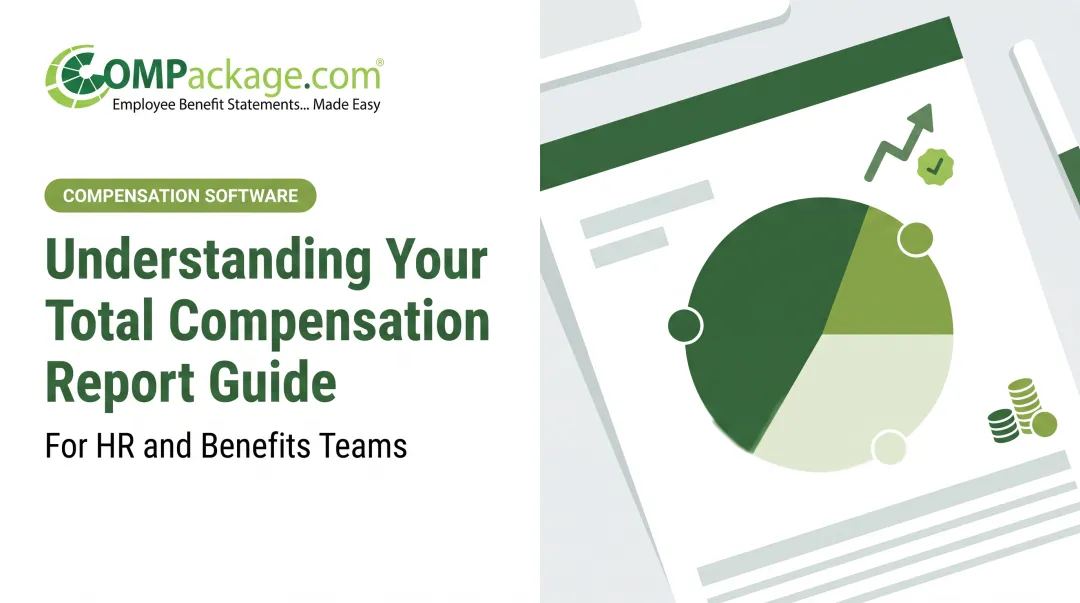
A formal total compensation statement fixes this. Software like COMPackage generates a personalized report showing every component (salary, insurance, retirement match, PTO value, perks) in one document. Employees see the number that matters, not just the number on their pay stub.
This is especially useful for small and mid-sized businesses. A larger competitor might advertise a higher base salary, but once benefits and perks are factored in, a smaller employer's total package can be just as strong, sometimes stronger. Without a clear statement, that story never gets told.
How to Calculate Total Compensation
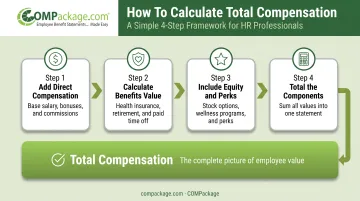
The formula is straightforward:
Total Compensation = Direct Pay + Indirect Compensation (Benefits) + Equity/Perks
The work starts with gathering every component an employee receives, whether it recurs every paycheck (salary) or shows up periodically (an annual bonus).
Step 1: Add Up Direct Compensation
Total the base salary or hourly wages, bonuses, commissions, and overtime pay earned over the year. This is the easiest step since it's already documented in payroll records.
Step 2: Calculate the Value of Benefits
Estimate the employer-paid portion of each benefit:
- Health, dental, and vision insurance premiums paid by the employer
- Retirement match contributions
- PTO value (daily pay rate × number of PTO days)
- Life insurance, disability coverage, and any other employer-funded benefit
Step 3: Include Equity and Perks
Add the annualized value of equity grants where applicable, then estimate a dollar value for perks: a wellness stipend, professional development budget, or phone allowance, for example.
Step 4: Total the Components
Add direct pay, benefits, and equity/perks together for the final figure. Here's a simple example using base salary and employer-paid benefits only:
| Component | Annual Value |
|---|---|
| Base salary | $56,000 |
| Employer-paid benefits | $32,138 |
| Total compensation | $88,138 |
In this example, benefits add nearly 57% on top of base pay, value the employee would never see on a pay stub alone.
Doing this by hand for one employee is manageable. Doing it for 50, 200, or 1,000 employees is not. That's where self-service total compensation report software helps. A platform like COMPackage can generate accurate reports for an entire employee census in hours, not the days or weeks manual calculation would take.
Key Factors That Influence Total Compensation Value
Not every compensation package is structured the same way. Several factors shape how the mix comes together:
Industry and role. Tech companies often lean on equity to attract talent when cash budgets are tight. Sales roles rely on commission, with structures like the 70/30 split determining how much pay is guaranteed versus performance-based.
Employment classification. Full-time versus part-time status, and exempt versus non-exempt classification under the Fair Labor Standards Act, determine benefits eligibility and overtime pay.
According to the Department of Labor's overtime fact sheet, exempt employees generally must earn at least $684 per week and meet specific duties tests. Job title alone doesn't decide it.
Company size, location, and market conditions. A business in a high-cost metro area may pay more in base salary but less generously in perks. A smaller company might do the reverse, offering flexible or voluntary benefits to compete without stretching payroll budgets.
Common Misconceptions About Total Compensation
A few misunderstandings show up constantly in pay conversations, and they're worth clearing up directly.
"Total compensation is just salary." It isn't. Salary is one line item. Benefits, bonuses, and equity are separate lines that often add 25–30% or more on top of base pay.
"A 70/30 split means 70% pay and 30% benefits." Not quite. In sales compensation, a 70/30 structure usually means fixed base pay (70%) versus variable bonus or commission (30%) within total target earnings. It is not the split between wages and benefits. Exact ratios vary by role and company.
"Every benefit is worth the same to every employee." What matters most depends on the person:
- A parent may value dependent healthcare coverage above almost anything else
- A recent graduate may value student loan assistance more than a 401(k) match
- An employee nearing retirement may prioritize the retirement plan over wellness perks
Equal sticker prices do not mean equal value. People weigh the same package very differently.
Frequently Asked Questions
What are the key components of total compensation?
Total compensation includes direct pay (salary, bonuses, commissions, overtime), indirect benefits (insurance, retirement contributions, PTO), equity where offered, and perks. That full package is the real value of the job, not base salary alone.
What does a 70/30 bonus structure mean?
It describes a pay split where 70% of target earnings comes from fixed base pay and 30% from variable bonus or commission. Exact splits vary by role, industry, and company policy.
Is total compensation the same as salary?
No. Salary is only the fixed base pay portion. Total compensation also includes bonuses, benefits, equity, and perks, which can add substantial value beyond the base number.
What is the difference between total compensation and total rewards?
Total compensation focuses on quantifiable pay and benefits. Total rewards is broader, adding non-monetary factors like company culture, career development, and recognition programs.
How often should total compensation be reviewed and communicated to employees?
At minimum, review and communicate it annually, ideally through a written or online total compensation statement. Ongoing conversations throughout the year reinforce the message rather than leaving it to a single meeting.
How do employers calculate the value of non-cash benefits?
Employers estimate the employer-paid cost or fair market value of each benefit, such as insurance premiums, retirement contributions, and PTO value, then add that total to direct pay to reach total compensation.