Introduction
Most employees see their paycheck and assume that's the whole story. They miss the employer-paid health insurance premiums, retirement contributions, paid leave accruals, and life insurance coverage that add real dollars to their total package. The result? A persistent perception gap — and a retention problem hiding in plain sight.
According to a 2024 American Staffing Association survey, 53% of U.S. workers felt their paycheck was not keeping up with inflation. Many of those employees may be receiving more than they realize — they just aren't seeing it.
Closing that gap starts with understanding what a compensation and reward system actually includes — and how to communicate it. This guide covers the core components, a step-by-step design process, common mistakes to avoid, and why transparency is just as important as the package itself.
Key Takeaways
- Effective compensation combines direct pay, indirect benefits, and non-financial rewards — all three matter
- Benefits represent roughly 30% of total compensation costs for private-sector employers, per BLS data
- Well-recognized employees are 45% less likely to leave, according to Gallup/Workhuman research
- Replacing an employee can cost 50–200% of their annual salary — making competitive compensation one of the highest-ROI decisions a company can make
- Sharing a total compensation statement can shift how employees perceive their pay — even before a single dollar of salary changes
What Is a Compensation and Reward System?
A compensation and reward system is the structured framework an organization uses to recognize and reward employees — covering the full spectrum of financial and non-financial value an employer provides. Done well, it aligns what the business needs (performance, retention, growth) with what employees value (security, recognition, flexibility).
Direct vs. Indirect vs. Non-Financial Compensation
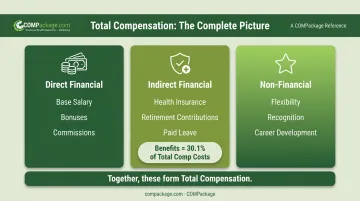
Direct financial compensation — the wages and variable pay employees see in every paycheck:
- Base salary or hourly wages
- Performance bonuses and commissions
- Overtime pay and shift differentials
Indirect financial compensation is what employees most frequently undervalue. According to the Bureau of Labor Statistics, benefits represent 30.1% of total compensation costs for private-sector employers — for every dollar in wages, employers spend roughly 43 cents more on benefits. This category includes:
- Employer-paid health, dental, and vision insurance
- Retirement plan contributions (401k matching, pension)
- Paid time off, disability coverage, and tuition assistance
Non-financial compensation can drive engagement as much as a pay raise — sometimes more:
- Flexible work arrangements
- Career development and mentorship
- Recognition programs and a strong workplace culture
Together, these three categories form total compensation — the complete picture of what an employee receives. Employees who understand this full picture report higher satisfaction, even without salary increases. Employers who fail to communicate it are leaving a powerful retention lever untouched.
Key Components of an Effective Compensation System
Competitive Base Pay
Gallup research found that 30% of the specific actions employees named for preventing their departure involved additional compensation or benefits — making base pay one of the most actionable levers in retention. That influence only holds when pay is grounded in real market data.
Salary benchmarking is how organizations keep base pay defensible and competitive. According to WorldatWork, 65% of organizations use market-based pay ranges, and the share with no formal compensation structure dropped from 17% in 2019 to just 9% in 2023 — a sign that structure matters.
Key benchmarking principles:
- Use at least two to three external salary surveys per role
- Segment data by industry, geography, and company size
- Update benchmarks annually — labor markets shift faster than most annual review cycles
Variable Pay and Incentives
For small and mid-sized businesses managing tight payroll budgets, variable pay is a practical way to reward results without permanently raising fixed costs.
Common variable pay structures include:
- Performance bonuses tied to individual, team, or company goals
- Profit-sharing that distributes a portion of company earnings to employees
- Commissions for sales and customer-facing roles
- One-time project-based incentives for specific outcomes
The right variable pay mix depends on the role. Sales and customer-facing positions typically benefit from higher variable ratios; administrative and technical roles generally need more base pay stability to reduce financial stress and maintain focus.
Benefits That Match Employee Needs
Health insurance, retirement plans, paid leave, and mental health support are baseline expectations today. What actually differentiates one employer from another is how well the benefits mix matches the workforce it serves.
A few practical examples:
- Younger employees often prioritize student loan assistance and professional development
- Mid-career employees tend to value family leave and healthcare quality
- Employees nearing retirement weigh retirement matching and financial planning support more heavily
Surveying employees annually is the most reliable way to align benefit spending with what people want. Offering benefits nobody values is a budget leak — and a missed retention opportunity.
Recognition and Non-Financial Rewards
Gallup and Workhuman tracking data found that well-recognized employees were 45% less likely to have changed organizations over a two-year period — and those receiving high-quality recognition were 65% less likely to be actively job searching.
The recognition gap is significant: only 22% of employees in 2024 said they received the right amount of recognition — unchanged from 2022.
Effective recognition includes both formal and informal channels:
- Peer recognition programs and formal awards
- Manager-led acknowledgment, especially timely and specific praise
- Career development pathways and visible promotion criteria
- Flexible scheduling as a day-to-day benefit
Non-financial rewards often cost little but deliver outsized engagement returns. COMPackage's total compensation reports support including non-quantifiable benefits — like flexibility, culture, and mentorship — alongside financial benefits, so employees see the complete picture in one document.
Transparent Pay Structures and Communication
A well-designed compensation system fails if employees don't understand it. Salary bands, bonus criteria, and promotion pathways need to be communicated clearly — not buried in a handbook nobody opens.
LIMRA's 2025 BEAT Study found that only 42% of employees receive a total compensation statement from their employer — meaning 58% never see a complete picture of what they receive. Among employees who do receive one, 68% understand their retirement benefits well or very well, compared to just 53% of those who don't.
Total compensation statements are the practical tool that makes transparency real. An effective statement should show each employee:
- Their full salary and any variable pay components
- Employer contributions to benefits, retirement, and health coverage
- Non-financial perks like flexibility, development opportunities, and wellness programs
COMPackage's self-service software lets businesses of any size generate personalized, detailed compensation reports in-house — showing employees their complete package without the cost of outside consultants.
How to Design a Compensation and Reward System Step by Step
Step 1 — Align Compensation to Business Objectives
Before choosing pay structures or benefit packages, define what the system needs to accomplish. A company competing on innovation rewards differently than one focused on high-volume customer service.
This is where compensation philosophy matters: the guiding set of principles behind every pay decision. A clear philosophy answers questions like:
- Do we lead the market, match it, or lag and compensate with other benefits?
- How much do we weight individual versus team performance?
- What signals does our pay structure send to candidates and current employees?
Without a clear philosophy, compensation decisions become reactive and inconsistent.
Step 2 — Conduct Market Research and Benchmarking
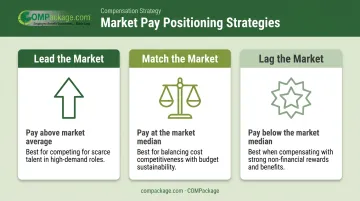
Research salary data by role, industry, and geography. Organizations generally choose one of three positions:
| Market Position | Approach | Best For |
|---|---|---|
| Lead the market | Pay above average | Competing for scarce talent |
| Match the market | Pay at median | Balancing cost and competitiveness |
| Lag the market | Pay below median | Compensating with strong non-financial rewards |
Establishing Internal and External Equity
Internal equity means similar roles receive comparable pay within the organization. When new hires earn more than long-tenured employees in equivalent roles, trust erodes quickly and experienced staff start updating their resumes.
External equity means pay rates are competitive with the broader labor market. Both must be managed simultaneously. Organizations that focus only on external competitiveness often create internal resentment; those focused only on internal parity can drift below market without noticing.
Labor markets shift quickly. Treat benchmarking as an ongoing discipline, not an annual checkbox — an outdated benchmark can be just as damaging as having none.
Step 3 — Balance Fixed and Variable Pay
Find the right ratio of stable base pay versus performance-contingent pay by role:
- Sales and customer-facing roles — higher variable ratio works; these employees expect and often prefer performance-based earning potential
- Administrative and technical roles — stable base pay matters more; financial unpredictability reduces focus and increases stress
- Leadership and management — blend of both, with variable pay tied to business outcomes
The goal is a ratio that feels fair to the employee and drives the behaviors the business actually needs. Lean too far toward variable pay and you create financial anxiety; eliminate it entirely and you lose a meaningful motivational lever.
Step 4 — Build in Communication and Visibility
The design phase isn't complete without a communication plan. Employees need to see not just their salary, but what the company contributes on their behalf — health insurance premiums, retirement matching, paid leave value, and employer-paid perks.
Total compensation statements consolidate all of this into a single personalized report. For organizations using COMPackage, the entire employee census can be processed in-house in a matter of hours, with reports covering both quantifiable and non-quantifiable benefits. Reports can be updated throughout the year, making compensation communication an ongoing practice rather than a once-a-year event.
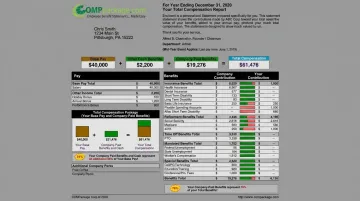
The retention impact is consistent: employees who understand their full compensation package report higher satisfaction with their benefits than those who only see a base salary figure.
Step 5 — Review, Refine, and Stay Compliant
A compensation system is never finished. Annual reviews should assess:
- Market competitiveness (are pay ranges still current?)
- Internal equity (are pay gaps emerging by tenure, gender, or role?)
- Legal compliance (are you meeting updated requirements?)
Key U.S. regulations every employer must account for:
- FLSA (Fair Labor Standards Act) — governs federal minimum wage, overtime pay, and worker classification. The 2024 independent contractor classification rule took effect March 11, 2024.
- Equal Pay Act / Title VII — require equal pay for equal work regardless of sex, race, and other protected characteristics. The EEOC enforces compensation discrimination claims under both.
- Pay transparency laws — SHRM reported in December 2024 that 14 states and 7 local jurisdictions require some form of pay transparency, with five more states adding requirements in 2025.
Pay equity audits should be conducted at minimum annually. Disparities that go unaddressed create legal exposure and destroy the trust that good compensation systems are designed to build.
Why an Effective Compensation System Matters
Retention, Recruitment, and the Cost of Getting It Wrong
Gallup's research puts replacement costs at 50–200% of an employee's annual salary — a conservative estimate. More recent Gallup data breaks this down further: replacing a frontline worker costs around 40% of salary; replacing a technical employee runs about 80%; replacing a manager or leader can reach 200%.
With the average U.S. voluntary turnover rate at 13% (Mercer, 2025), even a small reduction translates to significant savings. Competitive, transparent compensation is one of the most reliable levers for moving that number.
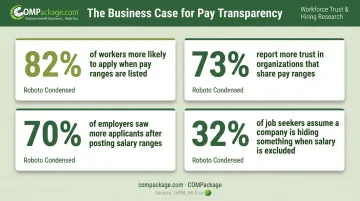
On the recruitment side, SHRM research found that 82% of workers were more likely to apply for a job with pay ranges listed, and 73% reported more trust in organizations that provided pay ranges. Among employers who posted salary ranges, 70% saw more applicants and 66% reported better applicant quality.
Engagement and Employer Brand
Employees who understand their compensation and feel fairly paid are more engaged, and engagement directly correlates with productivity. Financial rewards (bonuses, raises) and non-financial rewards (recognition, flexibility) work in tandem; removing either weakens the whole system.
A strong compensation reputation also reduces recruitment costs by attracting better-fit candidates from the start. Three factors drive this:
- Pay transparency is now legally required in a growing number of states, making it a baseline expectation
- Brand trust takes a hit when pay is absent from job postings — HR Dive found that 32% of job seekers assumed a company was hiding something when salary ranges were excluded
- Candidate quality improves when compensation is disclosed upfront, as SHRM data confirms
Common Pitfalls to Avoid When Building a Compensation System
Relying on Outdated Benchmarks
Salary data has a short shelf life in competitive labor markets. Using a three-year-old survey to set today's pay ranges is a fast path to falling behind. For high-demand roles, semi-annual benchmarking checks are worth the investment.
Overcomplicating the Structure
A system employees can't understand or explain won't drive the behavior it's intended to produce. Keep eligibility criteria simple, bonus calculations clear, and promotion pathways visible. Complexity signals either bureaucracy or obscurity — neither builds trust.
Failing to Communicate Total Compensation Value
This is the most common and most expensive mistake. Employees who only see their net paycheck consistently undervalue what they receive. LIMRA's 2025 data shows that employees who understand their benefits are over 70% likely to report being very satisfied — compared to just 18–22% of those with no benefits understanding.
Issuing total compensation statements regularly is the most direct fix. Tools like COMPackage make this practical for businesses of any size, generating personalized reports that show each employee the full employer investment — salary, benefits costs, retirement contributions, and perks — in-house without the cost of outside processing.
Frequently Asked Questions
What is the best compensation method?
There's no single best method. Effective compensation typically combines a competitive base salary with performance-based variable pay and meaningful non-financial benefits. The right mix depends on industry, company size, and role type — a commission-heavy structure that works for a sales team won't fit an engineering team.
What are the types of system compensation?
The three main types are: direct financial (salary, bonuses, commissions), indirect financial (health insurance, retirement plans, paid leave), and non-financial (recognition, career growth, flexible work). Most effective systems blend all three in proportions suited to their workforce.
What is an example of compensation payment?
A bi-weekly base salary is the most common form. Other examples include quarterly performance bonuses, employer contributions to a 401(k), overtime pay for hourly workers, and employer-paid health insurance premiums.
What is the difference between direct and indirect compensation?
Direct compensation covers cash payments: salary, wages, and bonuses. Indirect compensation includes non-cash value such as employer-paid health insurance, retirement contributions, and paid time off. Both count toward total compensation, though indirect benefits are frequently underestimated by employees.
How often should a compensation system be reviewed and updated?
At minimum, annually. High-demand or competitive roles may warrant semi-annual check-ins. Each review should assess market competitiveness, internal equity, legal compliance, and whether the current structure still supports business goals.
How can small businesses compete on compensation without large budgets?
By maximizing non-financial rewards (flexibility, recognition, career growth), tailoring benefits to what their specific workforce actually values, and clearly communicating total compensation. A small business that proactively shows employees every benefit and perk they receive — using an affordable tool like COMPackage — often looks far more competitive than it does on salary alone.