Introduction
Ask most employees what their job pays them, and they'll quote their salary. Maybe they'll mention health insurance. But for the majority of workers, that answer captures only a fraction of what their employer actually spends on them.
According to the U.S. Bureau of Labor Statistics, benefits account for 30.1% of total employer compensation costs in private industry — meaning nearly one-third of what companies spend on employees never registers in the employee's mind as "pay."
That gap has real consequences: workers feel underpaid, seek offers elsewhere, and leave jobs that actually compensate them well simply because no one showed them the full picture.
This article breaks down the five core components of a total reward package and explains what each one means for employees financially and personally. It also covers why communicating that full picture matters — for retention, satisfaction, and recruiting alike.
Key Takeaways
- Total reward encompasses five pillars: compensation, benefits, flexibility, recognition, and growth — not just salary
- Employer benefits contributions average $14.01 per hour, a figure most employees never see
- Well-recognized employees are 45% less likely to leave their organizations within two years
- Organizations with strong learning cultures retain employees at a 57% higher rate than average
- Sharing a clear total reward statement can shift employee perception of pay — without changing a single dollar of compensation
What Is Total Reward (and Why It's More Than a Paycheck)?
Total reward refers to the complete set of financial, non-financial, and developmental offerings an employee receives from their employer — compensation is just one piece of it. WorldatWork describes it as "a strategic portfolio of commitments employers deploy to attract, retain, and nurture a skilled, talented, and engaged workforce."
The distinction between total compensation and total reward matters here:
- Total compensation covers quantifiable monetary value: salary, bonuses, benefits, and retirement contributions
- Total reward includes everything above, plus non-monetary elements: recognition, flexibility, career development, and workplace culture
One without the other gives employees an incomplete picture. A company can offer below-market base pay but exceptional flexibility, mentorship, and growth — a combination many employees would choose if they understood the full value.
The problem is that most don't. WTW's 2025 research found that while 84% of employees reported feeling well-informed about their benefits, satisfaction with those benefits dropped from 66% to 61%. Awareness alone isn't enough. Employees need to understand the value — and that requires deliberate communication.
The 5 Core Components of a Total Reward Package
HR professionals and researchers broadly organize total reward around five pillars. Every employer's package looks different, but these five categories form the universal framework.
Compensation
Compensation includes more than the number on your offer letter. The full picture includes:
- Base/fixed pay: your guaranteed salary, regardless of performance
- Variable pay: bonuses or commissions tied to individual or team results
- Short-term incentives (STI): performance-linked payouts on annual or shorter cycles
- Long-term incentives (LTI) such as stock options, equity grants, or multi-year cash plans
According to WorldatWork's 2023 survey of 706 organizations, 99% of publicly traded companies offer STI programs and 93% offer LTI programs. Among privately held companies, STI adoption is still high at 92%, though LTI programs drop to 57%.
For employees evaluating a job offer, understanding the full compensation mix matters. A base salary of $85,000 with a 15% annual bonus target and restricted stock units represents meaningfully more total compensation than the base alone suggests.
Benefits
Benefits carry a direct dollar value that most employees consistently underestimate. The category spans two tiers:
Standard benefits: health, dental, vision, life insurance, disability coverage, and retirement plans
Emerging benefits: employee assistance programs (EAP), mental health support, pet insurance, pre-paid legal services, and wellness programs
The numbers tell the story:
- The average employer contributes $20,143 per year toward family health insurance premiums, against the employee's $6,850, according to KFF's 2025 Employer Health Benefits Survey
- The average employer 401(k) match is 6.3% of salary, per SHRM's 2025 data
- For a worker earning $70,000, that 6.3% match equals $4,410 in annual employer contributions — money many employees never consciously count as income

For an employee receiving employer-paid family health coverage plus a 401(k) match, those two benefits alone can add $24,000+ in annual value on top of their stated salary.
Work-Life Flexibility
Post-pandemic, flexibility has moved from a perk to an expectation. Gallup's 2024 data shows 60% of remote-capable employees prefer hybrid work, while fewer than 10% want to be fully on-site.
Flexibility encompasses:
- Remote or hybrid work arrangements
- Flexible or compressed schedules
- Paid time off — vacation, sick days, parental leave, sabbaticals
- Volunteer or community time
The monetary value is real. Harvard Business School research found 40% of workers whose jobs can be done remotely would accept a pay cut of at least 5% to avoid returning to the office full-time. That translates to thousands of dollars annually — reduced commuting costs, caregiving savings, and measurable quality-of-life benefits.
A flexible arrangement worth $5,000 in commuting savings and a 5% salary premium is real compensation. It just doesn't appear on your offer letter.
Performance and Recognition
Recognition is a component of total reward that salary cannot replace. Gallup and Workhuman's 2024 multi-year study of nearly 3,500 employees found:
- Well-recognized employees were 45% less likely to have changed organizations after two years
- Employees receiving quality recognition were 65% less likely to actively job search
- Employees with high-quality recognition were 9 times as likely to be engaged as those with none
Despite this, about 55% of U.S. employees currently receive no recognition — or recognition that fails to meet basic quality criteria.
Recognition takes several forms: formal programs (employee of the month, spot bonuses, peer-to-peer awards), performance-linked bonuses, and informal acknowledgment from managers. Together, they meet psychological needs that a paycheck simply cannot — the need to feel seen, valued, and connected to one's work.
Growth and Development
Development benefits are deferred financial reward. Skills gained through employer-funded training, tuition reimbursement, certifications, or leadership programs increase an employee's market value — sometimes by more than any raise would.
LinkedIn's 2024 Workplace Learning Report makes the retention case clearly: organizations with a strong learning culture have a 57% higher retention rate than the baseline, and 90% of organizations identify learning opportunities as their leading retention strategy.
Development offerings to look for include:
- Tuition reimbursement or education assistance
- Paid certifications and licensing
- Internal training and mentorship programs
- Leadership development tracks
- Access to senior leaders and cross-functional exposure
When a company funds your professional growth, it's investing in your future earning power. A single certification or advanced degree can shift your salary band permanently — that's a benefit with a decades-long return.
Financial Rewards vs. Non-Financial Rewards: Why Both Matter
A complete total reward package operates on three layers:
| Layer | Type | Examples |
|---|---|---|
| Foundation | Financial rewards | Base pay, bonuses, benefits, retirement contributions, stock |
| Middle | Non-financial rewards | Flexibility, recognition, culture, career opportunities |
| Top | Intrinsic rewards | Purpose, autonomy, mastery, personal growth |
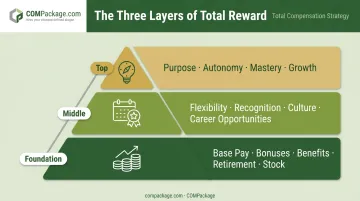
Financial rewards establish the baseline of security. Non-financial rewards address belonging and wellbeing. Intrinsic rewards — the sense that your work matters and that you're growing — drive the deepest engagement.
A McKinsey study of more than 5,700 employees across five countries found the top reasons for leaving were not feeling valued by the organization (54%), not feeling valued by managers (52%), and lacking a sense of belonging (51%). Employers, meanwhile, kept focusing on compensation and work-life balance — missing what employees actually needed.
Pay sets the floor, but it rarely seals long-term commitment. Gallup's 2025 data shows 50% of employees with strong work purpose were engaged, versus just 9% among those with low purpose. Employees in well-rounded organizations consistently report higher satisfaction — even when base salary isn't the highest available to them.
Why Employees Often Underestimate the True Value of Their Reward Package
Most employees practice salary tunnel vision — they track their take-home pay, glance at their health insurance card, and mentally ignore everything else. The result is a significant perception gap.
The BLS data makes this concrete: wages and salaries account for 69.9% of total compensation costs. Benefits represent the remaining 30.1%. For a typical employee, that means roughly $1 in every $3 their employer spends on them is invisible.
This gap creates real business harm:
- Employees feel underpaid relative to the market, even when they aren't
- They become more susceptible to competitor offers — even slightly higher base salaries look appealing when the full current package isn't visible
- Satisfaction declines despite employers investing more
Communication is a core part of the problem. WTW found that only 41% of employees felt their pay was aligned with their rewards — meaning employers are spending more while employees understand less.
Non-quantifiable rewards make this harder. Flexible schedules, learning opportunities, and team culture often rank among the most valued job elements, yet they're rarely presented alongside a dollar figure. When salary is the only number employees see, it becomes the only number they compare.
How Employers Can Bridge the Gap by Communicating Total Rewards Clearly
The standard tool for closing the perception gap is the total rewards statement (TRS) — an employer-issued document that itemizes every component of an employee's compensation package. A complete TRS typically includes:
- Base salary and variable pay
- Employer-paid benefits (with dollar values)
- Retirement contributions
- Employer-paid insurance premiums
- Paid time off value
- Non-monetary perks (flexible work, development programs, recognition)
Best practices for communicating total reward go beyond a once-a-year document:
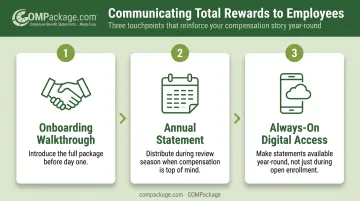
- Walk new hires through their full package during onboarding, ideally before their first day
- Distribute annual statements during review season, when compensation is already top of mind
- Make statements available in a digital format employees can revisit any time — not just during open enrollment
Transparency also strengthens recruiting. SHRM's 2023 research found that 82% of U.S. workers were more likely to consider a job when pay details were clearly communicated, and 73% were more likely to trust organizations that provided that information upfront. Candidates who see a fully itemized offer are better positioned to recognize the real value of accepting it.
For small and mid-sized businesses, generating personalized total compensation reports used to mean expensive service providers or manual spreadsheets. COMPackage was built to solve that directly — it's self-service software covering over 80 benefit categories, with 12 auto-calculators for common valuations and side-by-side documentation of both quantifiable and non-quantifiable benefits.
Employers can process reports for their entire workforce in a matter of hours, with no installation or outside vendor required.
Frequently Asked Questions
What are the five components of a total rewards package?
The five pillars are compensation, benefits, work-life flexibility, performance and recognition, and growth and development. Together, they represent both the financial and non-financial value of an employment relationship — well beyond salary alone.
What is the difference between total rewards and total compensation?
Total compensation covers quantifiable monetary value: salary, bonuses, retirement contributions, and benefits. Total reward is the broader concept, adding non-financial elements like recognition, flexibility, and development opportunities that affect satisfaction and retention without a direct dollar value.
Why is it important for employees to understand their total rewards?
Employees who only see their base salary frequently feel underpaid, even when their full package is competitive. Understanding total rewards leads to more accurate financial planning, stronger loyalty, and a more honest view of what a job actually offers versus what competitors are offering.
What is a total rewards statement?
A total rewards statement is an employer-issued document that itemizes every component of an employee's compensation: salary, employer-paid benefits, retirement contributions, insurance premiums, and perks. The result is one clear summary showing the full value of employment, not just the paycheck.
How do non-financial rewards affect employee satisfaction?
Non-financial rewards like flexibility, recognition, development, and culture satisfy psychological needs that salary cannot meet. Research consistently shows that employees who feel valued and supported are more engaged, less likely to leave, and more willing to go above and beyond.
How can small businesses compete on total rewards without large budgets?
Small businesses often already offer more than employees realize : flexible arrangements, genuine growth opportunities, and a close-knit culture that larger employers rarely match. The problem is rarely the package itself; it's that employees never see the full picture. Transparent reporting of the full package, including benefits values and non-monetary perks, is a low-cost way to change how employees perceive their compensation without changing the compensation itself.