The problem: that number often represents only 70% of what their employer actually spends on them. According to the Bureau of Labor Statistics, benefits account for 30.1% of private-industry employer compensation costs — meaning the average worker receives roughly $14 in benefits for every $32.60 in wages. When employees don't see that full picture, they feel underpaid. They browse job boards. Sometimes they leave — for a package that isn't actually better.
This guide defines what a compensation and benefits package includes, breaks down every major component, explains why the full picture matters, and shows how employers can close the perception gap.
Key Takeaways
- Total compensation includes base salary, bonuses, insurance, retirement contributions, paid leave, and legally required benefits
- Benefits typically add 30%+ to an employee's actual cost-to-employer beyond base wages
- Health insurance, retirement matching, and flexible work are among the most retention-critical benefits
- Only 38% of employees understand how their pay is determined — a communication problem, not a compensation problem
- Itemized compensation statements show employees the full value of everything they receive
What Is an Employee Compensation and Benefits Package?
A compensation and benefits package is the complete collection of financial and non-financial rewards an employer provides in exchange for work. It goes well beyond a base salary—and many employees still undervalue everything outside the paycheck.
Compensation refers to direct monetary payments: wages, salaries, bonuses, and commissions. Benefits are non-cash rewards and protections such as health insurance, retirement plans, paid time off, and more. Together, they form what's called total compensation: the full dollar value of everything an employee receives.
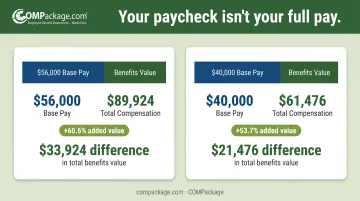
The gap between base salary and total compensation is often significant. COMPackage's reporting examples show this clearly.
One employee earning $56,000 in base pay received $89,924 in total compensation (a $33,924 difference). Another earning $40,000 had a total package worth $61,476. In both cases, the added value exceeded 50% of base salary.
Understanding total compensation matters for both sides of the employment relationship:
- Employers need to quantify and communicate the full package to compete for talent and reduce turnover
- Employees need accurate information to fairly evaluate their role and avoid making job decisions based on incomplete data
According to Morgan Stanley's workplace research, 91% of employees would consider switching jobs for financial benefits that better help them reach their goals. Total compensation—not base pay alone—drives those decisions.
This guide breaks down what belongs in a package, how total compensation is calculated, and how employers can communicate it clearly.
Types of Compensation
Direct Compensation
Direct compensation is the cash an employer pays to an employee. It has three main forms:
- Base pay: the fixed salary or hourly wage agreed upon at hiring; typically the largest single line item in any package
- Overtime pay: under the Fair Labor Standards Act, non-exempt employees must receive at least 1.5x their regular rate for hours over 40 in a workweek
- Variable pay: bonuses, commissions, and profit-sharing tied to individual, team, or company performance
Indirect Compensation
Indirect compensation has real financial value but doesn't show up in a paycheck. Common forms include:
- Equity and stock options: common in startups and growth-stage companies; employees share in long-term company performance
- Employer-paid benefit premiums: health, life, and disability insurance premiums paid on the employee's behalf
- Retirement contributions: 401(k) matching and similar deposits that build long-term employee wealth
Total Compensation
Total compensation adds it all up: cash pay plus the dollar value of equity, benefits, and other non-cash rewards. It's the number that answers, "What does this employee actually cost the company, and what does the employee actually receive?"
Most employees never see this number. They see their paycheck. That gap, between perceived pay and actual total compensation, is where retention problems start.
Types of Employee Benefits
Legally Required Benefits
Some benefits aren't optional. U.S. employers must provide:
- Social Security and Medicare (FICA) — 6.2% each from employer and employee for Social Security (up to the $184,500 wage base in 2026) plus 1.45% for Medicare
- Federal unemployment insurance (FUTA) — 6.0% on the first $7,000 of wages, usually reduced to 0.6% with the full state tax credit
- Workers' compensation — governed at the state level; requirements vary by state
- FMLA protections — employers with 50+ employees must provide up to 12 weeks of unpaid, job-protected leave for eligible employees
Beyond federal mandates, 14 states and the District of Columbia have enacted paid family leave programs, including California, New York, Washington, and Massachusetts. For employers in those states, paid leave is mandatory.
Health and Wellness Benefits
Health insurance is the benefit employees value most — and the one most likely to influence whether they stay or leave.
A 2026 Gallup/West Health survey found 24% of workers with employer-sponsored coverage stayed in a job they wanted to leave because they feared losing that coverage—retention driven by insurance dependency, not engagement or growth.
The financial stakes are high on both sides:
| Coverage Type | Average Annual Premium | Employer Pays | Employee Pays |
|---|---|---|---|
| Single | $9,325 | 84% (~$7,833) | 16% (~$1,492) |
| Family | $26,993 | 74% (~$19,975) | 26% (~$7,018) |
Source: KFF 2025 Employer Health Benefits Survey
Beyond medical coverage, employers commonly offer dental, vision, employee assistance programs (EAPs), and mental health coverage. SHRM data shows 90% of employers offered mental health coverage in 2024, up from 84% in 2019.
Retirement and Financial Security Benefits
Employer-sponsored retirement benefits add direct, compounding financial value that employees often underestimate.
Access and match rates show how much value is on the table:
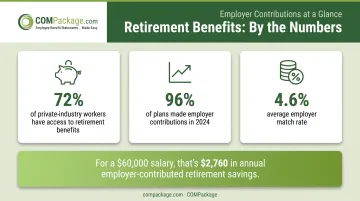
- 72% of private-industry workers have access to retirement benefits (BLS, 2025)
- 96% of Vanguard-recordkept plans made employer contributions in 2024
- The average promised employer match was 4.6% of pay
That 4.6% match isn't visible on a pay stub — it only shows up when someone adds it to total compensation. For an employee earning $60,000, that's $2,760 in employer-contributed retirement savings annually.
Other financial security benefits worth including:
- Life insurance (employer-paid premiums)
- Short- and long-term disability insurance
- Student loan repayment assistance (offered by 10% of employers per SHRM)
Work-Life and Lifestyle Benefits
Flexibility has shifted from a differentiator to a baseline expectation. Among remote-capable employees, 52% prefer hybrid work and 26% prefer fully remote arrangements (Gallup, 2025). Six in ten remote-capable workers say they'd actively seek another job if that flexibility disappeared.
Other benefits with strong retention value:
- Paid time off: vacation, sick leave, personal days
- Parental leave: 46% of employers offered paid parental leave in 2026, up sharply from prior years (SHRM)
- Professional development: 43% of employers offer tuition assistance
- Lifestyle perks: commuter benefits, childcare support, wellness stipends, and company-provided technology
These perks rarely appear on a pay stub, yet they represent real dollar value. A company-provided cell phone, free parking, and a $500 wellness stipend might add $3,000 or more to what an employee actually receives annually.
Why a Strong Compensation and Benefits Package Matters
A well-structured package does four jobs for the business: attract talent, retain employees, drive engagement, and support equity across the workforce.
Attracting Talent
Top candidates compare total packages, not just salaries. A company offering $70,000 with strong health coverage, a 5% 401(k) match, and four weeks of PTO can be more competitive than one offering $75,000 with bare-minimum benefits, but only if the full picture is communicated clearly.
Retaining Employees
Turnover is expensive. Gallup estimates replacement costs at approximately 200% of salary for leaders and managers, and 40% for frontline employees. Benefits that address employees' real-life needs (healthcare, retirement security, flexible schedules) are among the most effective retention tools available.
Engagement and Perceived Fairness
Pay transparency and fairness perceptions directly affect engagement. A Gartner study found only 32% of employees believe their pay is fair. Employees who perceived their pay as inequitable showed 15% lower intent to stay and were 13% less engaged than those who felt fairly compensated.
The same research found that educating employees about how their pay is determined correlated with a 10% increase in organizational trust and an 11% improvement in pay-equity perceptions. Those gains came from clearer communication, not a pay raise.
Equity and Inclusion
A thoughtfully designed package signals that the company values its full workforce. Benefits like parental leave, mental health support, student loan assistance, and flexible work arrangements address the real, varied needs of different employees. A uniform "everyone gets the same thing" approach often means some employees are underserved.
How to Communicate the True Value of Your Compensation Package
Here's the problem most HR teams face: they've invested heavily in building a competitive package, and their employees have no idea.
Only 38% of employees say they understand how their pay is determined. The package isn't the issue. Employees simply never see the full picture, and that has a direct fix.
What a Total Compensation Statement Is
A total compensation statement is a personalized, itemized report showing an employee the complete monetary value of their package:
- Base salary or wages
- Bonus and variable pay
- Employer-paid health, dental, and vision premiums
- 401(k) matching contributions
- Life and disability insurance premiums
- Paid time off (converted to a dollar value)
- Legally required contributions (Social Security, Medicare, workers' comp)
- Additional perks and non-cash benefits
When an employee sees that their $55,000 salary comes with $22,000 in employer-funded benefits, their perspective on their compensation changes. That's the purpose of the statement.
Making It Practical for Your Business
Many companies skip total compensation statements because they assume the process is expensive or time-consuming. Tools like COMPackage eliminate both barriers. The platform's self-service software lets HR teams generate professional, branded total compensation reports in-house, covering more than 80 benefit categories, without outside consultants.
An individual report takes roughly five to seven minutes to build. Entire employee populations can be loaded via Excel import, and you can finish setup plus first reports in a few hours. Pricing starts at $149 per year for up to five employees, scaling to $2,999 for unlimited employees, so even small businesses without dedicated HR staff can use it.
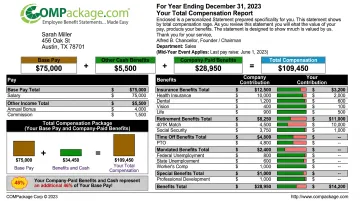
Used at hiring, during annual reviews, or any time an employee raises a compensation concern, these reports give employees the full picture and give employers credit for every dollar they're already spending.
Frequently Asked Questions
What is the difference between compensation and benefits?
Compensation refers to direct monetary payments: salary, hourly wages, bonuses, and commissions. Benefits are non-cash rewards like health insurance, retirement plans, and paid time off. Together they form total compensation: the complete value of what an employee receives.
Does compensation affect my benefits?
They're separate components, but often connected. Employer 401(k) matching contributions, for example, are typically calculated as a percentage of salary — so higher pay means a larger match. Some benefits also have eligibility rules tied to employment status or hours worked.
What benefits are employers required to provide by law in the US?
Federal law requires Social Security and Medicare contributions (FICA), federal unemployment insurance (FUTA), and FMLA leave protections for eligible employees at covered employers. Workers' compensation is mandated at the state level. Many states have also added paid family and medical leave requirements.
How do employers determine what to include in a compensation and benefits package?
Employers typically benchmark against industry and regional competitors, survey employee preferences, and balance desired offerings against available budget. The goal is a package that's competitive enough to attract and retain the talent they need.
What is a total compensation statement?
It's a personalized report that itemizes every element of an employee's package — salary, bonuses, employer-paid benefits, retirement contributions, PTO value — to show the full monetary value of their employment, not just their take-home pay.
How can small businesses compete on compensation and benefits?
Small businesses can compete with targeted high-value benefits—strong health coverage, flexible work, professional development—and by showing the full value of what they already provide. Tools like COMPackage make total compensation statements affordable so you can level the field without raising payroll.