This disconnect is the core problem total rewards compensation exists to solve. Most employees only see their paycheck — not the full picture of what their employer actually spends on them.
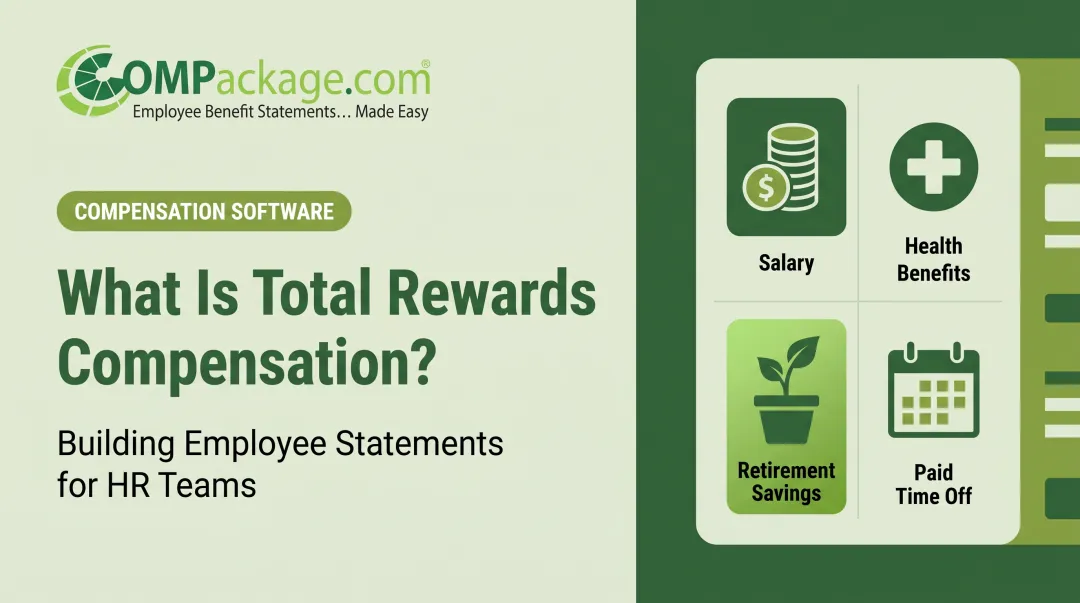
Total rewards compensation is the complete package of monetary and non-monetary value an employer provides: salary, yes, but also benefits, career development, recognition, wellness support, and workplace flexibility. This post covers what it includes, how it differs from total compensation, why it matters, and how to make it visible to the people it's meant to retain.
Key Takeaways
- Total rewards goes far beyond salary: it includes benefits, development, recognition, and well-being.
- Compensation is the financial piece; total rewards covers the full employee experience.
- Employees who can't see their full package are more likely to feel underpaid — even when they're not.
- Clear total rewards communication cuts turnover risk and strengthens retention and recruiting.
- Companies of any size can implement this strategy affordably, without expensive consultants.
Total Rewards vs. Total Compensation: What's the Difference?
These terms get used interchangeably, but they're not the same thing.
Total compensation is the financial component: everything measurable in dollars:
- Base salary and overtime pay
- Bonuses and commissions
- Employer contributions to health insurance, retirement plans, and other benefits
It's what shows up (at least partially) on pay stubs and W-2s. Quantifiable, concrete, auditable.
Total rewards is the broader picture. It includes everything in total compensation plus the non-financial elements that make a job worth keeping: career development programs, recognition and culture, workplace flexibility, and well-being initiatives. WorldatWork defines it as "a strategic portfolio of commitments employers deploy to attract, retain, and nurture a skilled, talented, and engaged workforce."
Why the Distinction Matters Practically
A company offering a mid-range salary but also providing full remote flexibility, tuition reimbursement, and comprehensive health coverage may be worth significantly more than a higher-paying competitor whose package stops at the base salary line. In competitive hiring markets, the employer that communicates the full picture wins candidates the other never even had a shot at.
There's a common trap here: many employers invest in total rewards but only talk about total compensation — usually in an offer letter, and rarely again. Current employees never get the same visibility, which creates a growing satisfaction gap over time. The employee forgets what they have. The recruiter reminds them what they're missing. That's a retention problem with a communication solution.
What Does Total Rewards Cover? The Five Core Components
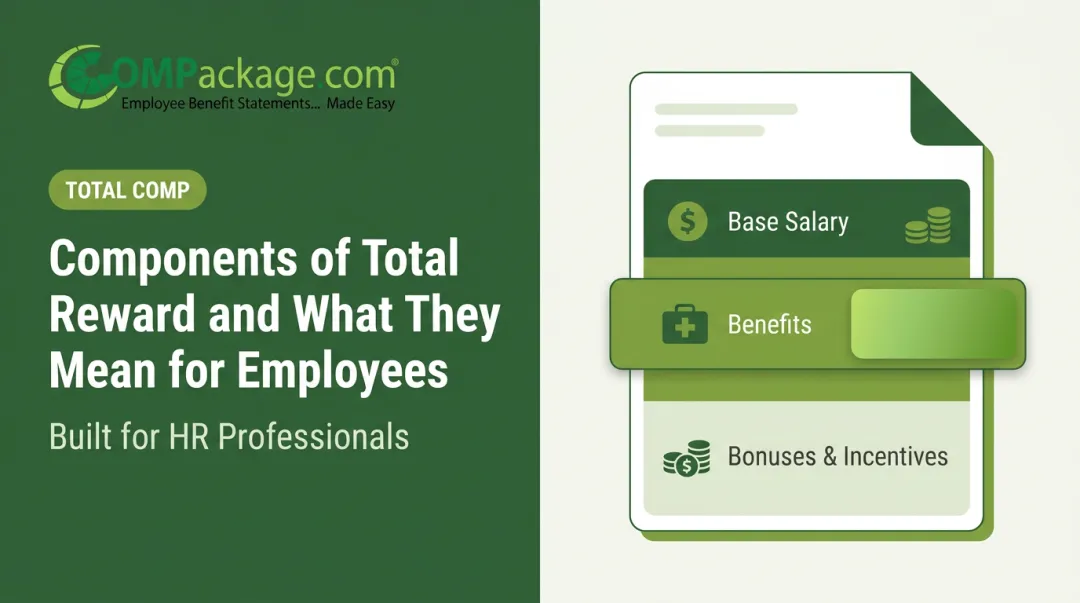
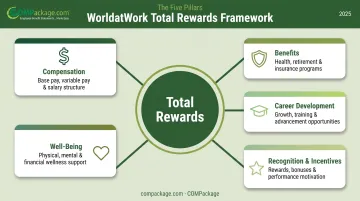
WorldatWork's Total Rewards model identifies five primary pillars: compensation, benefits, careers, recognition, and well-being. Each pillar breaks down into concrete rewards employees can see and use.
Compensation
The financial foundation. This includes:
- Base pay — the fixed salary or hourly rate
- Variable pay — bonuses, commissions, spot awards
- Long-term incentives — profit-sharing, stock options, equity
Compensation has to be competitive against market benchmarks to be credible. No amount of culture or flexibility fully overcomes a salary that's meaningfully below market. But when compensation is competitive, the other four pillars become differentiators.
Benefits
Benefits represent a substantial portion of what employers actually spend. According to the U.S. Bureau of Labor Statistics, benefits averaged $14.01 per hour worked for private-industry employees as of March 2026, or 30.1% of total compensation costs.
Core benefits employees expect:
- Health, dental, and vision insurance
- Life and disability coverage
- Retirement plans (401(k) with employer match)
- Paid time off, sick leave, and parental leave
These are baseline expectations. Gaps here disqualify many candidates before the conversation even starts.
Career Development
Learning opportunities have become a formal reward category, not just an HR afterthought. Gallup research found that 59% of Millennials called learning and growth opportunities extremely important when evaluating a new job, compared to 44% of Gen X and 41% of Baby Boomers.
Development rewards that resonate:
- Employer-funded training and certifications
- Tuition reimbursement programs
- Mentorship and coaching
- Clear, documented career pathing
For younger workers especially, "where will I grow?" ranks alongside "what will I earn?" in job evaluation.
Recognition and Incentives
Recognition works on two levels, formal and informal, and both matter.
Formal recognition includes performance bonuses, employee-of-the-month programs, and spot awards tied to specific achievements. Informal recognition is the daily manager acknowledgment, the peer shoutout, the handwritten note that costs nothing.
The business case is concrete: Gallup-Workhuman research tracked nearly 3,500 employees from 2022 to 2024 and found that well-recognized employees were 45% less likely to have left after two years. Recognition satisfies fundamental needs for esteem and belonging, and that translates directly into reduced turnover.
Work-Life Balance and Well-Being
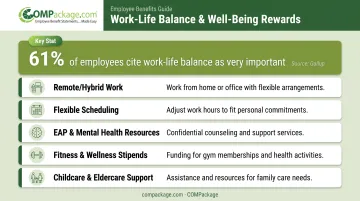
Well-being is now a decisive factor for candidates. In a Gallup survey of 13,085 U.S. employees, 61% cited better work-life balance and personal well-being as very important when considering a new job, second only to increased income at 64%.
What this category includes:
- Remote and hybrid work options
- Flexible scheduling and compressed workweeks
- Employee assistance programs (EAPs) and mental health resources
- Fitness reimbursements and wellness stipends
- Childcare and eldercare support
Expectations around flexibility and well-being have shifted for good. Employers who leave this pillar thin give candidates a clear reason to choose someone else.
Why Total Rewards Matters for Employers and Employees
Attracting Top Talent
Base salary alone isn't enough to land competitive candidates anymore. A Glassdoor survey found that 63% of job seekers specifically looked for benefits when evaluating a job posting, nearly as often as they looked for salary (67%). Another 59% of employees said benefits were an important reason they joined their current organization.
For smaller companies competing against larger employers with bigger compensation budgets, a well-constructed total rewards package, clearly communicated, levels the playing field. The company that can show a candidate what the full offer is worth, in writing, wins more often than the one that leads with a number alone.
Reducing Employee Turnover
Turnover is expensive. Gallup estimates replacement costs can run roughly half to twice an employee's annual salary, accounting for recruiting, onboarding, training, and lost productivity. Those figures make a clear business case for investing in retention.
Employees who understand the full value of their package are harder to poach. The recruiter's $8,000 pitch loses its pull when an employee can see, in black and white, that their actual total package is already ahead. Visibility is retention.
Boosting Engagement and Productivity
The engagement-performance link is well-documented. Gallup's 11th Q12 meta-analysis, drawing on 736 studies across 183,806 work units in 90 countries, found that top-quartile engagement units outperformed bottom-quartile units by 18% in sales productivity and 23% in profitability.
Total rewards strategies address both sides of motivation:
- Extrinsic: Compensation, bonuses, and benefits that meet financial needs
- Intrinsic: Recognition, development, and autonomy that support growth and belonging
Covering both is what separates a compensation strategy from a total rewards strategy.
Supporting Workplace Culture
A transparent, equitable total rewards program signals that the organization values people beyond their output. When employees see wellness support, flexibility, and recognition built into their package, that culture of care becomes a retention asset on its own.
It can reduce absenteeism and build loyalty that doesn't fold when a recruiter calls.
The Employee Perception Gap: Why Workers Undervalue Their Own Pay
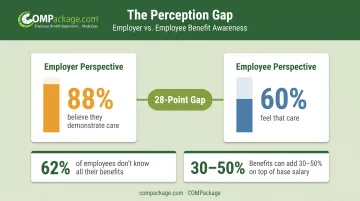
62% of employees are not completely confident they know all their available benefits, and 45% don't fully understand their benefits package, according to MetLife's 2024 Employee Benefit Trends Study.
Meanwhile, 88% of employers believe they demonstrate care for employees, but only 60% of employees feel that care. That's a 28-point gap.
The perception gap exists because employees focus on take-home pay. The employer's share of a health insurance premium? Invisible. The 401(k) match? Easy to forget. Three weeks of PTO? Rarely calculated in dollar terms. Taken together, these benefits can add 30–50% on top of base salary — and most employees have no idea.
Where the Gap Hits Hardest
Small and mid-sized businesses are particularly exposed. A few patterns show up again and again:
- Compensation conversations stay informal
- Benefits rarely get itemized in dollar terms
- No annual statement process closes the gap
Larger companies have used total compensation statements for years because the math works: show employees what they have, and they stop comparing salary to the market in isolation.
This approach is now accessible to businesses of any size. The cost of inaction—a departing employee, an accepted counteroffer, a candidate who chose a competitor—almost always exceeds the cost of communication.
How to Communicate Total Rewards to Employees
The Total Rewards Statement
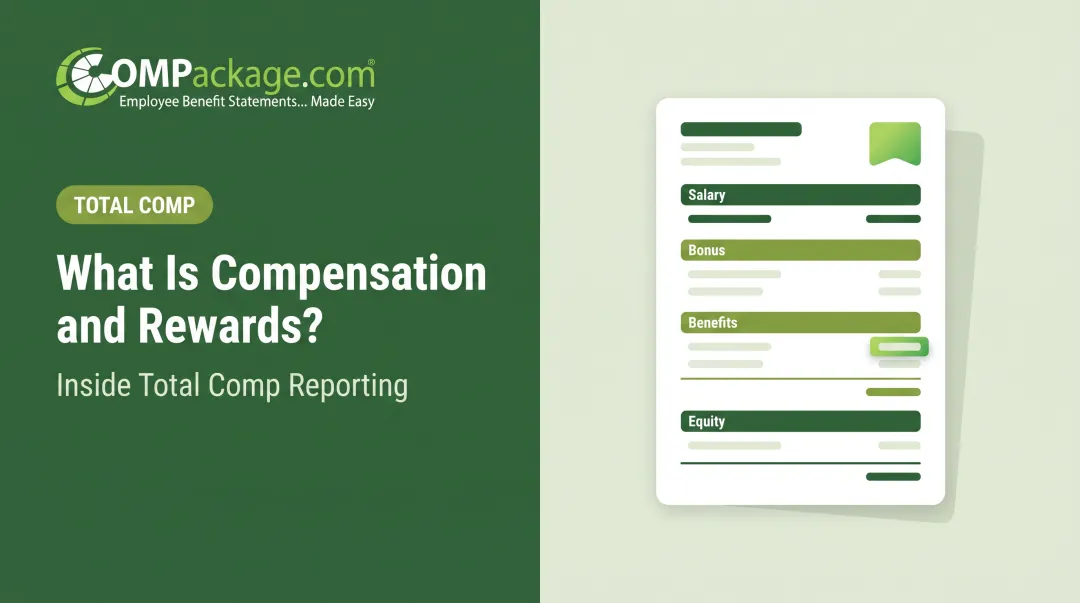
The most direct tool for closing the perception gap is the total rewards statement: a personalized, itemized summary of everything an employee receives. An effective statement includes:
- Base salary and any variable pay
- Employer contributions to health, dental, and vision insurance
- Retirement plan contributions and match
- Dollar value of paid time off
- Any allowances, perks, or stipends
- Non-quantifiable benefits (remote flexibility, professional development, wellness programs)
Review statements with employees at least once a year, ideally alongside performance reviews or open enrollment.
MetLife's research found that only 18% of employers say managers are well-equipped to discuss benefits with employees. The statement alone isn't enough—a short manager conversation on why each benefit exists sharply increases its impact.
Communication Best Practices
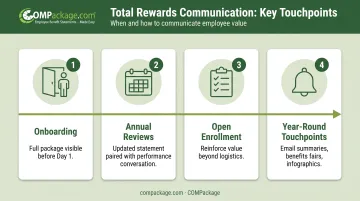
Total rewards communication works best when it's recurring, not a one-time event:
- Onboarding: New hires should see the full picture before their first day, not six months later
- Annual reviews: Pair the performance conversation with an updated total rewards statement
- Open enrollment: Use benefit selection periods to reinforce value, not just logistics
- Year-round touchpoints: Email summaries, benefits fairs, or simple infographics keep the package top of mind
Plain language matters. Employees who have to decode HR jargon to understand what they're receiving will disengage from the communication entirely.
Using COMPackage to Generate Total Rewards Reports
COMPackage is a self-service, cloud-based platform built to produce professional total rewards statements in-house. Built for organizations with 5 to 5,000 employees, it lets HR teams generate personalized total compensation reports for an entire workforce in a few hours, without external consultants.
Key capabilities:
- Over 80 preprogrammed benefit categories covering mandated benefits, insurance, time-off, retirement, and perks
- Employee LOADER for bulk import via Excel: map column headings, upload, and generate
- Automated calculators for 401(k), government mandatories, insurance, and time-off benefits
- Custom branding with company logo, colors, and report messaging
- Reports can be regenerated throughout the year at no additional cost
Pricing starts at $149 per year for companies with up to five employees and scales to $2,599 per year for unlimited employees. A Professional version at $2,999 per year supports HR consultants, benefits brokers, and accounting firms serving multiple clients, with unlimited reports across an unlimited client base.
Companies including Coca-Cola, Harley-Davidson, and Westfield Bank have used the platform. A 30-day satisfaction guarantee backs every plan if you want to evaluate fit before committing.
Frequently Asked Questions
What does total rewards cover?
Total rewards covers all monetary and non-monetary value an employer provides, organized into five categories: compensation (salary, bonuses), benefits (health, retirement, PTO), career development, recognition and incentives, and well-being and work-life balance programs.
What is the difference between total rewards and total compensation?
Total compensation refers to the financial components of a package — salary, bonuses, and employer benefit contributions. Total rewards is the broader umbrella that also includes non-financial elements like career development, recognition programs, and workplace flexibility.
Why is total rewards important for employee retention?
Employees who understand the full value of their package, not just their take-home pay, are less likely to feel underpaid and more resistant to outside offers. That visibility directly reduces the turnover risk that costs employers half to twice an employee's annual salary.
What should be included in a total rewards statement?
A complete statement should include base salary, bonuses, employer contributions to health and retirement benefits, the dollar value of paid time off, any perks or allowances, and non-quantifiable benefits like remote flexibility or professional development access.
How can small businesses implement a total rewards strategy?
Start by auditing your current offerings, identifying any gaps, and documenting the full package clearly. Tools like COMPackage make it affordable to produce professional total compensation reports in-house, without outside consultants' cost or wait time.
How often should companies communicate total rewards to employees?
At minimum annually, tied to performance reviews or open enrollment. New hires should receive a statement during onboarding, and any significant benefit change warrants an updated communication so employees always have an accurate picture of what they're receiving.