Two pressures are driving this shift simultaneously. First, an expanding web of state laws now mandates salary disclosures, with five new states joining the list in 2025 alone. Second, employees increasingly expect openness not just about base pay, but about the full value of what they receive. Staying ahead of both—legally and culturally—has become a competitive necessity, not a nice-to-have.
This guide covers the key trends reshaping compensation transparency and the practical steps employers can take to get ahead of them.
Key Takeaways
- Pay transparency laws now cover 14–15 states plus Washington, D.C., with more enacted each year
- 80% of employees underestimate their total compensation when benefits aren't communicated
- 91% of job seekers are more likely to apply to roles that include salary ranges
- Wage transparency can reduce gender pay gaps by 7–40%, depending on implementation depth
- Tools like COMPackage let employers generate full compensation statements in-house — no consultants required, starting at five employees
The Growing Legal Mandate for Pay Transparency
Pay transparency laws didn't exist before 2019. Colorado broke ground with the first salary range posting requirement, effective January 2021. By early 2023, seven states had active laws, with at least 15 more considering legislation. Fast forward to mid-2025: roughly 14–15 states plus Washington, D.C. have enacted pay transparency requirements, with five new states taking effect in 2025 alone—Illinois, Minnesota, New Jersey, Vermont, and Massachusetts.
What These Laws Actually Require
Requirements vary meaningfully by state, but most laws share a common core:
- Salary range posting in job listings (the most common requirement)
- Disclosure to applicants upon request, often before an offer is made
- Pay scale disclosure to current employees in some states (California, Washington)
- Pay data reporting to state agencies for larger employers (California, Illinois, Massachusetts)
Employer size thresholds also vary. Vermont applies to employers with just 5+ employees; Minnesota requires 30+; Illinois and Massachusetts set the bar at 15+ and 25+ respectively. Washington's penalties reach $5,000 per applicant for violations, while California and Illinois can hit $10,000 per violation for repeat offenses.
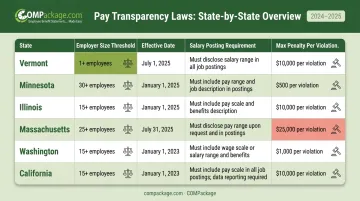
Twenty-two states have also enacted salary history bans, which typically accompany pay transparency laws and prevent employers from anchoring offers to prior compensation—a practice that compounds existing pay inequities.
Why Compliance Urgency Is High
For employers hiring across state lines or managing remote workers in multiple states, multi-jurisdiction compliance is complex. A single job posting visible in California, New York, and Colorado simultaneously must meet the requirements of all three states. Penalties escalate with repeated violations, and enforcement activity is increasing as these laws move past their initial rollout phases.
The practical response is to audit your job postings now, map which states apply to your workforce, and build salary band documentation before a complaint—not after. Companies that do this work proactively avoid scrambling when a new state law takes effect or a regulator comes knocking.
From Salary Ranges to Total Compensation Transparency
There's an important distinction that most legal frameworks ignore entirely.
Pay transparency means disclosing salary or wage ranges—what most state laws address. Compensation transparency goes further: it means showing employees the complete dollar value of everything they receive, including health insurance premiums, retirement contributions, paid leave, bonuses, equity, and perks.
The Perception Gap Is Bigger Than Most Employers Realize
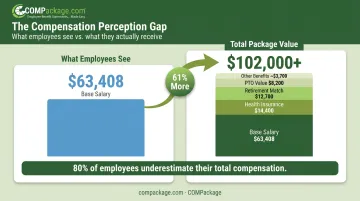
According to BLS data, employer benefit costs average $14.41 per hour for civilian workers—representing 31.2% of total compensation. For a typical salaried employee, that means benefits add 30% or more above base salary in real value. Yet research shows 80% of employees underestimate their total compensation when those contributions aren't explicitly communicated.
The gap shows up concretely in COMPackage's own reporting examples: an employee earning $63,408 in direct pay may actually receive a total package worth over $102,000 when employer benefit contributions are factored in—nearly $39,000, or 61% more than what appears on a paycheck.
Why This Matters More Than the Salary Range Alone
Most employees only see their base pay on a pay stub. They don't see the employer's share of health insurance ($3,500+ annually on average), the retirement match they're receiving, or the value of paid time off accruing in the background. When a competitor recruiter calls with an offer $5,000 higher in base salary, that employee has no framework for evaluating what they'd actually be giving up.
This is the problem total compensation statements solve. A well-structured statement itemizes every component of the package in dollar terms, transforming an abstract benefits list into a concrete number employees can compare.
Making Total Compensation Statements Accessible
Many employers now provide these statements annually or at key moments like hiring and performance reviews. Traditionally, generating them required HR consultants or benefits brokers at significant expense—but that cost barrier has largely gone away.
Self-service platforms like COMPackage allow employers with as few as five employees to generate fully customized statements in-house. Key capabilities include:
- 80+ preprogrammed benefit categories covering standard and niche benefits
- Bulk data import via Excel for fast setup across your employee census
- 12 automated calculators to reduce manual entry time
- Non-quantifiable perks like flexible scheduling and remote work shown alongside dollar figures
- Company-branded reports with logo and color scheme
- Personalized output—only the benefits relevant to each employee appear on their statement
Transparency as a Recruitment and Retention Strategy
Compensation transparency isn't just a compliance issue—it's a talent lever.
The Recruitment Impact
The data on candidate behavior is striking:
- 91% of job seekers are more likely to apply when salary ranges are posted
- Nearly 50% won't apply at all if no pay range is disclosed
- 66% of organizations that include pay ranges in postings report improved applicant quality
Posting salary ranges pre-screens for fit. Candidates who apply already know the compensation is in their range, which reduces wasted time on both sides and improves offer acceptance rates. It also signals organizational fairness, which matters most to top candidates who have options.
The Retention Angle
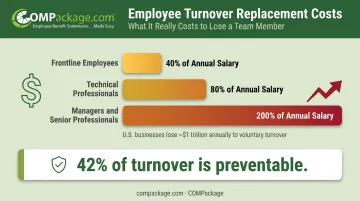
Turnover is expensive. According to Gallup, replacing a manager or senior professional costs roughly 200% of their annual salary; technical professionals run about 80%; frontline employees around 40%. SHRM puts the range at 50% to 200% depending on role level. U.S. businesses collectively lose approximately $1 trillion annually to voluntary turnover—and Gallup estimates 42% of that turnover is preventable.
When employees fully understand what their total package is worth—including the employer's $8,000+ annual health insurance contribution, the 401(k) match, and accrued PTO—they're far less likely to leave for a base salary bump of $5,000 or $6,000 that doesn't actually make them whole.
56% of workers say they'd consider leaving if salary concerns are ignored. But compensation dissatisfaction is frequently a perception problem, not a real compensation problem. Employees who don't know what they're receiving can't properly value it.
The Internal Culture Benefit
That perception problem doesn't stay contained to individual employees. When pay structures go undiscussed, rumors fill the gap.
Organizations that openly communicate pay structures, promotion criteria, and compensation philosophy build trust. Opacity creates rumors, resentment, and the assumption that "someone else is paid more for the same work." That assumption is corrosive to engagement, even when it's wrong.
Closing Wage Gaps Through Pay Equity
Compensation transparency is one of the most direct tools for surfacing and reducing pay disparities.
In 2023, women working full-time earned 82.7 cents per dollar earned by men. For Black women, that figure drops to 69.8 cents; for Hispanic women, 57.8 cents. The controlled gender pay gap—comparing people in the same role with the same qualifications—still sits at $0.99 per dollar, unchanged for five years according to Payscale.
How Transparency Disrupts the Cycle
Without a published salary range, candidates anchor their expectations to previous earnings. Women and people of color, who are statistically more likely to have been underpaid in prior roles, tend to request lower starting salaries as a result—perpetuating the gap even in well-intentioned organizations.
Research across multiple countries shows consistent results when pay information becomes public:
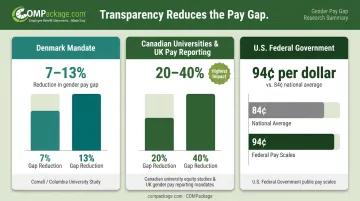
- A Cornell/Columbia study of Denmark's transparency mandate found it reduced the gender pay gap by 7–13%
- Studies of Canadian universities and UK pay reporting policies found reductions of 20–40%
- In the U.S. federal government, where pay scales are public, women earn 94 cents per dollar compared to men—versus 84 cents nationally
The Regulatory Intersection
Pay equity and pay transparency are increasingly treated as connected legal obligations, not separate ones. Illinois requires employers with 100+ employees to obtain an Equal Pay Registration Certificate and submit pay data. Massachusetts and California mandate annual pay data reporting to state agencies. Employers building transparency programs should treat pay equity audits as part of the same initiative rather than deferring them to a separate compliance workstream.
Best Practices for Implementing Compensation Transparency
Audit Your Internal Pay Structures First
Before disclosing anything externally, ensure your pay practices can withstand scrutiny. Publishing salary ranges when internal pay is inconsistent or poorly documented doesn't create transparency—it creates problems. Only 54% of organizations conduct pay equity audits annually, and 43% still don't share pay band information with employees, according to SHRM.
Fix internal inconsistencies first. Document the rationale for pay decisions. Establish clear salary bands tied to roles, levels, and skills. Only then does external disclosure become a competitive advantage rather than a liability.
Build Salary Bands with Clear Movement Criteria
Effective transparency requires infrastructure. Salary ranges without defined criteria for movement within them generate confusion and manager-employee conflict. Structured pay bands also give managers the confidence to have direct compensation conversations—instead of hedging or deferring to HR.
Provide Total Compensation Statements Regularly
Annual statements—or statements given at hire, on promotion, or during performance reviews—close the perception gap. Every employer should communicate the full dollar value of the package, not just base salary.
Tools like COMPackage make this practical for organizations of any size — generating reports for an entire employee census in hours via bulk Excel import, with no consultants required. Reports can be updated throughout the year as benefits change, and the Professional version supports multi-client management with statements in any language or currency.
Train Managers to Have Compensation Conversations
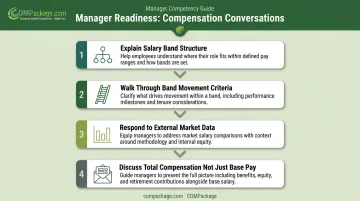
The most common failure point in transparency initiatives is managers who can't explain how pay decisions are made. Invest in coaching before rolling out any transparency program. At minimum, managers should be prepared to:
- Explain how salary bands are structured and where each role sits
- Walk through the criteria for moving within or between bands
- Respond confidently when employees reference external market data
- Discuss total compensation, not just base pay
Monitor Regulatory Changes by Jurisdiction
With new laws taking effect annually, compliance monitoring requires an ongoing process, not a one-time review. Companies with employees across multiple states or remote workers need a system for tracking obligations by jurisdiction, auditing job postings, and reviewing onboarding and promotion processes for gaps. Laws like Connecticut's expanded requirements (effective October 2026) and ongoing state-level activity mean the landscape will keep shifting.
Frequently Asked Questions
What is compensation transparency?
Compensation transparency is the practice of openly communicating the full value of an employee's total rewards package: salary, benefits, retirement contributions, bonuses, and perks, not just base pay. It goes beyond posting salary ranges to show employees the complete picture of what they receive.
What is the difference between pay transparency and compensation transparency?
Pay transparency refers to disclosing salary or wage ranges, which is what most state laws currently require. Compensation transparency is broader—it means showing employees the actual dollar value of their entire package, including health insurance premiums, employer retirement contributions, paid leave, and other benefits that don't appear on a paycheck.
Which states require salary transparency?
As of mid-2025, active laws include California, Colorado, Connecticut, Hawaii, Illinois, Maryland, Minnesota, New Jersey, New York, Nevada, Rhode Island, Vermont, Washington, Massachusetts, and Washington D.C. Effective dates and employer size thresholds vary by state, and the list continues to grow each year.
Is compensation transparency good or bad?
The benefits are well-documented—better hiring, stronger retention, reduced pay gaps, and improved employee trust. The main challenges involve preparation: organizations that expose pay inconsistencies without fixing them first, or deploy transparency without training managers, tend to create friction rather than confidence.
How does compensation transparency help reduce employee turnover?
Employees who see the full value of their package—including thousands of dollars in benefits beyond base pay—are far less likely to leave for a marginally higher salary elsewhere. Total compensation statements bridge the gap between what employees think they earn and what they actually receive, making it harder for competitors to recruit them away based on base salary alone.