Confusing the two carries real business risk. If you market a "total rewards package" but only deliver a paycheck and health insurance, candidates feel misled. If you build a robust rewards strategy but never explain the compensation math behind it, employees still feel underpaid.
Here's why the gap matters more than most HR teams realize: according to the Bureau of Labor Statistics' Employer Costs for Employee Compensation report, wages and salaries make up just 68.4% of what civilian employers actually spend on their workforce. The other 31.6% goes to benefits that employees frequently don't see, understand, or value correctly. That's nearly a third of total spend hiding in plain sight.
Key Takeaways
- Total compensation is the financial value of pay, bonuses, and benefits combined
- Total rewards is the broader strategy combining pay with growth, recognition, and culture
- Younger employees weigh development and flexibility heavily, but financial pressure hasn't gone away
- Communicating compensation clearly is a practical first step before building a full rewards strategy
Total Rewards vs Total Compensation: Quick Comparison
Before going deeper, here's how the two concepts stack up side by side.
| Factor | Total Compensation | Total Rewards |
|---|---|---|
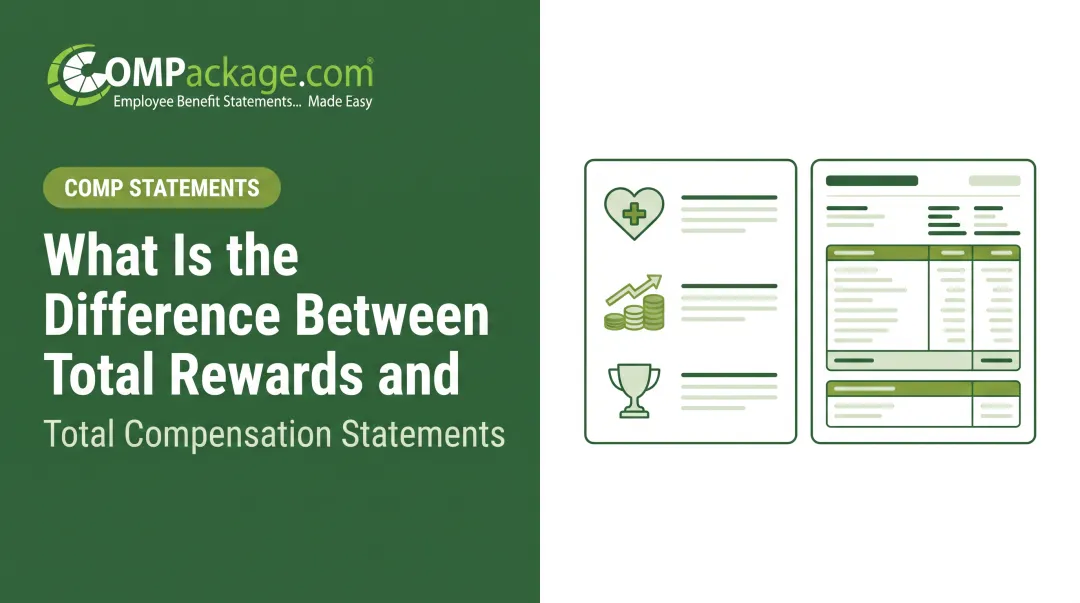
| Scope | Financial value of pay and benefits | Compensation plus career, recognition, well-being, and culture |
| Core Components | Salary, bonuses, equity, retirement match, insurance | All of the above, plus development, flexibility, recognition programs |
| Primary Purpose | Show true earning value; support benchmarking | Attract and retain talent through the full employee experience |
| Communication Frequency | Typically annual (year-end or open enrollment) | Ongoing, woven into everyday employee experience |
| Cost/Effort to Administer | Lower: often a single report or statement | Higher: requires programs, policies, and continuous investment |
Total compensation is a snapshot. Total rewards is a running narrative. Neither replaces the other.
What Is Total Compensation?
Total compensation is the complete financial value an employee receives for their work, not just the number printed on their paycheck. HR and finance teams rely on it constantly for benchmarking pay against market rates and for budgeting workforce costs accurately.
Core components typically include:
- Base salary or hourly wages
- Variable pay, bonuses, and commissions
- Equity or stock options (where applicable)
- Employer retirement contributions (401(k) match, pension)
- Health, dental, and vision insurance, expressed in dollar value
- Paid time off and other quantifiable perks
Most employees underestimate this number. They see their paycheck and assume that's their pay, full stop. They rarely calculate what the employer is spending on their behalf in insurance premiums, retirement matching, or other benefits, and no one is showing them the math.
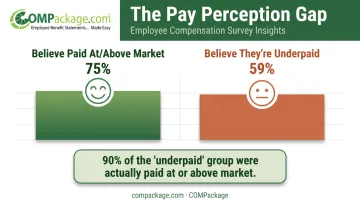
That's where a documented statement makes a difference. PayScale research covering more than 500,000 workers, reported by SHRM found job satisfaction hit 75% among employees who believed they were paid at or above market, versus just 59% among those who believed they were underpaid.
The catch: nearly 90% of the "underpaid" group was actually paid at or above market. They simply didn't know it.
Where Total Compensation Fits in HR Processes
Total compensation statements show up most often at:
- Annual performance reviews and open enrollment
- Compensation benchmarking exercises
- Offer letters for new hires
- Internal pay equity audits
Professional services firms, finance companies, and mid-sized employers competing on comp benchmarking treat these statements as standard practice, not a nice-to-have. If a perception gap like the one PayScale documented is costing you satisfaction and quiet turnover, the fix is clearer math, delivered where employees can see it, not a bigger raise.
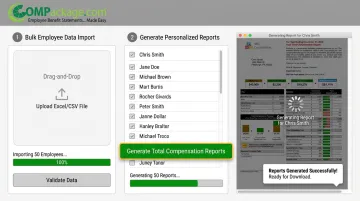
COMPackage's self-service Total Compensation Report software solves exactly this problem. Companies with anywhere from 5 to 5,000 employees can generate branded, personalized statements in-house, without hiring a benefits consultant.
Businesses import employee data in bulk, edit benefit details anytime, and rerun reports at no extra charge, so the statement stays accurate even after benefits change mid-year.
What Is Total Rewards?
Total rewards is the strategic umbrella over everything in total compensation, plus the non-financial elements that shape how someone actually experiences their job.
Core components typically include:
- Everything listed under total compensation
- Learning and development programs
- Flexible work arrangements
- Recognition programs
- Wellness initiatives
- Purpose-driven culture and mission alignment
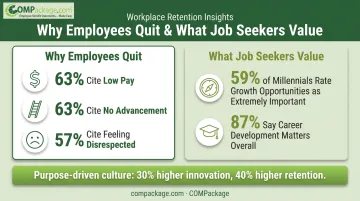
Why does this matter beyond the paycheck? Because pay isn't the only reason people quit. Pew Research Center's study of 2021 job leavers found 63% cited no opportunities for advancement and 57% cited feeling disrespected at work, numbers that rival the 63% who cited low pay itself. Total rewards directly addresses the advancement and respect gaps that a bigger paycheck alone won't fix.
Development matters just as much on the recruiting side. Gallup found 59% of millennials rated learning and growth opportunities as extremely important when job hunting, and 87% said career development mattered to them overall. That's a sharp contrast to older generations and a clear signal for anyone building an employee value proposition aimed at younger talent.
None of this means pay stops mattering. Deloitte's Gen Z and Millennial Survey found over half of both groups had delayed major life decisions due to financial pressure. Total rewards complements strong pay. It doesn't substitute for it.
Where Total Rewards Fits in the Employee Lifecycle
Total rewards shows up continuously, not once a year:
- Recruiting and employer value proposition (EVP) messaging
- Onboarding and first-90-day experience
- Engagement surveys and pulse checks
- Retention strategy and stay interviews
Mission-driven nonprofits and tech startups often lean hardest on total rewards because they can't always win on salary alone. Deloitte's research on purpose-driven companies associated a strong mission with 30% higher innovation and 40% higher retention, showing that culture and purpose measurably affect performance, even if they can't fully offset a below-market paycheck.
Total Rewards vs Total Compensation: Which Should You Prioritize?
The right starting point depends on a few practical factors:
- Company size and budget flexibility: smaller businesses often need low-cost wins before large program investments
- Workforce demographics: younger, growth-focused teams respond differently than tenured, benefits-focused teams
- Immediate goal: recruiting, retention, or simply closing a pay-perception gap
Lead with total compensation communication if you need to show employees or candidates the full financial value of their offer quickly and affordably. A statement can be built and distributed in-house within days, not months.
Invest in full total rewards if you're competing against employers who can outspend you on salary. Flexibility, growth paths, and recognition become your differentiators.
These aren't competing choices. The strongest employee value propositions layer total rewards on top of a clearly communicated total compensation foundation. You can't sell someone on career growth and culture if they don't already understand and trust the paycheck underneath it.
A Common Scenario: Turning Compensation Communication into Retention
Picture a 120-person regional business paying competitively but still losing people to companies offering barely more in salary. Exit interviews kept surfacing the same complaint: employees didn't feel their benefits were worth much.
Leadership's fix centered on visibility, not a bigger paycheck. Instead of hiring a consultant, they used a self-service platform like COMPackage to generate personalized, branded reports for the entire employee census in-house—a process that took less than a day instead of weeks of consultant back-and-forth.
Each report reflected the specific benefits each employee actually used, such as insurance, retirement match, paid leave, and the dozens of smaller perks that never show up on a paystub. Employees suddenly saw a number well above their salary alone.
The takeaway: you don't need a fully built total rewards program to move the needle on retention. Communicating total compensation clearly is often the fastest, cheapest win available.
If you're evaluating where the compensation communication gap sits in your own organization, a self-service reporting tool is a reasonable first step before scaling into a broader total rewards strategy.
Conclusion
Total compensation is the financial foundation. Total rewards is the complete experience built on top of it. Neither one works well in isolation.
Businesses that communicate total compensation clearly see stronger retention and better recruiting outcomes immediately. COMPackage makes that clarity simple, letting HR teams build detailed statements in-house within hours.
Companies that further invest in total rewards, such as growth paths, recognition, and flexibility, build loyalty that outlasts the next competing offer. Start with the math. Build the experience on top of it.
Frequently Asked Questions
What is the difference between total compensation and total rewards?
Total compensation covers the financial value of pay and benefits. Total rewards is the broader framework that also includes career development, recognition, and well-being alongside that financial foundation.
What do I put for total compensation?
Include base salary, bonuses or variable pay, equity if applicable, employer retirement contributions, and the dollar value of health and insurance benefits. Together, these show an employee's true earning value.
Is total rewards the same as employee benefits?
No. Benefits are just one component of total rewards, which also includes recognition programs, development opportunities, and culture-related offerings.
Does total compensation include salary?
Yes. Base salary is the foundational component of total compensation, sitting alongside bonuses and other financial benefits like retirement contributions and insurance value.
How often should companies communicate total compensation to employees?
At least once a year, ideally timed to year-end or open enrollment. Update the statement whenever benefits change so the numbers stay accurate.
Why do small businesses need a total rewards or total compensation strategy?
Smaller businesses often can't compete on salary alone. Communicating full compensation, then building rewards around it, helps them compete for and retain talent affordably.