Benefits now make up nearly 30% of total compensation for private industry workers — 30.1%, to be exact, according to the Bureau of Labor Statistics' Employer Costs for Employee Compensation report. That means almost a third of what a company spends on its people never shows up on a paycheck.
With competition for skilled workers still fierce, HR teams and small business owners need an affordable way to show employees — and candidates — the real value of what's on the table. That's where total compensation statements come in.
This article covers what these statements include, how to calculate one, a worked example, and how to build and deliver one without hiring a consultant.
Key Takeaways
- A total compensation statement shows the full dollar value of pay plus benefits, not just salary or wages
- Pay stubs cover one period’s gross-to-net wages; total compensation statements show the full annual employer investment
- Accurate, clearly framed statements strengthen retention and recruiting
- Self-service software now lets small and mid-sized businesses build these reports in-house, no consultant required
What Is a Total Compensation Statement?
A total compensation statement is a document that itemizes the full value of an employee's pay and benefits, typically issued once a year. It's not a pay stub. A pay stub shows gross-to-net wages for a single pay period. A total compensation statement zooms out to show everything an employer spends on that employee over a full year.
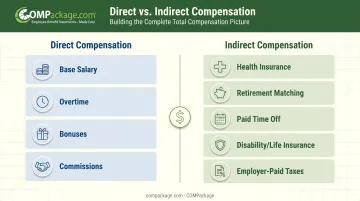
The California Employers Association describes it as combining two buckets:
- Direct compensation — wages, overtime, bonuses, and commissions
- Indirect compensation — insurance, retirement contributions, paid leave, and employer-paid taxes
Terminology: HR professionals often use "total compensation statement" and "employee benefit statement" interchangeably. Technically, a benefit statement can focus only on benefits, while a total compensation statement combines pay and benefits into one figure.
Neither should be confused with an ERISA Summary Plan Description, which explains plan rules and legal rights rather than dollar values.
Most companies time distribution around merit increases, bonus payouts, or open enrollment, when employees are already thinking about their compensation.
What's Included in a Total Compensation Statement?
A useful statement covers everything the company pays for on an employee's behalf, whether or not the employee ever sees the money directly.
Direct Compensation
This is the cash portion employees already recognize:
- Base salary or hourly wages
- Overtime pay
- Bonuses (holiday, performance, or discretionary)
- Commissions and other incentive pay
Indirect Compensation and Benefits
This is where most of the "hidden value" lives. Core categories include:
- Medical, dental, and vision insurance
- Retirement contributions, such as 401(k) matching
- Paid time off (vacation, holiday, and sick time)
- Disability and life insurance
- Employer-paid payroll taxes (Social Security and Medicare) and workers' compensation
Beyond the basics, more employers are adding perks that carry real dollar value:
- Tuition assistance and wellness programs
- Stock options or equity grants
- HSA or FSA contributions
- Company vehicle, phone, or parking/transportation stipends
- Childcare assistance and pet insurance
Those dollars add up. 61% of employers now offer HSAs, with average maximum employer contributions of $1,059 for individual coverage and $1,735 for family coverage, per SHRM's 2025 Employee Benefits Survey.
The rule of thumb: if it costs the company money and benefits the employee, it belongs on the statement.
One caveat: statements should be personalized. If an employee doesn't have dependent coverage, that line item shouldn't appear on their report. A generic company-wide template packed with benefits they don't receive only creates confusion.
How to Calculate Total Compensation (With an Example)
The basic formula is straightforward:
Total Compensation = Base Pay + Bonuses/Commissions + Employer-Paid Benefits + Employer Taxes and Contributions
The tricky part is valuing benefits that don't have an obvious dollar figure attached.
Paid time off: Multiply the employee's daily or hourly rate by their eligible PTO days. A $25/hour employee with 10 PTO days gets $2,000 in PTO value (based on an 8-hour day).
Equity or stock options: Separate the grant details (number of shares, vesting schedule) from the estimated dollar value. Disclose that the value can fluctuate with the stock price. Never present equity as a fixed, guaranteed number.
401(k) match: Use the plan's actual match formula. Vanguard's research found the median employer match promised across plans is 4.0% of pay, though formulas vary widely by employer.
A Worked Example
Here's how it looks in practice, based on a sample compensation statement:
| Component | Value |
|---|---|
| Base pay | $56,000 |
| Additional income (bonuses) | $1,786 |
| Employer-paid benefits | $32,138 |
| Total compensation | $89,924 |
In this example, benefits and additional income add more than 60% on top of base pay. Employees would never see that value on a pay stub alone.
Common pitfalls to avoid:
- Using inconsistent valuation methods across categories (hourly rate for PTO, but a rough guess for insurance)
- Overstating benefit value beyond what the plan documents actually show
- Skipping a disclaimer that plan documents govern actual terms, not the statement
Reliable numbers matter here. If an employee cross-checks their statement against their benefits portal and the figures don't match, the whole document loses credibility.
Why Total Compensation Statements Matter
For employees, seeing the full package changes how they value their job. Many workers genuinely don't know what their benefits cost the company: insurance premiums, retirement matches, and payroll taxes are invisible line items most people never see broken out.
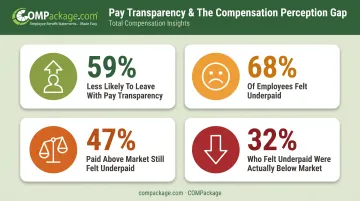
For employers, transparency around pay pays off. Payscale's 2025 Fair Pay Impact Report found that employees at organizations with high pay transparency were 59% less likely to leave than those at organizations without it.
The same report highlights a fairness gap worth closing:
- 68% of employees felt underpaid, even when pay was at or above market
- 47% of employees paid above market still believed they were underpaid
- Only 32% of those who felt underpaid were actually below market
That's a massive perception gap. A total compensation statement doesn't fix pay equity issues on its own. It does give employees accurate information to judge their situation, instead of guessing or comparing notes with a coworker on a different benefits package.
Potential Drawbacks and How to Address Them
Total compensation statements aren't risk-free. Here's what can go wrong, and how to head it off.
Employees compare notes and get upset. If Sarah in accounting sees her coworker's statement is $8,000 higher for a similar role, that's a problem you want to know about before rollout, not after. Run a pay equity review before distributing statements company-wide, and fix disparities first.
Employees assume it's a manipulation tactic. Even after equity is solid, some workers will read the statement as an excuse to skip raises ("look how much we already give you"). Frame it as an education tool, clearly label which benefits are guaranteed versus optional, and keep that conversation separate from raise discussions.
Calculation errors undermine trust. Accuracy matters just as much as framing—one wrong number and employees stop believing the rest of the document. Use standardized formulas for every employee, label estimates as "estimated employer cost," and note that actual plan documents govern final terms.
How to Create and Deliver an Effective Total Compensation Statement
How you build and deliver the statement matters as much as the numbers on it.
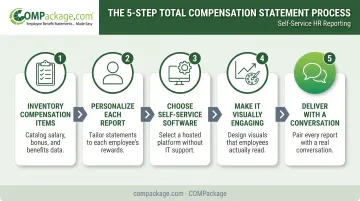
- Inventory every compensation item. List all direct pay and indirect benefits your company offers before building a single report.
- Personalize each report. Show only the benefits an employee is actually enrolled in — not a generic template with irrelevant line items.
- Choose self-service software over spreadsheets or consultants. Manual spreadsheets break down at scale, and consultants add ongoing cost. Self-service tools like COMPackage let teams with 5 to 5,000 employees build statements in-house, including:
- Bulk Excel import via Employee LOADER so a full census loads in minutes
- 80+ preprogrammed benefit categories, from health insurance to pet insurance
- Auto-calculators for mandated benefits, 401(k), PTO, and insurance
- Same-day generation for the full census, often under 90 minutes after data load
- Annual pricing from $149 for small teams, scaled by employee count
- Make it visually engaging. Add company branding, a short leadership message, and simple charts. Distribute statements around bonus cycles or open enrollment, when pay is already top of mind.
- Don't just email a PDF. Have managers walk employees through their statements individually. A document nobody explains gets skimmed and forgotten. A five-minute conversation makes the numbers stick.
Frequently Asked Questions
What is a total compensation statement?
A total compensation statement shows an employee's full pay and benefits value for a given period, typically a year. Unlike a pay stub, it captures both direct wages and indirect employer costs like insurance and retirement contributions.
How do I calculate my total compensation?
Add base pay, bonuses and commissions, employer-paid benefits, and employer taxes and contributions. See the calculation section above for a full worked example with real numbers.
What is an example of a total compensation statement?
In the worked example above, $56,000 in base pay plus $1,786 in additional income and $32,138 in employer-paid benefits totals $89,924. Actual line items vary by employee and employer.
Are employers legally required to provide total compensation statements?
No. In the U.S., these statements are not legally mandated. They're a voluntary best practice that more employers are adopting to improve retention and recruiting.
How often should companies distribute total compensation statements?
Annually is standard. Most companies time distribution around bonus payouts, merit increases, or open enrollment, when employees are already focused on their pay and benefits.
What's the difference between a total compensation statement and a pay stub?
A pay stub covers gross-to-net wages for one pay period. A total compensation statement summarizes an entire year's worth of direct pay plus indirect benefits in a single dollar figure.