Introduction
Most employees only see their paycheck. They don't see the $9,325 their employer pays annually toward their health insurance premium, the 401(k) match accumulating on their behalf, or the dollar value of the PTO sitting in their account. The result? They underestimate what they're actually earning — and that gap costs employers in retention and engagement in ways that are entirely avoidable.
According to EBRI's 2025 Workplace Wellness Survey, U.S. workers estimate that benefits represent just 16% of their total compensation, when the actual figure is closer to 30%. A well-crafted employee benefits statement closes that gap directly.
This guide covers everything HR teams need: a clear definition of benefits statements, what to include, real-format samples, and a five-step writing process you can use immediately.
Key Takeaways
- A benefits statement documents total compensation beyond base salary, including benefits, perks, and employer contributions.
- Employees who understand their full compensation are more likely to feel valued and stay.
- Effective statements combine quantifiable benefits with non-quantifiable perks like flexibility and development opportunities.
- HR teams can simplify creation using consistent templates and dedicated compensation reporting tools like COMPackage.
What Is an Employee Benefits Statement?
An employee benefits statement is a formal document that summarizes every element of a worker's total compensation — salary, employer-paid insurance premiums, retirement contributions, paid leave, bonuses, and other perks — expressed in dollar terms wherever possible. For HR teams, it's the clearest way to show employees what they're actually earning beyond their paycheck.
Benefits Statement vs. Total Compensation Statement
These terms get used interchangeably, but there's a technical distinction worth knowing:
- Benefits statement — focuses specifically on the non-salary elements of a compensation package
- Total compensation statement — combines base salary plus all benefits into a single comprehensive dollar figure
In practice, most HR teams use both terms to mean the same thing. Either way, the document answers one employee question: "What am I actually worth to this company?"
Knowing what to call the document is step one. Knowing when to send it is where most teams gain real traction.
When to Issue Them
Benefits statements aren't just an annual exercise. Common distribution points include:
- Open enrollment — when employees are actively thinking about their benefits
- Annual performance reviews — to connect compensation transparency with recognition
- New hire onboarding — to make a strong first impression on incoming employees
- Mid-year benefit changes — when contribution rates or plan options shift
Why Benefits Statements Matter for HR Teams
The Perception Gap
Employees perceive benefits as roughly 16% of their compensation — but the actual figure is nearly double that. When workers can't see the full value of what they earn, their total package feels smaller than it is. That perception gap is what drives dissatisfaction, job searches, and resignations that better communication could have prevented.
The Retention Argument
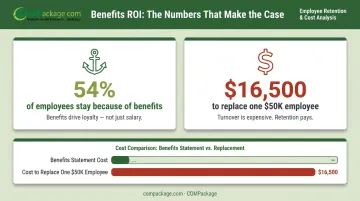
According to WTW's 2024 Global Benefits Attitudes Survey, 54% of U.S. employees say they stay with their employer because of their benefits package, and 40% would leave for better benefits even without a salary increase. Benefits aren't a secondary perk — they're a deciding factor in whether people stay or walk.
The cost of getting it wrong adds up fast. The Work Institute's 2025 Retention Report puts replacement cost at 33% of annual base salary — roughly $16,500 for a $50,000 earner. A well-designed benefits statement costs a fraction of that to produce and distribute.
The Recruiting Advantage
Forty-nine percent of WTW survey respondents said the benefits package influenced their decision to choose their current employer. For small and mid-size businesses that can't always match large-company base salaries, a detailed benefits statement during the offer process can shift how competitive a package looks — often enough to close a candidate who's comparing offers.
Key moments to present a benefits statement to candidates:
- During the formal offer, alongside the salary figure
- In response to a counteroffer from another employer
- As part of onboarding, to reinforce the full picture of compensation
What to Include in a Benefits Statement
Direct Compensation
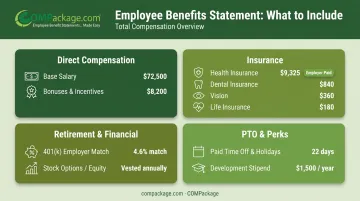
Start with the familiar numbers. Base salary or hourly wage, variable pay (bonuses, commissions), and overtime eligibility anchor the document before you layer in additional value. Employees need to see their known number first. Once that baseline is set, the additional value lands with far more impact.
Employer-Paid Insurance Contributions
This is where many employees get surprised. The average 2025 employer-sponsored health insurance premium is $9,325 for single coverage and $26,993 for family coverage. Employees typically see only their paycheck deduction — not what the employer contributes on their behalf. Showing that dollar figure directly, rather than just listing the plan name, changes how employees perceive their compensation.
Include contributions toward:
- Medical/health insurance
- Dental and vision coverage
- Life insurance
- Short- and long-term disability
Retirement and Financial Benefits
Express these as annual dollar values:
- 401(k) match: Vanguard's 2025 data puts the average employer match at 4.6% of pay — for someone earning $60,000, that's $2,760 annually.
- Stock options or profit-sharing
- Financial wellness programs or employee assistance plans
Paid Time Off
PTO is an invisible benefit until you put a dollar value on it. Convert it using a simple formula: daily pay rate × number of PTO days. For an employee earning $55,000 annually with 15 days of PTO, that's approximately $3,173 in annual leave value.
Include vacation, sick leave, personal days, parental leave, and company holidays.
Non-Quantifiable Perks
Not every benefit has a clean dollar amount, and that's fine — include them anyway. These perks still reinforce the full picture of employment value:
- Remote work flexibility
- Professional development stipends
- Tuition reimbursement
- Gym memberships
- Employee assistance programs
COMPackage handles both financial and non-quantifiable benefits in a single report, with over 80 benefit category ideas to ensure nothing gets overlooked.
Benefits Statement Samples: Real Examples for HR Teams
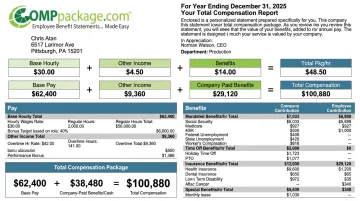
The three formats below cover the most common use cases HR teams encounter — from warm, personalized letters to quick-scan tables. Adapt the language, structure, and categories to fit your organization's benefit mix and workforce size.
Sample 1 — Narrative Paragraph Format
Best for: personalized communications, performance review packets, or small teams where a warmer tone fits the culture.
Dear [Employee Name],
At [Company Name], we want you to see the full picture of what you earn. In addition to your annual salary of $58,000, we invest an additional $14,200 in your health and wellness, retirement, and paid time off each year — bringing your total compensation to $72,200. We're grateful for your contributions and committed to supporting your financial well-being.
Sample 2 — Itemized Table Format
Best for: most employees, annual distributions, open enrollment packets. This format is easy to scan and easy to verify.
| Benefit Category | Annual Employer Contribution |
|---|---|
| Base Salary | $58,000 |
| Health Insurance (Employer Portion) | $6,200 |
| Dental & Vision (Employer Portion) | $850 |
| 401(k) Match (4% of salary) | $2,320 |
| Life Insurance Premium | $430 |
| PTO Value (15 days at daily rate) | $3,346 |
| Company Holidays (10 days) | $2,231 |
| Professional Development Stipend | $1,000 |
| Total Compensation | $74,377 |
Sample 3 — New Hire Onboarding Version
Best for: offer letters, onboarding packets, or recruiting conversations. Keep it short and lead with the headline number.
Your Total Compensation Package: $74,377
Your offer includes:
- Base salary: $58,000
- Employer health insurance contribution: $6,200/year
- 401(k) match: up to $2,320/year
- PTO and holiday value: $5,577/year
- Professional development: $1,000/year
We're excited to invest in you.
When adapting these templates, keep the following in mind:
- Workforce composition: Hourly and salaried employees may need separate formats with different benefit categories
- Union status: Collectively bargained benefits often require specific language — verify with legal before distribution
- Benefit mix: Only include categories that apply to each role; irrelevant line items create confusion
- Consistency: Use the same template across comparable roles to support equitable communication and reduce disputes
How to Write a Benefits Statement Step by Step
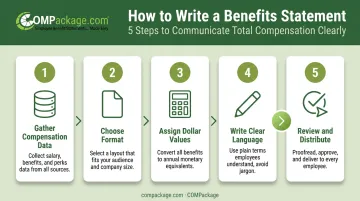
Step 1 — Gather Compensation Data
Pull each employee's base pay alongside all employer contribution figures from payroll records, insurance carriers, and benefit administrators. Incorrect numbers erode the trust the statement is meant to build, so accuracy is non-negotiable. Use a centralized HR or payroll system when possible to reduce manual errors.
Step 2 — Choose a Format That Fits Your Audience
- Narrative paragraph — works well for small teams or personalized communications
- Itemized table — best for most use cases; scannable and clear
- Visual report with charts — most impactful for company-wide distributions or onboarding
Simpler formats work better for hourly or frontline employees. Salaried or managerial staff often appreciate a more detailed breakdown.
Step 3 — Assign Dollar Values to Each Benefit
Convert every benefit into an annual dollar figure. For PTO, use: daily pay rate × number of days. For health insurance, use the actual employer premium contribution from your carrier invoice.
Tools like COMPackage can automate these calculations using built-in auto-calculators and bulk data import, which is especially useful when generating statements across a large employee population.
Step 4 — Write in Clear, Employee-Friendly Language
Write directly to the employee — use "you" and "your" throughout. Lead with the total compensation figure before breaking it down into components. Avoid HR jargon; if someone outside your department couldn't understand a line item, rewrite it.
Step 5 — Review, Personalize, and Distribute
Before distributing, confirm each statement reflects only the benefits that specific employee actually receives. A salaried employee and a part-time hourly worker should never get identical statements.
Key checks before sending:
- Personalization — only include benefits applicable to that employee's role and status
- Numerical accuracy — errors create confusion and, in some cases, legal exposure
- Formatting — ensure the layout is appropriate for that employee's level (hourly vs. salaried)
Best Practices for Creating Effective Benefits Statements
A well-crafted benefits statement doesn't happen by accident. These three practices separate statements that get read from ones that get filed away:
- Update annually — at minimum. Health insurance premiums rose 5-6% in 2025 compared to the prior year. A statement from last year is already understating your investment. Tie your update cycle to open enrollment or annual reviews so employees always see current figures.
- Make it visually scannable. Dense blocks of text don't get read. Use headers, line items, and white space. Including your company logo and brand colors signals this is an official, thoughtful document — not a generic form letter.
- Pair it with a conversation. A printed or digital statement can't answer questions on its own. When a manager or HR team member briefly walks an employee through their statement, it reinforces the message and invites dialogue. Group sessions during open enrollment work well for this.
Frequently Asked Questions
What is a benefits statement?
An employee benefits statement is a document HR provides to show employees the full value of their compensation — including employer-paid insurance, retirement contributions, PTO, and other perks — not just base salary. It translates invisible employer investments into visible dollar figures.
What is an example of a benefits statement?
See the samples above. A straightforward example: an employee earning $55,000 in salary, alongside $8,500 in employer-paid health insurance, a $2,200 401(k) match, and $4,100 in PTO value — totaling over $69,800 in annual compensation.
How do you write a benefits statement?
Follow five steps: gather compensation data, choose a format that fits your audience, assign annual dollar values to each benefit, write in plain employee-friendly language, then personalize and distribute.
What should be included in an employee benefits statement?
At minimum, include base salary, employer-paid insurance premiums (health, dental, vision, and life), retirement contributions, PTO value, and bonuses. Non-quantifiable perks — such as remote work flexibility or professional development support — should also appear.
How often should HR teams update benefits statements?
At least once annually — timed to open enrollment or performance review cycles. Any mid-year benefit changes, such as updated insurance contribution rates or new plans, should trigger a revised statement.
What is the difference between a benefits statement and a total compensation statement?
A benefits statement focuses on non-salary compensation elements. A total compensation statement combines salary and all benefits into one comprehensive dollar figure.