Introduction
Every January, employees across the country open their W-2 and head straight to Box 1 — "Wages, Tips, and Other Compensation." It's the number that drives federal tax calculations, yet it confuses employees and employers.
Why does it differ from gross pay on the final pay stub? Why is it lower than Boxes 3 and 5? And does it actually reflect what someone earns?
This guide breaks down each piece — for HR professionals managing payroll, benefits consultants advising clients, and employees trying to reconcile their W-2 against their pay stubs. You'll find clear answers covering:
- What counts as wages, tips, and other compensation
- What reduces that number through pre-tax deductions
- How Box 1 differs from Social Security and Medicare wages
- Why Box 1 alone doesn't capture total compensation
Key Takeaways
- Box 1 is gross pay minus pre-tax deductions — not the same as total earnings
- Pre-tax 401(k) deferrals reduce Box 1 but not Social Security or Medicare wages
- All tip income is taxable, even if never reported to an employer
- Employer-paid benefits like health insurance and retirement matches don't appear on a W-2
- The 2025 Social Security wage base is $176,100; Medicare has no cap
What Is "Wages, Tips, and Other Compensation"?
Box 1 on Form W-2 contains the total taxable compensation paid to an employee during the year for services performed. Per the IRS Form W-2 instructions, this is the figure used to calculate federal income tax liability — not state taxes, not FICA, just federal income tax.
The term covers three distinct categories:
- Wages and salaries — hourly pay, salaried compensation, piece-rate pay
- Tips — cash gratuities reported by employees, plus tips received via credit or debit card
- Other compensation — bonuses, commissions, awards, prizes, taxable fringe benefits, and certain non-cash payments
All of these are taxable income that must be reported on a federal return. Non-cash compensation — goods, services, awards — gets included at fair market value under IRS Publication 15-B.
Box 1 Is Not Gross Pay
This distinction trips people up constantly. Box 1 is a calculated figure, not a simple tally of everything paid. It starts with gross earnings and then subtracts pre-tax deductions — which is why the number is almost always lower than what appears on the final pay stub of the year.
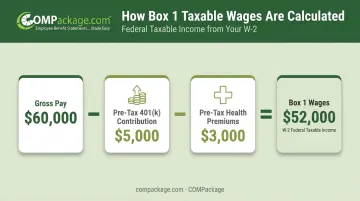
Consider a straightforward example. An employee earning $60,000 in gross wages who contributes $5,000 to a pre-tax 401(k) and pays $3,000 in pre-tax health premiums would see $52,000 in Box 1. That's an $8,000 difference from gross pay — entirely due to pre-tax deductions. Actual results vary based on specific plan structures, but the direction is consistent: Box 1 is nearly always lower than gross pay.
What's Included in W-2 Box 1
Most employees assume Box 1 just captures salary and maybe a bonus. The actual list is longer.
Common items that feed into Box 1:
- Regular wages, hourly pay, and salary
- Bonuses and commissions
- Tips reported by the employee to the employer
- Taxable fringe benefits (personal use of a company vehicle, certain employer-paid housing)
- Group-term life insurance coverage exceeding $50,000 (the imputed cost above this threshold is taxable)
- Third-party sick pay, when taxable
- Non-cash compensation at fair market value — prizes, awards, gift cards
Understanding Imputed Income
Imputed income is one of the more counterintuitive Box 1 items. It refers to benefits the employer provides that carry monetary value and are therefore treated as taxable wages, even though the employee never receives cash.
The group-term life insurance rule illustrates this well: if an employer provides $150,000 in coverage, the cost attributable to the coverage above $50,000 is calculated using an IRS table and added to Box 1. The employee owes income tax on that amount, even though no cash changed hands.
Gift cards work similarly. Per IRS de minimis fringe guidance, cash equivalents and gift cards redeemable for general merchandise cannot be excluded as de minimis benefits — they go into Box 1 at face value.
The same logic extends beyond structured benefits programs. The IRS requires all wages and compensation to be reported regardless of whether the employer properly documented them on a W-2 — unreported cash wages are still legally taxable income.
What's Excluded from W-2 Box 1
Box 1 often shows a lower figure than gross pay — and that gap comes from pre-tax deductions. These reduce the amount subject to federal income tax before Box 1 is calculated.
Items that reduce Box 1:
| Pre-Tax Deduction | IRS Mechanism |
|---|---|
| Health, dental, vision insurance premiums | Section 125 cafeteria plan |
| Healthcare and dependent care FSA contributions | Section 125 (2025 FSA limit: $3,300) |
| 401(k), 403(b), 457(b) elective deferrals | Excluded from Box 1; reported in Box 12 |
| Employer HSA contributions | Reported in Box 12, Code W |
| Qualified transportation benefits | Up to $325/month for 2025 |
These exclusions exist because Congress chose to incentivize retirement savings and employer-sponsored health coverage through tax advantages. The practical result: employees reduce their federal taxable income, but their take-home pay doesn't drop dollar-for-dollar with each deduction.
Why Boxes 3 and 5 Are Often Higher Than Box 1
Here's the detail that surprises many employees: a pre-tax 401(k) contribution reduces Box 1 but does not reduce Social Security wages (Box 3) or Medicare wages (Box 5). Those boxes capture a broader definition of compensation.
So an employee with $60,000 gross pay and $5,000 in 401(k) deferrals might see:
- Box 1: $52,000 (after 401(k) and health premiums)
- Box 3: $57,000 (after health premiums only, before 401(k))
- Box 5: $57,000 (same treatment as Box 3)
When the numbers differ across boxes, that's the tax code functioning correctly — each box reflects a different legal definition of taxable wages.
Tip Income: Reporting Rules Every Worker Should Know
All tip income is taxable. This applies to cash tips, tips added to credit or debit card transactions, and tips received through tip-sharing arrangements. There are no exceptions based on amount received or how tips were paid.
The $20/Month Reporting Threshold
Per IRS Topic 761, employees who receive $20 or more in tips during any calendar month must report those tips to their employer. The deadline is the 10th day of the following month, and employees can use IRS Form 4070 to make that report.
When employees report tips to their employer, those amounts get included in Box 1 of the W-2.
When tips go unreported (whether intentional or not), the employee still owes tax on them. Unreported tips must be reported on the federal return using IRS Form 4137, which also calculates the Social Security and Medicare tax owed on those amounts.
Workers in tip-reliant roles should keep this in mind regardless of how their tips are paid. Industries where this applies most include:
- Food service and restaurants
- Hotels and hospitality
- Hair salons and personal care
- Valet and parking services
- Delivery and rideshare
The IRS recommends keeping a daily tip log — this is the most reliable way to ensure accurate reporting at tax time.
Box 1 vs. Social Security Wages vs. Medicare Wages
These three figures on the W-2 confuse employees and occasionally HR teams as well. They measure different things.
| W-2 Box | What It Measures | Affected by 401(k) Deferrals? | Wage Cap? |
|---|---|---|---|
| Box 1 | Federal taxable wages | Yes — reduced | No cap |
| Box 3 | Social Security wages | No — not reduced | $176,100 (2025) |
| Box 5 | Medicare wages | No — not reduced | No cap |
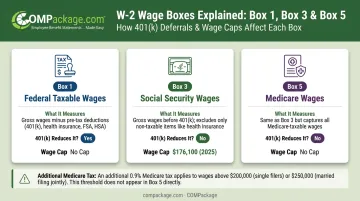
The 2025 Social Security wage base is $176,100. Wages above that threshold aren't subject to Social Security tax — which is why Box 3 stops growing for higher earners while Box 5 continues to reflect all earnings.
Medicare has no wage cap, but high earners face an additional layer: the Additional Medicare Tax of 0.9% applies to wages exceeding $200,000 for single filers, withheld by the employer once that threshold is crossed.
The Social Security wage cap also creates a practical issue for employees with multiple jobs. Each employer withholds Social Security tax separately, which can result in over-withholding. If total Social Security wages across all jobs exceed $176,100, the excess withholding can be claimed as a credit on Form 1040.
Why W-2 Box 1 Doesn't Tell the Full Compensation Story
Box 1 captures taxable wages. It says nothing about what an employer actually spends to employ someone.
BLS data from March 2026 shows private-industry compensation averaged $46.60 per hour — with wages at $32.60/hour and benefits at $14.01/hour. Benefits represent roughly 30% of total employer compensation costs. None of that $14.01/hour appears anywhere on a W-2.
What's invisible to employees in Box 1:
- Employer health insurance premium contributions
- 401(k) matching contributions
- Employer-paid life and disability insurance
- Employer-side FICA taxes (Social Security and Medicare)
- Paid time off accruals
- Professional development and tuition assistance
This creates a real perception problem. Employees evaluating their pay — or weighing a competing job offer — often compare salaries or Box 1 figures without accounting for the benefits differential.
An employee earning $60,000 with generous health coverage and a 5% 401(k) match may be receiving compensation worth considerably more than a $70,000 role with minimal benefits.
According to the EBRI 2024 Workplace Wellness Survey, 72% of workers cited health insurance and 55% cited retirement savings plans as top factors when deciding whether to stay at or leave a job. Yet only 44% reported being extremely or very satisfied with their overall benefits package — a gap that often reflects a lack of visibility, not a lack of generosity.
Bridging the Gap with Total Compensation Reports
COMPackage's total compensation statement software gives employers a direct way to close this gap. It generates personalized reports showing each employee the full dollar value of their compensation — not just their paycheck.
One sample report shows an employee with $40,000 in base pay whose total compensation reaches $61,476 once employer-paid benefits are factored in — a $21,000 difference that never appears on a W-2. The platform includes:
- Coverage for over 80 benefit and perk categories
- Non-quantifiable perks like remote work flexibility
- Bulk data import via Excel for workforce-wide report generation
- Personalized reports showing only each employee's specific benefits
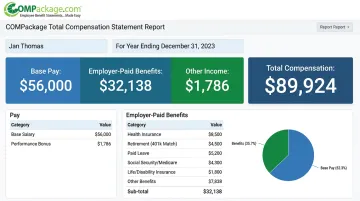
For employers managing retention without raising base salaries, that visibility can shift how employees perceive their compensation — before they start looking elsewhere.
Frequently Asked Questions
What is considered wages, tips, and other compensation?
Wages, tips, and other compensation (W-2 Box 1) includes all taxable pay received for services — hourly wages, salaries, bonuses, commissions, reported tips, taxable fringe benefits, and non-cash compensation at fair market value — minus pre-tax deductions like health insurance premiums and retirement plan contributions.
Is wages, tips, and other compensation my annual income?
Box 1 is your federal taxable income from your employer, which is not the same as gross annual earnings. It's typically lower because pre-tax deductions reduce the figure, and it also excludes employer-paid benefits.
What's the difference between Box 1 and Social Security or Medicare wages?
Box 1 is reduced by pre-tax retirement contributions like 401(k) deferrals, while Social Security wages (Box 3) and Medicare wages (Box 5) generally are not — making Boxes 3 and 5 higher than Box 1. Social Security wages are also capped at $176,100 for 2025; Medicare wages have no cap.
Are all tips required to be reported on my taxes?
Yes. All tip income — cash, credit card, and pooled tips — is taxable and must be reported. Employees should report tips exceeding $20 in any month to their employer by the 10th of the following month, and report all tip income on their federal return regardless.
Why is my W-2 Box 1 amount lower than my gross pay?
Box 1 is gross pay minus pre-tax deductions such as health insurance premiums, FSA contributions, and 401(k) deferrals. These reduce the amount subject to federal income tax, which is why Box 1 is lower than gross earnings on your final pay stub.
Do employer-paid benefits count as wages, tips, and other compensation?
Most employer-paid benefits — health insurance contributions and retirement matches — are excluded from Box 1 and are not taxable wages. However, certain benefits like group-term life insurance above $50,000 or the value of personal use of a company vehicle are considered taxable fringe benefits and are included in Box 1.