Introduction
Most employees know their base salary. Few understand everything else they're earning, and that gap costs companies more than they realize.
Total variable compensation is the portion of pay that fluctuates based on performance: bonuses, commissions, profit sharing, and other incentive-linked pay. It's a core part of how modern employers structure pay packages.
Yet according to MetLife's 2024 Employee Benefits Trends Study, 45% of employees don't fully understand their compensation package, and half say better understanding would increase their loyalty.
That misunderstanding has a direct cost. When employees can't see the full value of what they earn, they underestimate their total pay, feel underpaid, and start looking elsewhere.
This guide explains what total variable compensation is, how it's calculated, where it fits into overall pay, and how to build a program that motivates people.
Key Takeaways
- Total variable compensation combines bonuses, commissions, profit sharing, and other performance-based pay.
- Unlike base salary, it fluctuates with individual, team, or company results against set goals.
- Variable pay falls into two categories: Short-Term Incentives (STIs) and Long-Term Incentives (LTIs).
- Clear metrics set before the performance period anchor any effective variable pay program.
- Employees who see their full variable pay picture report higher satisfaction and stay longer.
What Is Total Variable Compensation?
Total variable compensation is the combined value of all non-guaranteed, performance-based pay an employee can earn on top of their fixed base salary. It covers more than a year-end bonus: every form of incentive-linked pay built into the compensation structure.
Companies use it for three core reasons:
- Align behavior with outcomes: pay rises when employees hit the goals the business cares about
- Create financial flexibility: variable costs flex with performance rather than staying fixed regardless of results
- Differentiate pay by contribution: reward results, not just tenure or title
Variable Compensation vs. a Discretionary Bonus
These two things are often confused, but they're structurally different.
A discretionary bonus is a one-time payment the employer chooses to give, with no predetermined criteria, no performance thresholds, and no obligation to pay it again. True variable compensation is a structured, recurring component of the pay design, tied to measurable goals defined before the performance period begins.
If the rules change mid-cycle or payouts feel arbitrary, the program is a discretionary bonus with better branding.
STIs vs. LTIs: The Two Structural Categories
| Category | Time Horizon | Common Examples |
|---|---|---|
| Short-Term Incentives (STIs) | One year or less | Annual bonuses, quarterly payouts, spot awards, project bonuses |
| Long-Term Incentives (LTIs) | Multi-year (typically 3–5 years) | Stock options, restricted stock units, performance shares, long-term cash plans |
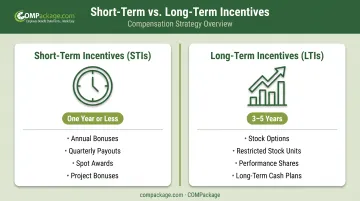
The right mix depends on role level and what behaviors the company wants to drive. Frontline employees benefit most from STIs with a clear line of sight to their work. Senior leaders typically carry a heavier LTI weighting to align their decisions with long-term company health.
Pay Mix: How the Ratio Shifts by Role
Pay mix is the ratio of fixed-to-variable pay in total compensation. It shifts meaningfully with seniority. According to WorldatWork's Incentive Pay Practices survey, median target annual incentive awards as a percentage of base salary are:
- Hourly workers: 5%
- Exempt salaried professionals: 10%
- Managers and supervisors: 17–20%
- Senior executives (non-CEO): 40–60%
The pattern is consistent: the greater the accountability and the broader the impact on business outcomes, the higher the variable share of pay.
How Does Total Variable Compensation Work?
Variable pay operates through a defined cycle: goals are set, performance is tracked, results are evaluated, and payouts are calculated and distributed. Each stage shapes whether an employee earns a payout and how much they receive.
Setting Performance Goals and Metrics
The cycle begins when the employer defines:
- The performance period: quarterly, annual, or multi-year
- The specific, measurable goals: individual targets (sales quota), team goals (project delivery), or company-wide results (EBITDA thresholds)
- The eligibility rules: who participates and what they're measured on
Goal quality is where most variable pay programs succeed or fail. Gallup research covering 18,665 U.S. employees found that only 47% strongly agreed they knew what was expected at work.
Employees involved in setting their own goals were twice as likely to report clear expectations. Quarterly goal check-ins made employees 90% more likely to be engaged and 2.1 times more likely to view the process as fair.
Vague, constantly shifting, or unattainable targets fail to motivate and actively erode trust.
Calculating Variable Pay
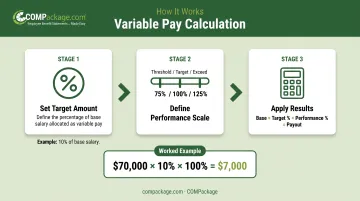
Most programs use a standard structure:
- Set a target variable amount: typically expressed as a percentage of base salary (for example, 10% for a salaried professional)
- Define a performance scale: for example, 75% payout at threshold, 100% at target, 125%+ for exceeding target
- Apply results: multiply the base amount by the payout percentage based on actual performance
Example: An employee with a $70,000 base salary and a 10% target bonus achieves 100% of their goals. Payout = $70,000 × 10% × 100% = $7,000.
Many companies add a funding formula layer. The total bonus pool is first funded based on company performance — for instance, profit above a predetermined baseline — and individual payouts are then allocated from that pool based on personal performance ratings. If the company underperforms, the pool shrinks. If it outperforms, it may expand up to a cap.
Payout Timing and Tax Treatment
Timing matters more than most employers acknowledge. The longer the gap between performance and payout, the weaker the motivational connection. Common schedules:
- Monthly: commissions and sales-based variable pay
- Quarterly: project bonuses and short-cycle short-term incentives (STIs)
- Annually: year-end bonuses and profit sharing
On the tax side, variable pay is classified by the IRS as supplemental wages and is subject to federal income tax withholding. Employers use one of two methods:
- Flat rate method: A flat 22% federal withholding rate applies when income tax was withheld from the employee's regular wages in the current or prior calendar year
- Aggregate method: Regular and supplemental wages are combined, withholding is calculated as a single payroll payment, and the regular-wage portion is subtracted
Supplemental wages above $1 million in a calendar year are withheld at 37%. All variable pay is also subject to Social Security and Medicare taxes regardless of which method is used.
Where Variable Compensation Fits in Total Pay
Variable compensation is one piece of a larger total compensation framework that includes base salary, employer-paid benefits (health insurance, retirement contributions), and non-cash perks. "Total variable compensation" refers specifically to the sum of all performance-linked elements within that full package.
Which Roles Carry the Most Variable Pay
Sales and revenue roles have traditionally carried the highest variable components, with commission often the primary earnings driver. But variable pay has expanded well beyond sales teams.
WorldatWork's 2023 data shows Annual Incentive Plan (AIP) eligibility among salaried professionals at 91% for public companies and 86% for private companies. Even among hourly workers, eligibility reaches 49–55% across company types. Coverage falls as you move down in seniority, but the reach is broader than many employees assume.
Company Size and Program Complexity
Large enterprises typically layer multiple programs:
- Annual incentive plans (AIPs)
- Long-term incentive programs (LTIs)
- Spot or project-based awards
Smaller businesses more commonly rely on annual bonuses or profit sharing. The BLS reports that access to nonproduction bonuses varies: 37% of workers at establishments with fewer than 100 employees have access versus 44% at larger establishments.
That gap is real, but it doesn't mean small businesses can't compete. They need to work harder to communicate the value of what they do offer.
A company offering a $10,000 annual bonus, a 5% 401(k) match, and fully paid health insurance has a compelling total compensation story. The problem is that employees rarely see it presented as one number.
Benefits and Challenges of Variable Compensation
The Core Benefits
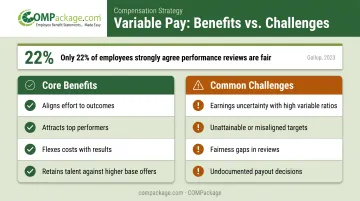
- Aligns employee effort with measurable outcomes that matter to the business
- Attracts top performers who value earnings upside, even when base pay is not the highest offer
- Lets compensation costs flex with results, protecting the business during difficult periods
SHRM notes that variable pay can also help retain top performers who receive competing offers with higher base salaries. Total earnings potential, including upside, can close a base-pay gap without raising fixed costs.
The Real Challenges
Variable pay programs fail in predictable ways:
- High variable ratios create real earnings uncertainty, often linked to greater risk aversion and lower program preference
- Unattainable targets, or metrics that reward the wrong behaviors, disengage the people they should motivate
- Fairness gaps persist: only 22% of U.S. employees strongly agree that performance reviews are fair and transparent (Gallup, 2023)
- Undocumented payout decisions create pay equity risk. SHRM flags bonuses as a compensation factor where weak documentation drives complaints, morale issues, and turnover
Run periodic audits of variable pay outcomes by role, level, and manager. That catches disparities early, before they become legal or reputational problems.
Best Practices for Implementing and Communicating Variable Pay
Design Principles That Hold Up
- Tie metrics to outcomes employees can actually influence; company-wide financials alone create a weak motivational link for most people
- Keep the structure simple enough that a manager can explain the plan in two minutes
- Set the rules before the period begins; mid-cycle changes to targets or funding formulas destroy credibility fast
- Review the plan annually so targets still match current business conditions
Communication Is Where Programs Break Down
A well-designed variable pay program with poor communication is still a failed program. Employees who don't understand how their payout is calculated, what they're tracking toward, or why they received what they did won't feel motivated. They'll feel managed.
Strong communication habits include:
- Written plan documentation distributed before the performance period
- Regular progress updates (quarterly at minimum)
- Clear statements after payout explaining how results translated to earnings
Show Employees the Full Picture
Present variable pay alongside base salary and employer-paid benefits in a single total compensation statement. Employees consistently underestimate what they earn, and that gap drives voluntary turnover even when pay is competitive.
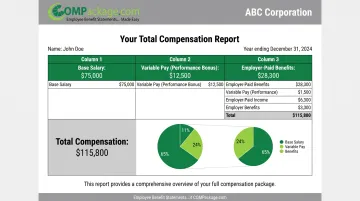
Tools like COMPackage help employers generate personalized total compensation reports that list base pay, variable pay (bonuses and other incentive income), and employer-paid benefits as separate line items with one aggregated total.
A sample report with $56,000 in base pay, a $1,786 performance bonus, and $32,138 in employer-paid benefits totals $89,924: a very different picture from a pay stub. Reports can be updated and regenerated throughout the year at no extra charge, so you can refresh them after each quarterly bonus payout.
Frequently Asked Questions
What is total variable compensation?
Total variable compensation is the combined value of all performance-based pay an employee can earn, including bonuses, commissions, profit sharing, and incentive awards. Unlike base salary, none of it is guaranteed without meeting performance criteria.
Is variable compensation considered a bonus?
A bonus is one specific type of variable compensation, not the whole category. Variable compensation is the broader term that includes bonuses, commissions, profit sharing, spot awards, and other incentive-linked pay. The key distinction: true variable compensation requires predetermined metrics, while discretionary bonuses do not.
What is the difference between fixed and variable compensation?
Fixed compensation (base salary or hourly wages) is guaranteed regardless of performance. Variable compensation fluctuates based on whether defined performance goals are met. Most employees receive a combination of both as part of their total pay package.
How is total variable compensation calculated?
Multiply the target variable percentage by the employee's base salary, then apply the payout scale based on actual performance. For example: a 10% target bonus on a $70,000 base salary at 100% performance achievement = $7,000 variable payout.
What are common types of variable compensation?
The most common types include annual performance bonuses, sales commissions, profit sharing, spot or project bonuses, stock options or equity grants, and gain-sharing plans. Each serves different business goals and fits different roles and company types.
Is variable compensation taxable?
Yes. Variable compensation is taxable as supplemental wages. Employers withhold using either the flat 22% federal rate or the aggregate method, and employees also owe Social Security and Medicare taxes on all variable pay received.