Introduction
Look at your last paycheck. Now realize it's only telling part of the story.
Base pay typically represents 60% to 70% of what a company actually spends on you — the rest goes toward benefits, taxes, and perks that never show up on that direct deposit notification.
This gap creates a real problem. 68% of employees believe they're underpaid, even when their pay sits at or above market rate.
That figure comes from Payscale's 2025 Fair Pay Impact Report, which analyzed more than 325,000 salary survey responses.
This post breaks down what actually belongs in a compensation package, what a compensation statement looks like when done right, real examples across job types, and why showing employees the full picture benefits everyone at the table.
Key Takeaways
- Wages are only ~70% of employer costs; benefits, bonuses, and perks make up the rest (BLS)
- A compensation statement translates that total into one clear dollar figure for each employee
- Companies sharing these statements regularly see stronger retention and easier recruiting
- COMPackage can generate statements for an entire employee census in under 90 minutes
- Employees who see their full statement make sharper career and financial decisions
What Is a Total Compensation Package?
A total compensation package is everything an employer pays or provides in exchange for someone's work — not just the number on their paycheck.
Base salary or hourly wage is just one piece. Total compensation adds bonuses, commissions, health insurance, retirement contributions, paid time off, and other perks on top.
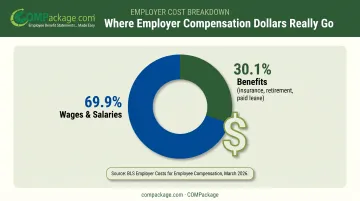
The Bureau of Labor Statistics' Employer Costs for Employee Compensation report puts real numbers behind this. As of March 2026, wages and salaries accounted for 69.9% of employer compensation costs in private industry, with the remaining 30.1% going toward benefits like insurance, retirement, and paid leave.
That means for every $70 an employer spends on wages, they're spending roughly $30 more on benefits most employees never see itemized.
Why this matters:
- For HR teams: Total compensation is a recruiting and retention lever. Candidates comparing job offers rarely factor in benefit value unless someone shows it to them.
- For employees: Understanding total compensation changes financial planning. A lower base salary with strong benefits might beat a higher salary with thin coverage.
Package vs. Statement: What's the Difference?
These two terms get mixed up constantly, so here's the distinction:
- Compensation package = the structure. It's the combination of pay, bonuses, benefits, and perks an employer offers.
- Compensation statement = the document. It's the personalized report that shows one employee the total dollar value of everything in their package.
Think of the package as the recipe and the statement as the plated dish. One is the plan; the other is what the employee actually gets to see.
Key Components of a Compensation Package & Benefits
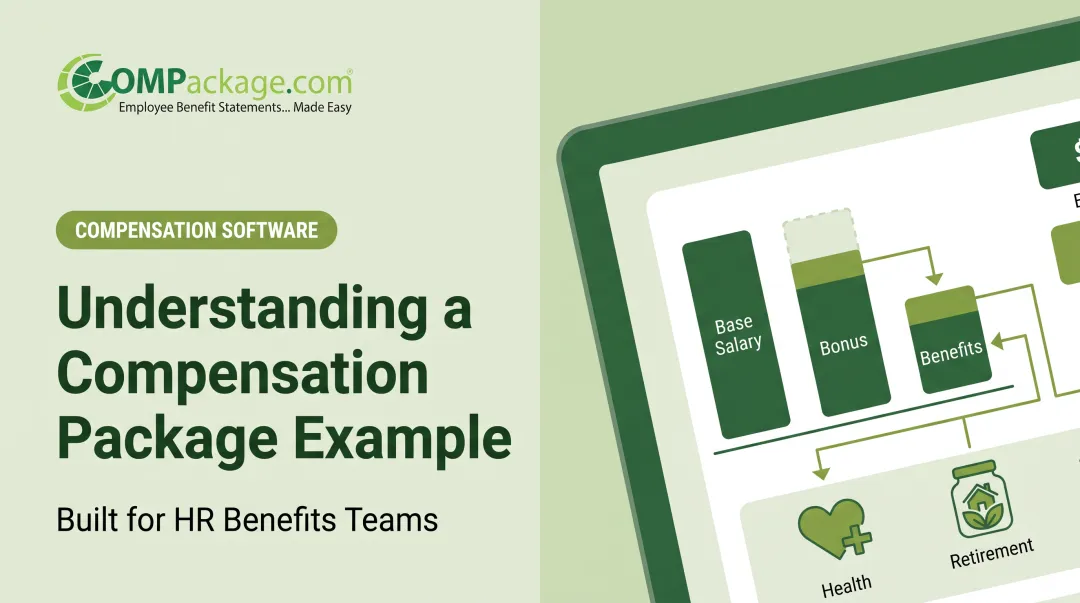
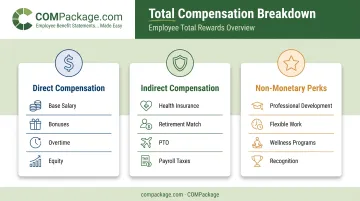
Every compensation package breaks into three buckets: direct pay, indirect benefits, and non-monetary perks.
Direct (Monetary) Compensation
This is the cash portion, the part most people think of as "their pay."
- Base salary or hourly wages: the fixed core of compensation
- Bonuses and commissions: variable pay tied to performance or sales
- Overtime pay: required for eligible hourly employees working beyond 40 hours
- Equity or stock options: increasingly common, especially in tech and startup roles
Stock options typically come with a vesting schedule, meaning employees earn the right to exercise their shares over time rather than all at once. Many plans include a "cliff," an initial waiting period (often a year) before any equity vests at all.
Indirect Compensation & Benefits
This is where most of the "hidden" value lives.
- Health, dental, and vision insurance: premiums paid by the employer
- Retirement contributions: such as a 401(k) match
- Paid time off: vacation, sick days, and holidays
- Disability and life insurance: employer-paid coverage for income protection and survivors
One category almost nobody mentions: employer-paid payroll taxes. Employers contribute 6.2% toward Social Security (up to the annual wage base) and 1.45% toward Medicare on every dollar earned. That combined 7.65% never appears on a pay stub, but it counts as real compensation cost.
Non-Monetary Perks
Not everything valuable comes with a clean price tag. These still belong on a total compensation statement even when the dollar value is harder to pin down:
- Professional development stipends: tuition support, courses, and certifications
- Flexible or remote work arrangements: hybrid schedules and location flexibility
- Wellness programs: gym subsidies, mental health resources, and similar offerings
- Employee recognition initiatives: awards, spot bonuses, and peer recognition
What Does a Compensation Statement Look Like?
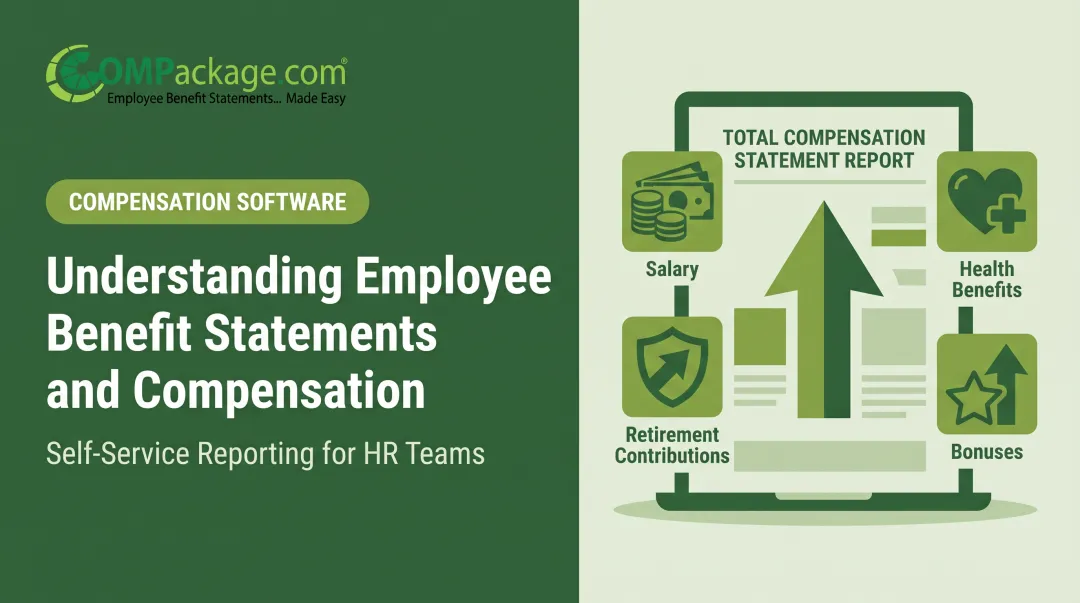
A compensation statement is a personalized document, usually one to two pages, that lists an employee's name, the reporting period, and a category-by-category breakdown ending in one total dollar figure.
Common line items include:
- Base pay or annual salary
- Bonuses and additional cash compensation
- Employer-paid insurance premiums
- Retirement contributions
- Estimated value of PTO
- Any special perks or fringe benefits
Strong statements go further than a plain list. Group categories clearly, add a simple pie chart or bar graph for the total, and include your logo and colors so the document feels personal.
Steps to Create Your Own Compensation Statement
Building these by hand in Excel can take days or weeks once headcount grows. Purpose-built software shortens that work to hours.
Gather employee-specific data. Collect salary, benefits, and perk details for each person. For larger teams, bulk import from Excel (for example, COMPackage's Employee LOADER) can load hundreds of records in minutes after you map column headings.
Choose your platform. Self-service tools like COMPackage help teams from 5 to 5,000 employees build branded statements in-house, without consultants. Pricing scales by headcount (from about $149/year for very small teams to $2,999 for a Professional tier used by multi-client agencies), and built-in calculators cover 401(k), time-off, insurance, and related math.
Review and distribute annually. Add a brief note on each line item, then share statements with a performance review or year-end meeting. With the right tool, teams often finish a full census in under 90 minutes, and a single report in about 5 to 7 minutes.
Compensation Package Examples Across Roles & Industries
Compensation structures shift dramatically depending on the role. Here's how three common employee types typically break down:
| Role Type | Base Pay | Additional Elements |
|---|---|---|
| Hourly/entry-level | Hourly wage | Basic health coverage, standard PTO |
| Salaried professional | Annual salary | Bonus target, full benefits suite, 401(k) match |
| Executive/sales | Base pay | Commission or equity, long-term incentives, added perks |
In practice, those categories often look like this:
- Warehouse associate: $17 hourly wage, basic medical plan, and two weeks of PTO
- Marketing manager: Salary plus a 10% bonus target, dental and vision, and a 4% 401(k) match
- Sales director: Lower base pay offset by uncapped commission, stock options, and a car allowance
Industry shapes the mix too. Retail and manufacturing often emphasize wages, overtime, and medical contributions. Tech and finance lean harder on bonuses and equity, while healthcare packages frequently highlight shift differentials and richer benefit tiers.
A compensation statement shows each employee, in their own report, exactly what their specific mix adds up to.
Why Sharing Total Compensation Transparency Matters
Pay transparency changes behavior on both sides of the employment relationship.
For employees:
- Builds trust by showing the full value of the package
- Supports better financial and career planning decisions
- Closes the gap between "what I earn" and "what I'm worth"
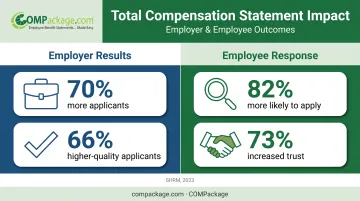
For employers, the data backs this up. SHRM research from 2023 found that among organizations sharing pay information, 70% reported more applicants and 66% reported higher-quality applicants.
Workers respond the same way: 82% said they'd be more likely to apply when compensation details were visible, and 73% said it increased their trust in the employer.
The same research found that 36% of organizations sharing pay ranges saw more employees asking informed questions about raises — a sign that transparency surfaces pay conversations rather than avoiding them.
There's a recruiting angle too. A candidate comparing two offers with similar salaries will pick the one that visibly includes stronger insurance, retirement matching, and PTO. A compensation statement makes that generosity impossible to miss.
Frequently Asked Questions
What is a compensation summary?
A compensation summary consolidates an employee's salary, bonuses, benefits, and perks into one total value. It's different from a pay stub, which only shows wages and deductions for a single pay period.
What does a compensation statement look like?
It's typically a personalized, one-to-two-page document broken into categories like pay, insurance, retirement, and PTO, ending in a single total compensation figure. Many include charts or graphs and company branding.
Can you give me some examples of compensation plans?
Yes. Hourly employees usually see base wage plus basic insurance and PTO. Salaried professionals often add bonus targets and retirement matching, while executives or sales roles may include commission, equity, and long-term incentives.
What's the difference between a compensation package and a benefits package?
Benefits are one piece within the broader compensation package. The full package also includes base salary, bonuses, commissions, and equity. Benefits alone don't tell the whole story.
How often should a company update employee compensation statements?
At least once a year, ideally tied to annual reviews. Update statements sooner after a promotion, raise, or benefits change so the numbers stay accurate.
Do small businesses really need total compensation statements?
Yes. Small employers competing against larger companies for talent benefit even more from showing an offer's true value. Affordable self-service tools now make this accessible regardless of company size.