That gap creates real problems: turnover, dissatisfaction, and recruiting challenges that cost far more than closing the communication gap would.
This guide covers everything both employers and employees need to understand about hourly work — from how pay is calculated and what overtime requires, to what benefits hourly workers can access and what federal law protects.
Key Takeaways
- 55.6% of US wage and salary workers are paid hourly — about 80.3 million people
- Nearly all hourly employees are "non-exempt" under the FLSA, entitling them to minimum wage and overtime
- Federal overtime pays 1.5x regular pay after 40 hours/week; many states also set daily overtime thresholds
- Benefits eligibility often hinges on whether you work 30+ hours per week under ACA rules
- Hourly workers typically receive only 50–65% of their total employer compensation cost as take-home pay
What Is an Hourly Employee?
An hourly employee earns a set wage for each hour worked. Their paycheck varies week to week based on hours, unlike salaried employees who receive a fixed annual amount regardless of hours worked.
According to the Bureau of Labor Statistics, 80.3 million US workers were paid hourly in 2024, representing 55.6% of all wage and salary workers. Hourly work isn't a niche arrangement — it's the dominant pay structure in the US economy.
Who Works Hourly?
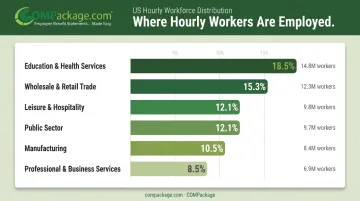
Hourly positions span virtually every sector. The largest concentrations:
| Industry | Hourly Workers | Share of Hourly Workforce |
|---|---|---|
| Education & health services | 14.8 million | 18.5% |
| Wholesale & retail trade | 12.3 million | 15.3% |
| Leisure & hospitality | 9.8 million | 12.1% |
| Public sector | 9.7 million | 12.1% |
| Manufacturing | 8.4 million | 10.5% |
| Professional & business services | 6.9 million | 8.5% |
Hourly arrangements cover both full-time and part-time workers. A 40-hour-per-week warehouse associate and a 15-hour-per-week retail associate are both hourly employees — their legal protections and benefit eligibility differ primarily based on hours worked, not their hourly classification itself.
Exempt vs. Non-Exempt: Where Hourly Workers Fall
Under the Fair Labor Standards Act (FLSA), virtually every hourly employee is classified as non-exempt, meaning they're entitled to federal minimum wage and overtime pay for hours worked beyond 40 in a workweek.
Exempt status requires meeting both a salary basis test and specific duties tests. The DOL's EAP exemption framework covers executive, administrative, and professional roles, with a salary-basis threshold of at least $684/week. Few hourly workers qualify — and misclassifying them as exempt carries real financial risk.
Misclassifying a non-exempt worker as exempt is one of the most common and expensive compliance mistakes employers make. In FY2024, the DOL's Wage and Hour Division recovered $126.9 million in back wages from overtime violations alone, affecting over 101,000 employees. One Georgia plastics manufacturer paid $154,009 after failing to include bonuses in overtime calculations — affecting 743 workers.
How Hourly Employees Get Paid
The basic math is straightforward: hourly rate × hours worked = gross wages.
At $18/hour for 40 hours: $18 × 40 = $720 gross pay for the week.
That calculation gets more complex when you factor in overtime, variable schedules, and what legally counts as "hours worked."
Minimum Wage Requirements
Employers must pay at least the federal minimum wage of $7.25/hour — unchanged since July 24, 2009. But many states and cities mandate significantly higher rates:
- California: $16.90/hour statewide (2026); $19.18/hour in San Francisco
- Washington: $17.13/hour (2026)
- New York: $17.00/hour in NYC, Long Island, and Westchester; $16.00/hour elsewhere
- Colorado: $15.16/hour (2026)
The applicable minimum is always whichever rate is highest. Check your state's Department of Labor for current figures.
What Counts as "Hours Worked"?
The FLSA defines "employ" broadly — including work an employer "suffers or permits" an employee to perform. That means compensable time extends beyond scheduled shifts.
Hours that are generally compensable:
- Work done voluntarily after a shift to finish an assigned task
- Rest breaks of 20 minutes or less
- On-call time spent on the employer's premises
- Travel between job sites during the workday
Hours generally NOT compensable:
- Commuting to and from work
- Bona fide meal breaks (30+ minutes with full relief from duties)
- Personal activities during off-duty time
Employers who require off-the-clock work — or allow it without paying for it — face the same legal exposure as if they'd never paid overtime at all.
Pay Schedule and Timekeeping
Hourly employees are typically paid weekly or bi-weekly. Federal law requires employers to maintain accurate records of hours worked.
Common timekeeping methods include:
- Time clocks and punch cards
- Biometric systems
- Digital scheduling software
- Manual timesheets
The method matters less than accuracy and consistency.
Overtime: Rules, Rights, and Calculations
Federal law is clear: non-exempt employees must receive at least 1.5 times their regular rate for every hour worked beyond 40 in a single workweek.
Example calculation:
An employee earning $18/hour works 45 hours in one week:
- Regular pay: $18 × 40 hours = $720
- Overtime pay: $27 × 5 hours = $135
- Weekly total: $855
That $27 overtime rate is the "time and a half" figure — the regular $18 rate multiplied by 1.5.
State Overtime Rules Go Further
The 40-hour federal threshold is a floor, not a ceiling. Several states add daily overtime triggers:
- California: 1.5x after 8 hours/day; 2x after 12 hours/day; 1.5x for first 8 hours on a seventh consecutive workday
- Alaska: 1.5x after 8 hours/day or 40 hours/week
- Colorado: 1.5x after 12 hours/day or 40 hours/week
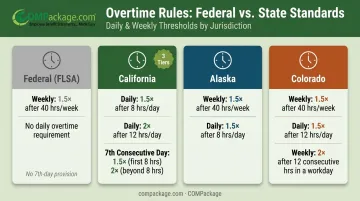
Employers operating in multiple states need to know each state's rules — applying the most protective standard.
Overtime cannot be waived. Employers who cross this line face liability for every hour of unpaid wages, plus potential FLSA penalties. Common violations include:
- Asking employees to "volunteer" extra hours
- Offering comp time in place of overtime pay
- Requiring workers to clock out before finishing a task
Benefits for Hourly Employees
Benefit eligibility for hourly workers depends on two things: how many hours they work and what the employer's policies provide.
ACA Health Insurance Requirements
Under the Affordable Care Act, employers with 50 or more full-time equivalent employees must offer health coverage to workers logging 30+ hours per week (or 130+ hours per month). Failing to offer qualifying coverage exposes those employers to potential tax penalties.
The access gap between full-time and part-time workers is stark. BLS March 2025 data shows:
| Benefit | Full-Time Workers | Part-Time Workers |
|---|---|---|
| Medical care | 87% | 25% |
| Retirement plans | 81% | 47% |
| Paid sick leave | 88% | 56% |
For hourly workers at the 30-hour threshold, benefits eligibility is a meaningful financial consideration — not just a nice-to-have.
Common Benefits Full-Time Hourly Employees May Receive
- Health and dental insurance
- Life insurance
- Paid time off (vacation, sick leave, holidays)
- 401(k) plans, sometimes with employer matching
- Bonuses and shift differentials
- Employee assistance programs
Part-time hourly workers often receive fewer benefits — sometimes none — though this varies widely by employer.
The Hidden Compensation Problem
Here's a number most hourly workers never see: employer benefits represent 30.1% of total compensation costs in the private sector. The average private-industry employer spent $46.60 per hour in total compensation as of March 2025 — with $32.60 going to wages and $14.01 to benefits.
For an hourly worker earning $18/hour, that benefit gap could mean their employer is actually investing $24–$26 per hour in total when you account for health insurance contributions, retirement matching, paid leave, and employer payroll taxes. Workers who only see their wage rate are looking at roughly half the picture.
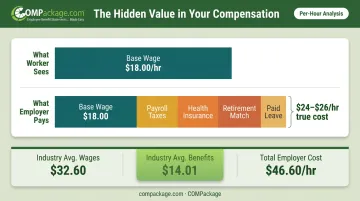
Tools like COMPackage's total compensation reports give employers a way to show hourly workers the full dollar value of what they receive, not just the number on their paycheck.
COMPackage's Annual Hourly Report format takes this further, translating benefits into both annual and per-hour terms — framed in the language hourly workers already use.
Hourly vs. Salaried Employees: Key Differences
| Factor | Hourly | Salaried |
|---|---|---|
| Pay structure | Per hour worked | Fixed annual amount |
| Overtime eligibility | Non-exempt (generally yes) | Often exempt (no) |
| Income predictability | Variable | Consistent |
| Timekeeping | Required | Typically not required |
| Paycheck flexibility | Reflects actual hours | Same regardless of hours |
For employees: Hourly work means you're paid for every hour you work — including overtime at a premium. The tradeoff is variable income and sometimes thinner benefits, particularly for part-time schedules.
For employers: Hourly workers offer labor cost flexibility: you pay for hours worked, which helps manage seasonal demand and variable workloads. The administrative tradeoff includes rigorous timekeeping, overtime monitoring, and compliance with state-specific scheduling rules.
FLSA and Other Laws Protecting Hourly Employees
The FLSA is the primary federal framework governing hourly work. Its core protections:
- Federal minimum wage: Currently $7.25/hour (state rates may be higher)
- Overtime pay: 1.5x regular rate for 40+ hours/week
- Recordkeeping: Employers must maintain accurate time and pay records
- Child labor protections: Workers under 18 face restrictions on hours and job types; 14 is the minimum age for most non-agricultural employment
Other Federal Laws That Apply
- FMLA: Employers with 50+ employees must provide up to 12 weeks of unpaid, job-protected leave for qualifying medical or family reasons. Employees need 12 months of service and 1,250 hours worked in the prior year to be eligible.
- OSHA: Requires safe working conditions for all employees, including hourly workers in physically demanding roles.
- EEO Laws: Prohibit discrimination based on race, sex, age, disability, and other protected characteristics — applicable regardless of pay structure.
State and Local Protections
Many states go further than federal law. As of 2024, key examples include:
- Paid sick leave: Sixteen states plus DC have active laws, including Arizona, California, Colorado, Massachusetts, Michigan, and New York.
- Predictive scheduling: Cities such as New York City, Seattle, Chicago, and San Francisco require advance notice of work schedules and compensation for last-minute changes.
When federal, state, and local rules overlap, the most protective standard always applies. HR teams should audit their compliance obligations by location annually, since state and local laws change frequently.
Frequently Asked Questions
What does "hourly employee" mean?
An hourly employee is a worker paid based on the number of hours they work, earning a set wage per hour. Under the FLSA, most hourly employees are entitled to the federal minimum wage and overtime pay for hours exceeding 40 in a workweek.
What are hourly employees called?
Under the FLSA, hourly employees are most commonly called non-exempt employees, distinguishing them from "exempt" workers who are not covered by overtime and minimum wage protections. The terms are often used interchangeably.
Why am I an hourly employee?
You're classified as hourly when your pay is tied to time worked rather than a fixed salary. This typically reflects the nature of the role (shift-based work), an employer's need for staffing flexibility, or because the position doesn't meet the criteria for FLSA exempt status.
What are the rules for hourly employees in California?
California has among the strictest hourly employee laws in the US, including daily overtime (1.5x after 8 hours/day, 2x after 12 hours), a statewide minimum wage of $16.90/hour in 2026, and mandatory meal and rest breaks with pay penalties if not provided. See the California Labor Commissioner's Office for specifics.
Do hourly employees get benefits?
Full-time hourly employees (30+ hours/week) are often entitled to employer-sponsored health insurance under the ACA if the employer has 50+ full-time equivalents. Other benefits — PTO, retirement plans, dental — depend on employer policy and vary widely.
What is the difference between hourly and salaried employees?
The primary difference is pay structure: hourly employees earn a wage per hour worked and are generally non-exempt (eligible for overtime), while salaried employees receive a fixed annual amount and are often exempt. Non-exempt salaried employees do exist, though — exemption depends on job duties and salary level, not pay structure alone.