Introduction
Compensation in 2026 is caught between two competing forces. Budgets are tightening. Employee expectations, raised by pay transparency laws and freely available salary data, are not.
Payscale's 2026 Compensation Best Practices Report (CBPR) frames this moment as "The Year of Strategic Alignment," signaling that compensation has moved from an HR administrative task to a boardroom priority.
The numbers back that up: 68% of executive teams now view compensation as a strategic lever for business success, and 75% request compensation reporting from HR regularly.
For small and mid-sized businesses, this creates a particular challenge. Large enterprises have dedicated compensation analysts, sophisticated HR platforms, and benchmark data on demand. SMBs face the same workforce pressures with a fraction of those resources.
This report unpacks what the 2026 CBPR data means in practice, covering:
- The AI pay gap and what it signals for skill-based compensation
- Pay transparency acceleration and compliance pressure
- Why uniform raises create more problems than they solve
- The most underused retention lever in most HR toolkits: communicating total compensation clearly
Key Takeaways
- Compensation maturity is rising: 45% of organizations now operate at the "Advancing" or "Optimizing" stages — a 12% year-over-year increase.
- Raises are flat and uniform: The median base pay increase is 3.5%, with 44% of organizations giving identical raises regardless of performance.
- AI skills are going uncompensated: 55% of organizations require AI competencies in updated roles but offer no pay premium for them.
- Pay transparency is accelerating: 49% of organizations are targeting organization-wide or public transparency in 2026, up from 33% in 2025.
- Pay communication is underused: Only 31% of organizations proactively explain pay decisions to employees — leaving a straightforward retention lever untouched.
The 2026 Compensation Landscape: What the Data Tells Us
A Cooling Labor Market — But Not a Reason to Cut
The labor market shifted noticeably in 2025. Total nonfarm payroll employment grew by just 584,000 for the full year — an average of 49,000 jobs per month, well below prior-year levels. BLS data shows monthly gains peaked at 158,000 in April before turning negative in August and October. Voluntary turnover dropped to a median of 8%, and only 43% of organizations reported actively hiring across most departments.
For employers, this means more leverage. But using that leverage to reduce compensation investment is a short-term play with long-term costs — especially when the next market upturn will reward organizations that maintained strong pay programs through the slowdown.
The Core Tension: Budgets vs. Expectations
51% of organizations cite balancing employee pay expectations against financial constraints as their single biggest compensation challenge in 2026. That tension isn't going away. Employees now have access to salary data from dozens of public and semi-public sources, and pay transparency legislation has raised expectations for clarity.
The result: 25% of organizations report losing talent because employees believe their pay is unfair — even when it isn't. The top driver of that misperception isn't actual underpayment. It's misinformation from unverified salary data sources, cited by 40% of those organizations.
Unfair Pay Perceptions Cost More Than You Think
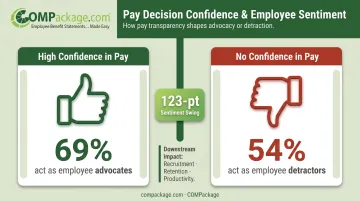
When employees believe they're underpaid — whether accurately or not — the damage shows up in trust, morale, and eventually in voluntary turnover. Payscale data puts numbers to this:
| Pay Decision Confidence | Employee Outcome |
|---|---|
| High confidence | 69% act as advocates |
| No confidence | 54% act as detractors |
That 123-point swing in employee sentiment directly affects recruitment, retention, and productivity — well beyond what any compensation budget line captures.
2026 Compensation Best Practices
Align Compensation with Business Goals
61% of organizations have a formal compensation strategy. Among top-performing companies, that number rises to 66% — and those organizations report significantly higher confidence in market pricing, pay increases, and total rewards packages.
The practical difference: organizations with a formal strategy can explain pay decisions in business terms, not just HR terms. That matters when employees ask why their raise was 3% instead of 5% — and when the CFO asks whether the payroll budget is actually working.
Ways to connect pay to business priorities:
- Performance-based increases tied to measurable role outcomes
- Skills-based pay bands that reward demonstrated competency growth
- Role leveling that creates clear progression paths and reduces compression
- Variable pay structured around company or team performance milestones
Benchmark Regularly Using Trusted Market Data
Organizations use a median of three salary data sources for market pricing — a healthy practice that reduces the distortions that come from relying on any single dataset.
The most-used sources break down as follows:
| Source Type | Usage Rate |
|---|---|
| Traditional publisher salary surveys | 60% |
| Free sources | 48% |
| HR-reported aggregate market data | 38% |
| Job postings data | 34% |
| Closed-network HR-reported salary data | 31% |
One caution here: industry specificity is the top data quality factor, cited by 71% of organizations. A general market benchmark for a software engineer in "technology" is far less useful than a benchmark specific to SaaS companies in the mid-Atlantic, for example. Free salary sites rarely offer that granularity — and over-reliance on them is the leading driver of the unfair pay perception problem described earlier.
Connect Pay to Performance Thoughtfully
76% of organizations plan to provide merit or performance-based increases in 2026. But only 48% plan to differentiate raises based on performance — and 18% report no formal pay-for-performance process at all.
That gap creates what Payscale calls the "peanut butter" problem: spreading the same raise across all employees regardless of contribution. According to Payscale's 2026 pay increase preview, 44% of organizations are using or considering this approach.
The strategic cost is real. When your strongest performers receive the same 3.5% increase as your weakest, you're spending budget without reinforcing the behavior that drives results — and giving high performers a compelling reason to test the market.
Review Benefits and Variable Pay as Total Rewards
Total rewards trends in 2026 show a mixed picture:
- Variable pay is declining — 75% of organizations offer it, down 6% year-over-year across all bonus types
- Benefits investment is holding steady, with 61% of organizations keeping levels flat and only 14% expanding
- Mental health and wellness benefits are the most commonly added new benefit, implemented by 42% of organizations
Evaluate the entire total rewards package together. A base salary at the 50th percentile reads very differently to an employee who also receives full health coverage, remote flexibility, and a generous retirement match. It reads differently still when that employee can see the full dollar value of what they're receiving — not just the base pay line on their offer letter.
The AI Pay Gap: A Critical 2026 Compensation Challenge
The Gap Is Already Opening
Organizations are updating roles to require AI competencies:
- 31% of IT roles now include AI skill requirements
- 20% of non-IT roles have been updated
- 10% of leadership and strategy roles reflect AI expectations
30% of organizations are currently replacing workers with AI or actively considering it. Yet 55% of organizations have made no compensation adjustment for employees who have developed those skills.
For the minority that do reward AI proficiency: 14% offer higher base pay, 10% offer bonuses or variable pay, and 9% offer equity or long-term incentives. Technology companies are leading — 29% offer higher base pay for AI skills — but across most industries, the gap between what's being required and what's being compensated is significant.
Why This Creates a Retention Risk
When employees upskill in AI — often on their own time — and then watch those skills fold into their existing job description without any pay recognition, they have a legitimate grievance. They're also operating in a market where tech-sector competitors are beginning to move faster on AI pay premiums.
Unlike general pay perception issues, this one isn't a misread of the situation. The organization is genuinely benefiting from the skill and not compensating for it.
A Practical Framework for SMBs
You don't need an enterprise compensation team to address this. A simple approach:
- Audit current roles — identify which positions have absorbed AI-related tasks or now require AI tools as part of daily work
- Assess scope change — determine whether the role has materially expanded in skill complexity
- Choose a recognition mechanism — options include base pay adjustments, one-time spot bonuses, or updated pay band positioning
- Communicate proactively — tell employees when and how AI skill premiums will be introduced, even if the timing is future-dated
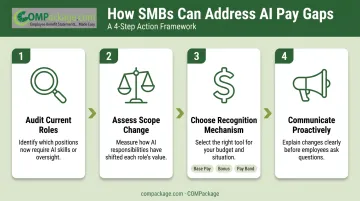
That last step matters as much as the pay decision itself. Employees who know a plan exists — even one that's future-dated — are far less likely to start looking elsewhere. A total compensation statement that itemizes current value alongside a note on upcoming adjustments can make that commitment concrete rather than a verbal promise.
Pay Transparency and Equity: From Compliance to Culture
The Acceleration Is Real
49% of organizations are targeting organization-wide or fully public pay transparency in 2026 — up from 33% the prior year. That's a 16-percentage-point jump in 12 months.
For multinational employers, there's also a hard compliance deadline: the EU Pay Transparency Directive transposition deadline passed in June 2026. Requirements include providing pay range information to job seekers before interviews, prohibiting pay-history questions, and mandating pay gap reporting for employers with 100 or more workers.
Even for U.S.-based businesses with no EU operations, these requirements are reshaping candidate and employee expectations broadly. The standard for "normal" transparency is shifting.
What Organizations Are Actually Doing
Steps organizations are taking in response to pay transparency pressure:
- Posting salary ranges in job advertisements
- Investing in compensation benchmarking data
- Training managers on how to have pay conversations
56% of organizations now train managers on compensation communication — a recognition that transparency only works if the people having those conversations are prepared for them. A manager who can't explain why two employees in similar roles have different salaries will generate more distrust than no transparency at all.
Pay Equity as a Related Practice
Those conversations only hold up when the underlying pay decisions are defensible. That's where equity analysis comes in.
60% of organizations have a current or planned pay equity analysis initiative. For small businesses that assume pay equity review is only an enterprise concern: 19% of organizations cite increased turnover linked to perceived pay inequities as a primary reason for prioritizing it.
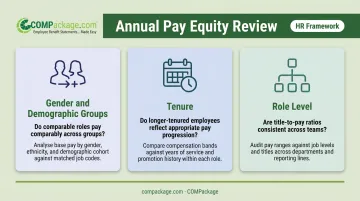
A basic annual review doesn't require sophisticated software. It means examining pay data across three dimensions and flagging gaps that lack a clear, defensible rationale:
- Gender and demographic groups — are comparable roles paying comparably?
- Tenure — do longer-tenured employees reflect appropriate progression?
- Role level — are title-to-pay ratios consistent across teams?
Communicating Total Compensation: The Retention Lever Most Organizations Are Underusing
The Communication Gap
Only 31% of organizations use proactive, transparent communications to explain pay decisions. 40% handle pay communications reactively — on a case-by-case basis through managers, typically only when an employee raises a concern.
The Payscale data shows this matters directly: organizations that communicate pay decisions clearly and proactively see significantly higher employee advocacy scores. Those that don't see more detractors. The mechanism isn't complicated — employees who understand how and why their pay was set are far less likely to assume the worst.
What a Total Compensation Statement Should Include
Most employees only see their take-home pay. BLS March 2026 data shows that for private industry workers, benefits account for 30.1% of total compensation costs — an average of $14.01 per hour on top of $32.60 in wages. That's a substantial portion of what an employer actually spends that most employees never see.
A complete total compensation statement should cover:
- Base salary
- Employer-paid benefits (health, dental, vision)
- Retirement contributions (employer match amounts)
- Paid time off (quantified as a dollar value)
- Bonuses and variable pay
- Non-quantifiable benefits (remote flexibility, professional development, wellness programs)
Only 43% of organizations currently provide total rewards statements that cover both cash and benefits. That means the majority of employers are leaving this retention tool entirely on the table.
Where COMPackage Fits
For SMBs without a dedicated compensation team, producing individual total compensation statements has felt out of reach — too time-consuming to do in-house, too expensive to outsource.
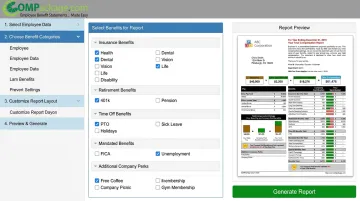
COMPackage was built to close that gap. The platform serves companies of any size, with a guided, menu-driven report builder that walks HR generalists through the process with no compensation specialist required. Features that make this practical for smaller teams include:
- Over 80 pre-programmed benefit categories, ready to use or customize
- Automated calculators for government mandatories, retirement contributions, and time-off valuation
- Employee LOADER for bulk data import — process an entire workforce's data from a single spreadsheet
- Per-employee display logic that shows only the benefits relevant to each employee
- Custom branding with company logo and report colors
The cost difference for organizations currently outsourcing compensation reporting is significant. Outsourced services often run into tens of thousands of dollars for mid-sized employers. In-house processing with COMPackage for a 5,000-employee company can come in under $2,000 for the year.
For service providers — HR consultants, benefits brokers, accounting firms, and payroll providers — the Professional version supports multi-client management from a single platform, enabling firms to produce statements across their entire client base without juggling separate tools.
Frequently Asked Questions
What is the average pay increase in 2026?
Payscale's 2026 CBPR reports a median planned base pay increase of 3.5%, unchanged from 2025. WTW's Salary Budget Planning Survey corroborates this with a 3.4% average for U.S. organizations. Increases are flat, and a growing share are being distributed uniformly rather than tied to performance.
What is a "peanut butter pay increase" and why is it a problem?
A peanut butter increase means spreading the same raise across all employees regardless of individual performance — like spreading peanut butter evenly. 44% of organizations are using or considering this approach. It demotivates high performers who receive the same reward as low performers and fails to align compensation investment with business outcomes.
How is AI changing compensation practices in 2026?
Organizations are adding AI competency requirements to existing roles across IT, non-IT, and leadership functions — but 55% are offering no pay premium for employees who have those skills. This creates a growing gap between what's being required and what's being rewarded, raising retention and equity risks.
What does pay transparency mean for small businesses?
Pay transparency means communicating pay ranges and the reasoning behind compensation decisions clearly, to both employees and candidates. Even small businesses benefit: proactive pay communication is directly linked to higher employee engagement and lower voluntary turnover, independent of whether your pay levels are above or below market.
What should a total compensation statement include?
A complete statement should cover base salary, employer-paid benefits, retirement contributions, paid time off value, bonuses, and non-monetary perks like remote flexibility or professional development. Showing employees the full picture corrects pay misperceptions that push people to leave — often unnecessarily.
How often should businesses review and update their compensation strategy?
At minimum, annually — with more frequent check-ins for high-volatility roles or during periods of market disruption. Tracking voluntary turnover, time-to-fill, and employee engagement scores helps identify when compensation adjustments are needed before small gaps become bigger ones.