Employee benefit statements exist to close that gap. This article covers what a benefit statement is, what it should include, why it matters for retention and recruiting, and how to start creating them — whether you have 10 employees or 1,000.
Key Takeaways
- Benefit statements show total pay value beyond salary: insurance, retirement, PTO, and employer taxes
- Employees who understand their full package are less likely to leave for a marginally higher salary
- Statements double as a retention tool and a recruiting asset
- Businesses of any size can create professional, personalized statements without expensive consultants
- Timing and delivery format shape whether employees notice—and act on—the full package value
What Is an Employee Benefit Statement?
An employee benefit statement is a personalized document that summarizes everything an employer contributes to an employee's compensation, not just the paycheck. Where a pay stub shows wages, a benefit statement captures the full picture.
It covers employer-paid insurance premiums, retirement contributions, payroll taxes paid on the employee's behalf, the dollar value of paid time off, and other perks that never appear as a line item on any check.
According to the Bureau of Labor Statistics' March 2026 Employer Costs for Employee Compensation report, private-industry employers spent $46.60 per hour on total compensation, of which $14.01 (30.1%) went to benefits, not wages. Employees rarely see that number.
Terminology: Benefit Statement vs. Total Compensation Statement
The terms "employee benefit statement," "total compensation statement," and "total rewards statement" are often used interchangeably, though there are subtle scope differences:
- Employee benefit statement: typically focuses on employer-paid benefit value
- Total compensation statement: covers cash compensation plus all employer-paid benefits
- Total rewards statement: may extend further to include well-being programs, recognition, and career development
For practical purposes, most HR teams use these terms to mean the same thing. The content matters more than the label.
Who Gets One?
Benefit statements can be issued to employees at any level — full-time, part-time, salaried, or hourly — across private and public-sector organizations. The specific content varies by role and benefits eligibility, so a statement for a part-time worker will look different from one for a senior manager with full benefits.
What to Include in an Employee Benefit Statement
A well-built benefit statement covers two broad categories: direct compensation (what shows up in a paycheck) and indirect compensation (everything the employer funds beyond the paycheck).
Direct Compensation
Most employees are familiar with these figures already:
- Base salary or hourly wages
- Performance bonuses
- Commissions
- Overtime pay
Including direct compensation gives context: the statement supplements the pay stub rather than replacing it.
Indirect Compensation and Benefits
This is where benefit statements do their real work. Core items to include:
- Health, dental, and vision insurance — employer premium contributions
- Retirement plan contributions — such as 401(k) matching
- Employer-paid life and disability insurance
- FICA/payroll taxes — Social Security (6.2%) and Medicare (1.45%) on covered wages
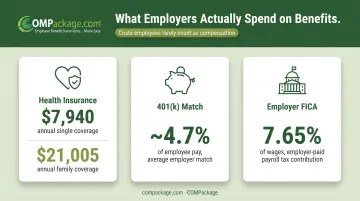
Benchmarks help put those line items in perspective. Per the 2025 KFF Employer Health Benefits Survey, employers contributed an average of $7,940 for single coverage and $21,005 for family coverage annually. Typical 401(k) matches land near 4.7% of pay in large-plan data, and the employer share of FICA adds another 7.65%—costs employees rarely count as compensation on their own.
Beyond the core, these items add perceived value:
- Paid time off — calculated as a dollar amount (daily rate × days earned)
- Employee Assistance Programs (EAPs)
- Flexible spending accounts
- Tuition reimbursement
- Wellness stipends
- Professional development and training budgets
Non-Quantifiable Benefits
Not everything has a price tag, but it can still belong on a benefit statement:
- Flexible work arrangements and remote options
- Career advancement opportunities
- Job security
Listing these perks, even without a dollar figure, shows that the employment relationship goes beyond compensation math.
Illustrative Example
Here's what a benefit statement might look like for a hypothetical employee earning $50,000 in base salary:
| Compensation Component | Annual Value |
|---|---|
| Base salary | $50,000 |
| Employer health insurance (single) | $7,940 |
| 401(k) match (4% of salary) | $2,000 |
| Employer FICA contributions (7.65%) | $3,825 |
| PTO value (15 days × daily rate) | $2,884 |
| Life/disability insurance | $600 |
| Total Employer Investment | ~$67,249 |
This example is illustrative, using current published benchmarks. Individual figures will vary by employer, plan design, and employee benefits eligibility.
That $50,000 salary becomes a $67,000+ total package. Most employees never see that gap without a statement like this.
Why Employee Benefit Statements Matter
Retention
When employees only see their take-home pay, they're more vulnerable to leaving for a competitor offering a few thousand dollars more in salary. What they don't calculate is what they'd be giving up.
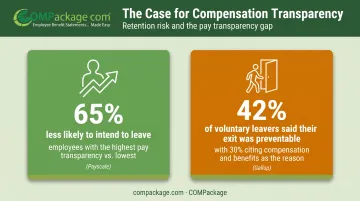
Research from Payscale found that employees reporting the highest level of pay transparency were 65% less likely to intend to leave than those at the lowest transparency level.
Benefit statements directly support that transparency. They make the employer's total investment visible. Once an employee sees that their "real" compensation is $20,000 more than their paycheck suggests, the math on switching jobs looks very different.
A separate Gallup analysis found that 42% of recent voluntary leavers said their manager or organization could have done something to prevent their exit, and compensation and benefits accounted for 30% of those preventable actions. Benefit statements won't solve every turnover problem, but they close an information gap that contributes to preventable departures.
Engagement and Morale
Employees who feel their employer is transparent about compensation show higher engagement and job satisfaction. A benefit statement shows the full value behind the role, not salary alone. Shared clearly and on a regular cadence, that recognition strengthens how employees feel about staying put.
Recruiting Advantage
Benefit statements aren't just for current employees. Sharing a total compensation summary with job candidates makes an offer look more compelling against competitors who quote salary only. A candidate comparing a $58,000 offer with a complete package breakdown to a $62,000 offer with no context may find the first offer more attractive once the full picture is clear.
Trust and Communication
Sharing statements annually creates a regular touchpoint. It opens conversations about compensation, benefit utilization, and career development, and it reduces the kind of misunderstanding that fuels HR inquiries. Employees who know their employer communicates openly about pay are less likely to assume the worst.
How to Create an Employee Benefit Statement
Creating an employee benefit statement is a clear four-step process. The hard part is doing it accurately for every employee without living in spreadsheets.
The Core Steps
- Gather compensation data: Collect salary or wage figures, employer-paid benefit costs, tax contribution rates, and PTO accrual values for each employee.
- Organize into categories: Group items into direct compensation, employer-paid benefits, and any non-quantifiable perks that still matter.
- Calculate total employer investment: Add every component so the statement shows the full cost to the company.
- Personalize and format: Include the employee's name, role, and only the benefits that apply to them. Use charts or graphs where they clarify the breakdown.
The Challenge for Small and Mid-Sized Businesses
Building individual statements manually for 50, 100, or 200 employees in spreadsheets is slow and error-prone. That friction is why many businesses skip the process, then wonder why employees undervalue their compensation.
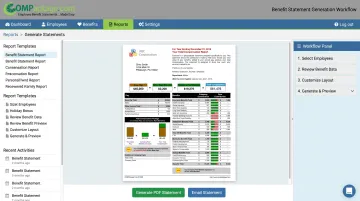
COMPackage is built for this workflow. It lets you generate personalized, professional benefit statements in-house—no consultants or custom development. Key capabilities include:
- 80+ benefit categories: Preprogrammed perk and benefit types, each customizable by name
- Employee LOADER: Map Excel column headers and bulk-import hundreds of employees in minutes
- 13 auto-calculators: Cover government mandatories, 401(k), time-off, insurance, and workers' compensation costs
- Employee-level personalization: Only benefits with a value for that person appear on their report
- Full-census speed: Finish reports for an entire employee census in under 90 minutes
Pricing starts at $149/year for companies with up to 5 employees and scales through tiered annual packages to an Unlimited plan. A Professional version ($2,999/year) is available for HR consultants, benefits consultants, insurance agencies, and accounting firms that run benefit reporting for multiple clients.
Formatting Tips
- Include your company logo and brand colors
- Use a pie chart or bar graph to show how total compensation breaks down
- Keep statements to one page when you can; COMPackage fits up to 23 benefit line items per page, with overflow on a second page
- Avoid generic, one-size-fits-all templates—personalization is what makes the statement credible
Best Practices for Sharing Employee Benefit Statements
Timing matters. Issue statements annually, ideally at year-end or early in the new year. That timing reflects the prior year's full compensation. Avoid releasing during open enrollment, when employees are already processing a lot of information and benefit fatigue sets in.
Don't just email a PDF. Walk employees through their statements in a one-on-one or team setting. Explain what each line means, especially items like employer FICA contributions that employees rarely think about. Invite questions. SHRM's 2024 guidance notes that 54% of employees wanted personalized benefit recommendations, and half said improved benefits communication would make them feel more valued.
Prompt action. Use the statement as a starting point for a financial conversation:
- Are employees maximizing their 401(k) match?
- Are they using their EAP or wellness stipend?
- Do they understand what their PTO is actually worth annually?
Frame the statement as a financial planning tool that helps employees make smarter decisions, not only another HR handout.
Frequently Asked Questions
What is an employee benefit statement?
An employee benefit statement is a personalized document showing an employee's total compensation: base salary plus the full monetary value of employer-paid benefits like health insurance, retirement contributions, and paid time off. It gives employees a complete picture of what their employment is actually worth, not just what appears on their paycheck.
Can you provide an example of an employee benefit statement?
An employee earning $52,000 in base salary might have an additional $15,000–$18,000 in employer contributions (health premiums, 401(k) match, PTO value, payroll taxes), bringing total compensation to roughly $67,000–$70,000. The statement presents all these figures in a clear, itemized format with the employee's name and a category-by-category breakdown.
What is the difference between an employee benefit statement and a total compensation statement?
The terms are largely interchangeable in practice. "Total compensation statement" tends to emphasize that the document covers all direct and indirect compensation, while "benefit statement" focuses on the employer-paid benefit portion. Most organizations use both terms to mean the same document.
How often should employee benefit statements be issued?
At least once a year, most commonly at year-end or early in the new year. Some employers also issue statements during significant career events like promotions, salary increases, or open enrollment periods to reinforce the value of the total package at a relevant moment.
How do employee benefit statements help with employee retention?
Statements reduce turnover by making the full employer investment visible. When employees see their total package is $15,000–$20,000 more than their take-home pay suggests, leaving for a modest salary bump elsewhere becomes a much less attractive proposition, because they can now see exactly what they'd be giving up.
Who is responsible for creating employee benefit statements?
HR departments typically own the process, working with payroll and finance to gather accurate data. In smaller businesses without dedicated HR, owners or office managers often handle it. Total compensation software like COMPackage makes the process manageable at any company size, from five employees to several thousand.