Introduction
Most employees see their paycheck and think that's their full pay. What they miss (retirement contributions, health insurance, PTO, and other perks) can easily add 30% or more on top of base salary.
That gap creates a real problem. Employees feel underpaid and leave for marginally higher base salaries elsewhere. Employers lose people they were actually paying well to retain, without ever understanding why.
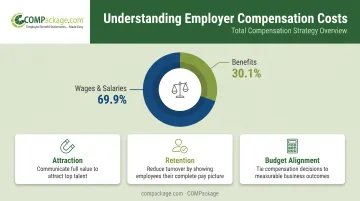
According to the U.S. Bureau of Labor Statistics, benefits account for 30.1% of total employer compensation costs for private-industry workers, averaging $14.01 per hour on top of wages. Yet most of that value stays invisible.
This article walks through what a total compensation strategy is, what goes into one, how to build it step by step, and how to communicate it effectively, with practical guidance that works for businesses of any size.
Key Takeaways
- Benefits are roughly 30% of total compensation costs; optimizing base pay alone ignores nearly a third of labor spend
- A written compensation philosophy creates consistency in pay decisions and helps managers explain packages to employees
- Benchmark the full package, not just salaries, and revisit those benchmarks at least annually
- Tax-favored benefits let employers deliver more value per dollar without increasing tax liability
- Employees who see their full compensation picture are less likely to leave for slightly higher base pay
What Is a Total Compensation Strategy and Why Does It Matter?
A total compensation strategy is a deliberate, documented plan that defines what an organization offers employees beyond base pay. It covers every monetary and non-monetary reward, and how those offerings are structured, communicated, and reviewed over time.
Without a strategy, compensation decisions become reactive and inconsistent. With a strategy in place, organizations gain three concrete advantages:
- Attraction: Candidates increasingly compare full packages, not just starting salaries. A well-structured offer communicates value beyond the number on the offer letter.
- Retention: Employees who understand what their employer actually invests in them are less likely to leave for a competitor offering $5,000 more in base pay.
- Budget alignment: A documented strategy helps HR forecast labor costs accurately and make deliberate trade-offs between cash and benefits.
BLS data makes the case: wages account for 69.9% of employer compensation costs, while benefits cover the remaining 30.1%. A strategy that only focuses on base salary is optimizing roughly two-thirds of total spend while leaving the rest unmanaged.
The Core Components of Total Compensation
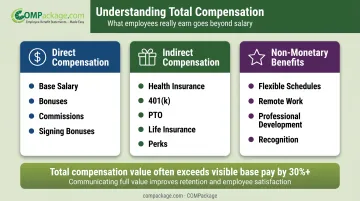
Total compensation breaks into three categories: direct compensation, indirect compensation, and non-monetary benefits.
Direct Compensation
Direct compensation includes all monetary payments made to the employee:
- Base salary or hourly wages (typically ~70% of total compensation)
- Performance bonuses and commissions
- Profit sharing and overtime pay
- Signing bonuses and retention bonuses
Base pay is the anchor of any package. Everything else builds from it.
Indirect Compensation
Indirect compensation covers non-cash benefits with real monetary value:
- Health, dental, and vision insurance — including the employer-paid portion, which averages $3.41/hour for health insurance alone
- Retirement contributions — 401(k) matching and employer contributions
- Paid time off — vacation, sick leave, holidays, and parental leave (averaging $3.54/hour in employer costs)
- Life and disability insurance
- Perks — commuter benefits, gym memberships, tuition reimbursement
These are the benefits employees most frequently underestimate. An employee earning $70,000 in base salary may be receiving $90,000 or more in total employer investment once indirect compensation is counted.
Non-Monetary Benefits
Non-monetary benefits are harder to price, but they often decide where people take jobs:
- Flexible schedules and remote/hybrid work options
- Professional development and career growth opportunities
- Recognition programs
- Workplace culture and leadership quality
Transamerica's 2024 multigenerational workforce study found that flexible work arrangements mattered to 90% of Gen Z and Millennials, and 70% of Baby Boomers. Flexible work and growth opportunities belong in every total compensation strategy and should appear on compensation statements wherever possible.
How to Build a Total Compensation Strategy: Step-by-Step
Any organization, from a 10-person small business to a 1,000-person mid-market company, can follow this framework. The goal is a strategy that is competitive, financially sustainable, and clearly understood by employees.
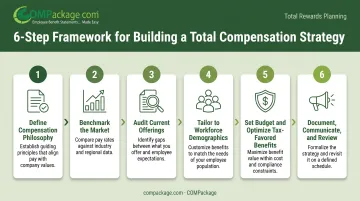
Step 1: Define Your Compensation Philosophy
A compensation philosophy is the written foundation of your strategy. It answers three core questions:
- Market position: Will you lead, match, or lag the market on pay?
- Cash vs. benefits balance: How do you split total investment between wages and non-wage benefits?
- Pay for performance: What role does individual or team performance play in compensation?
According to WorldatWork's 2021 survey, only 62% of organizations had a written compensation philosophy. The other 38% make pay decisions without a documented framework. That creates inconsistency and leaves managers without clear answers when employees ask why they earn what they do.
Document the philosophy. It doesn't need to be long. It needs to be clear.
Step 2: Benchmark Against the Market
You can't compete for talent without knowing where you stand. Benchmarking involves researching:
- Industry compensation surveys (WorldatWork, SHRM, Mercer, Willis Towers Watson)
- Job-specific market data for your key roles
- Competitor offerings across both direct and indirect compensation
Benchmark the full package, not just base salaries. A company offering below-market health coverage may look competitive on salary alone but loses out when candidates compare total packages.
73% of organizations adjust compensation ranges annually, according to WorldatWork's 2023 research. At minimum, run a benchmarking review once a year. If you're in a fast-moving labor market, twice a year is worth considering.
Step 3: Audit Your Current Offerings and Identify Gaps
Before redesigning anything, map what you already have:
- List every compensation element across direct, indirect, and non-monetary categories
- Calculate the total employer cost per employee
- Compare that total against market benchmarks
- Identify where you're competitive, where you're falling short, and where you're over-investing relative to impact
Gather employee survey data at this stage. Prudential's 2025 study found employers underestimated employee demand for retirement matching by 12 percentage points and long-term disability by 11 points. They overestimated demand for dependent-care FSAs by 9 points. Assumptions about what employees value are often wrong. Ask them.
Step 4: Tailor Benefits to Your Workforce Demographics
A single benefits package rarely fits everyone equally. Use workforce demographic data to weight the benefits mix:
| Workforce Segment | High-Priority Benefits |
|---|---|
| Early career / Gen Z | Student loan assistance, flexible schedules, career development |
| Mid-career employees | Robust health coverage, childcare support, 401(k) matching |
| Employees 50+ | Retirement planning tools, enhanced 401(k), financial wellness programs |
Health insurance matters universally. Transamerica found it important to 94–96% of workers across all generations. But the priorities around everything else vary significantly. A package built around what 30-year-olds want will miss the mark for a workforce that skews older, and vice versa.
Step 5: Set a Sustainable Budget and Optimize for Tax-Favored Benefits
Labor costs consume a large share of operating expenses. SHRM data puts median salary expense at 49% of operating costs. Your compensation strategy must fit within financial reality.
Tax-favored benefits are the most efficient tool available for stretching that budget. They allow employers to deliver more value per dollar without triggering additional tax liability:
- Employer health plan contributions are generally excluded from employee wages
- 401(k) contributions up to the annual limit ($72,000 in total additions for 2026) receive favorable tax treatment
- Group-term life insurance up to $50,000 of coverage is excluded from wages
- Educational assistance up to $5,250 per employee annually can be excluded under a qualifying written plan
Prioritizing these benefits, rather than equivalent cash increases, often delivers more value to employees at lower net cost to the employer.
Step 6: Document, Communicate, and Review Regularly
A generous package that employees don't understand is a wasted investment. The strategy must include a communication plan that covers:
- When compensation is shared: offer letters, onboarding, annual reviews, and open enrollment
- What format is used: personalized total compensation statements with itemized breakdowns
- How often the strategy itself is reviewed: at minimum annually, plus when growth, market shifts, or major benefits changes demand it
Self-service tools such as COMPackage help HR teams generate those itemized statements in-house in a few hours, so employees can see the full value of their package.
Review cadence matters. Markets shift, workforce demographics evolve, and what was competitive two years ago may not be today.
How to Calculate Total Compensation
Follow this four-step process to calculate total compensation per employee:
- Gather direct compensation data — base salary, bonuses, commissions, overtime pay
- Gather indirect compensation data — employer-paid insurance, retirement contributions, PTO value, and legally required costs (Social Security, Medicare, workers' comp)
- Sum all components to arrive at total employer cost
- Schedule regular updates — at least annually, or when any component changes significantly
Total employer cost is not the same as total employee value. Group health insurance, for example, would cost an employee far more to buy on their own — so the value they receive often exceeds what you pay.
Total Compensation Package Example
Here's a sample breakdown for a mid-level employee earning $65,000 base salary:
| Compensation Component | Annual Value |
|---|---|
| Base Salary | $65,000 |
| Performance Bonus (5%) | $3,250 |
| Employer Health Insurance Contribution | $7,200 |
| 401(k) Match (4%) | $2,600 |
| PTO Value (15 days) | $3,750 |
| Life Insurance | $500 |
| Commuter Benefits | $1,200 |
| Professional Development Budget | $1,500 |
| Total Compensation | $85,000 |
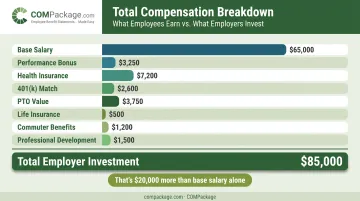
An employee who only sees the $65,000 base salary misses $20,000 in employer investment. Leave that gap uncommunicated, and you invite retention risk.
Communicating Total Compensation to Your Employees
What a Total Compensation Statement Is
A total compensation statement is a personalized document that presents the full monetary value of an employee's package in a clear, itemized format. It answers the question every employee should be able to answer: "What is my employer actually investing in me?"
Share statements at key moments in the employee lifecycle:
- With job offers, so candidates evaluate the full package
- During annual reviews, to reinforce total value alongside any salary discussion
- After significant benefits changes, so employees always have an accurate picture
The Business Case for Sharing Statements
BambooHR's 2024 compensation research found that 63% of employees would accept a pay cut for specified perks. Benefits clarity and communication have real retention value. Employees who understand their full compensation are better positioned to weigh a competitor's offer accurately, rather than being swayed by a higher base salary number alone.
How COMPackage Makes It Practical
For small and mid-sized businesses, generating personalized total compensation statements has historically meant paying consultants or service bureaus, or building something in Excel that breaks the moment someone adds a new benefit.
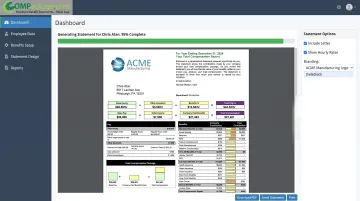
COMPackage is self-service software that lets you build those statements in-house without a consultant or service bureau. You can:
- Cover 80+ benefit categories, from health insurance and 401(k) to commuter benefits and non-quantifiable perks
- Bulk-import employee data from Excel with Employee LOADER (minutes for 100 or 1,000 records after column mapping)
- Auto-calculate government mandatories, 401(k), time-off, and insurance with 12+ built-in calculators
- Brand reports with your logo, colors, and custom benefit category names
- Regenerate reports anytime during the 365-day subscription at no extra cost
Pricing starts at $149/year for 1–5 employees and scales to $2,999/year for unlimited employees.
Common Mistakes to Avoid When Building a Total Compensation Strategy
Mistake 1: Benchmarking only base salary
Many organizations compare salaries against market data but stop there. Benefits benchmarking is equally important.
A competitive salary paired with below-market health coverage or no 401(k) match is still an uncompetitive total package. Salary data alone won't show that gap. Benchmark the whole picture.
Mistake 2: Building the strategy without employee input
Prudential's 2025 research found significant gaps between what employers assumed employees valued and what employees actually prioritized. Before finalizing your benefits mix, run pulse surveys or focus groups. Revisit the feedback annually. Allocating budget to benefits employees don't value is the most common source of compensation waste.
Mistake 3: Communicating compensation only once
Sharing a total compensation statement at hire and never revisiting it means employees gradually forget what they're receiving. Build a year-round rhythm instead:
- Brief reminders during open enrollment
- Mid-year benefits summaries
- Annual statements tied to performance reviews
Continuous visibility is what shifts how employees perceive their compensation.
Frequently Asked Questions
Can you give me an example of a compensation strategy?
A mid-sized company might target the 50th market percentile on base pay, fully cover health insurance, match 4% on a 401(k), and offer flexible remote work. It then shares the full package value each year through personalized total compensation statements.
What are the four components of total compensation?
The four main components are base pay, variable pay (bonuses and commissions), indirect benefits (health insurance, retirement, PTO), and non-monetary rewards such as flexible work and professional development.
What is the difference between total compensation and total rewards?
Total compensation focuses on quantifiable monetary and benefit values: salary, bonuses, insurance, retirement, and PTO. Total rewards is a broader framework that also covers recognition, career development, and workplace culture.
What is a total compensation statement?
It's a personalized document that shows the full value of an employee's package—base pay, benefits, and other rewards—in one place. Issued annually or with an offer, it helps people see true package worth instead of only take-home pay.
How often should a total compensation strategy be reviewed?
At minimum annually, to reflect market benchmarks, business financials, workforce demographics, and employee feedback. Review sooner after major events such as rapid hiring, labor-market shifts, or large benefits changes.
How do small businesses build a competitive total compensation strategy on a limited budget?
Prioritize tax-favored benefits like qualified health plans and 401(k) matching for strong value at lower tax cost. Add lower-cost perks employees care about, such as flexibility and development. Self-service tools like COMPackage make the full investment visible with total compensation statements.