Introduction
Picture an employee at a mid-sized manufacturing company. A recruiter calls with a job offer paying $4,000 more per year. On paper, it looks like an easy decision.
What that employee doesn't see is the 401(k) match, fully funded health plan, tuition reimbursement, and PTO payout already on the books. They're weighing one number against a full package no one has ever spelled out.
That gap—between total compensation and total rewards—is why small and mid-sized businesses keep losing people they wanted to keep.
The terms get used interchangeably, but they aren't the same. Knowing the difference matters when you're competing with bigger companies for talent.
This guide defines both terms, covers the five components of a total rewards package, and shows why the distinction affects retention and recruiting. You'll also see how to build and communicate a strategy without hiring a consultant.
Key Takeaways
- Total compensation is monetary pay only; total rewards also include benefits, well-being, development, and recognition
- Educating employees on pay decisions boosts trust by 10% and pay-fairness perceptions by 11% (Gartner)
- WorldatWork’s five-component model is the standard framework for designing total rewards
- Personalized total rewards statements close the gap between what employers spend and what employees think they earn
Total Compensation vs. Total Rewards: What's the Difference?
In everyday conversation, people use "total compensation" and "total rewards" as if they mean the same thing. They don't. Each term represents a different scope of value, and that difference shapes how a business should talk about its pay and benefits offer.
What Is Total Compensation?
Total compensation is the sum of every monetary element an employee receives:
- Base salary or hourly wage
- Bonuses and commissions
- Overtime pay
- Equity or stock options
This is the dollar figure on a paycheck or W-2. It doesn't capture insurance coverage, retirement contributions, or development programs. None of that shows up here.
Here's the problem for smaller employers: if you're competing against a company with deeper pockets on total compensation alone, you'll often lose. Larger companies can typically outbid you on base salary. Framing the conversation around total compensation only plays to their strength.
What Is Total Rewards?
Total rewards is the complete employee value proposition. It includes total compensation, plus:
- Health, dental, and vision coverage
- Retirement contributions
- Wellness programs
- Career development
- Recognition
This is the investment employees don't see on a pay stub.
According to BLS data on employer costs for employee compensation, benefits make up 30.1% of what private-industry employers spend on workers, averaging $14.01 per hour on top of $32.60 in wages. That's roughly 43 cents of benefit value for every dollar of pay — value most employees never add up on their own.
Total rewards strategy usually sits with HR and compensation teams, but it doesn't work in a vacuum. Finance has to fund it, and leadership has to buy into what it says about the company.
Key Differences at a Glance
| Total Compensation | Total Rewards | |
|---|---|---|
| Scope | Monetary only | Holistic (monetary + non-cash) |
| Purpose | Paycheck value | Full employee value proposition |
| Communication | Pay stub, offer letter | Total rewards statement |
For small and mid-sized businesses, leading with total rewards framing is the smarter move. A total rewards statement puts that full package in writing, so you can compete for talent without matching a larger competitor dollar-for-dollar on salary.
The 5 Core Components of a Total Rewards Package
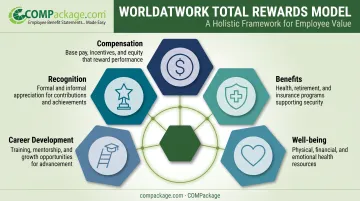
WorldatWork's Total Rewards Model has served as the standard framework for compensation professionals since 2000. It organizes everything an employer offers into five buckets: compensation, benefits, well-being, career development, and recognition.
Compensation
This is the financial foundation: base pay, variable pay, bonuses, and equity. It's the number that anchors every conversation, and it's usually the first line on any total rewards statement.
Benefits
Health, dental, and vision insurance. Retirement plans with an employer match. Life and disability coverage. PTO. Newer benefits are gaining ground too. SHRM reports that student loan repayment assistance grew from 7% of organizations offering it in 2022 to 9% in 2024.
Well-being
Physical, mental, and financial wellness programs. Employee assistance programs. Wellness stipends. This is often the most undercommunicated piece of the whole package. companies pay for it, then never tell employees it exists.
Career Development
Training budgets, tuition reimbursement, mentorship, internal mobility. Visible career pathing improves retention even in entry-level and hourly roles, where employees often assume there's no path forward at all.
Recognition
Formal programs like service awards and spot bonuses matter, but so does informal, day-to-day acknowledgment from a manager. Consistency beats budget size here. a small, regular recognition habit outperforms a once-a-year banquet.
Why Total Rewards Compensation Matters for Your Business
The Perception Gap Is Real
Employees consistently underestimate what their employer spends on them. A 2025 EBRI Workplace Wellness Survey of over 1,400 workers found employees estimated only 16% of their total compensation went to benefits. The actual figure is closer to 30%. That's a nearly two-to-one gap between perception and reality.
That gap has consequences. When employees only see their base salary, they compare it against a competitor's base salary and walk away, even if their current package is stronger overall.
Closing that gap shows up in retention, recruiting, and how much employees actually use their benefits.
Improved Retention
Gartner's research on over 3,200 employees found that clearly explaining how pay decisions get made increased organizational trust by 10% and perceptions of pay fairness by 11%. Employees who felt their pay was fair also reported 15% higher intent to stay than those who didn't.
Stronger Recruiting Position
A documented total rewards package lets you compete with companies offering higher base pay but a thinner benefits story. When a candidate can see the 401(k) match, the healthcare contribution, and the development budget laid out in dollars, the base salary gap looks a lot smaller.
Higher Benefit Utilization
Benefits sitting unused aren't helping anyone. Often, employees simply don't know a program exists: an EAP, a wellness stipend, a tuition benefit. Documenting the full package puts these programs in front of employees instead of buried in a handbook nobody reads.
Closing the Gap Without a Consultant
COMPackage gives businesses with 5 to 5,000 employees a way to close that gap in-house. Its self-service software builds and distributes personalized total compensation statements, typically in less than a day, without consultant fees or a third-party production schedule.
How to Build and Communicate a Total Rewards Program
Building the Program
- Inventory everything — List every benefit and program across all five components, then survey employees to see what they actually value most (it's often not what leadership assumes).
- Assign dollar values — Put a real number on the 401(k) match, healthcare contributions, and PTO. Vague claims don't land; specific figures do.
- Feature your differentiators — A generous parental leave policy or an employee-controlled development budget is worth highlighting in every recruiting conversation.
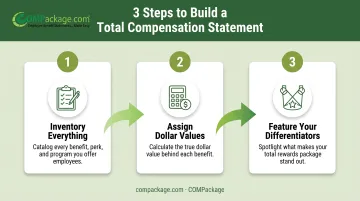
COMPackage's report builder includes 12 automated calculators that speed up step two, pulling values for government-mandated benefits, 401(k) contributions, time-off, and insurance costs directly onto each statement.
Communicating the Program
Distribute personalized statements at least annually, ideally timed around open enrollment, performance reviews, or retention conversations. That's when employees are already thinking about pay and benefits, so the timing does some of the work for you.
Statements work best when the rest of your communication supports them:
- Train managers to explain the "why" behind pay decisions, not just hand over a document
- Revisit the program every year as benefits change
- Track utilization data to see where communication or investment needs adjusting
With COMPackage, you can generate reports for an entire employee census using the Employee LOADER, which imports data directly from Excel. Updates and reruns are free throughout the 365-day subscription, so a mid-year benefits change doesn't mean starting over.
Frequently Asked Questions
What's the difference between total rewards and total compensation?
Total compensation covers only monetary pay: salary, bonuses, commissions, and equity. Total rewards is the broader picture, adding benefits, well-being, development, and recognition on top.
What should I include in total compensation?
Base salary or hourly wages, bonuses, commissions, overtime pay, and equity or stock options. These are the elements that show up as dollar figures on a paycheck or W-2.
Is total rewards considered HR?
Yes, generally. HR and compensation teams typically own the strategy, but building and funding it requires input from finance and buy-in from leadership.
What are the 5 components of a total rewards package?
Per the WorldatWork model: compensation, benefits, well-being, development (often labeled "career growth"), and recognition. These five buckets cover the full employee value proposition.
How do I calculate the total value of an employee's compensation package?
Add base pay and bonuses to the dollar-equivalent value of benefits like health coverage, retirement contributions, and PTO. Many employers use compensation statement software, such as COMPackage, to automate that math.
Why should small businesses invest in total rewards statements?
Statements show candidates and employees the real value of an offer — often 30% or more beyond base pay. That visibility improves retention and recruiting without necessarily raising salaries.