
Compensation management is the structured process of designing and overseeing how employees are rewarded — covering base salary, bonuses, benefits, and non-cash perks. Done reactively, it's just keeping up with market rates. Done proactively, it becomes one of the most powerful tools in a company's talent strategy.
This article covers the core objectives of compensation management, why transparency belongs near the top of that list, the types of compensation involved, common challenges, and practical steps for getting it right — whether you're running a 15-person team or a 1,500-person organization.
Key Takeaways
- Compensation management objectives extend far beyond fair pay, directly shaping how companies attract talent, retain employees, and build culture.
- Core objectives include attracting talent, retaining employees, motivating performance, ensuring legal compliance, and maintaining internal pay equity.
- Transparency about total compensation is one of the highest-impact and most overlooked objectives.
- Wage inflation, pay compression, and expanding pay transparency laws require ongoing strategy review.
- Small and mid-sized businesses can compete effectively by clearly communicating their total compensation package — not just base salary.
What Is Compensation Management?
Compensation management is how organizations plan, implement, and oversee the full spectrum of employee rewards — from base salary and performance bonuses to employer-paid benefits and non-monetary perks. The goal is to balance internal fairness with external market competitiveness.
Two terms worth distinguishing:
- Compensation philosophy — a written statement of how an organization intends to pay and reward employees, aligned with its goals of attracting, retaining, and motivating talent
- Compensation plan — the operational execution of that philosophy, covering salary structures, merit increase budgets, incentive eligibility, and payout criteria
Both are necessary. Without a plan, a philosophy stays on paper. Without a philosophy, decisions become inconsistent and difficult to defend when employees or leadership push back.
Compensation management is not a one-time exercise, either. According to a WorldatWork survey of 1,007 organizations, 73% adjust their compensation ranges annually — meaning most organizations treat market benchmarking and structure review as ongoing operational work, not a periodic reset.
Key Objectives of Compensation Management
Every organization has different priorities, but most compensation strategies share a common set of objectives that guide how pay is structured, communicated, and adjusted over time.
Attract and Recruit Top Talent
A compensation package is often a candidate's first signal about how much a company values its people. Salary and benefits directly influence whether strong candidates apply at all.
SHRM research from 2024 found the following about pay transparency in job postings:
- 41% of professionals lose interest in a role when no salary range is listed
- 80%+ of U.S. workers are more likely to apply when a pay range is included
- 70% of organizations that post salary ranges report receiving more applicants
- 65% say pay transparency makes them more competitive in recruiting
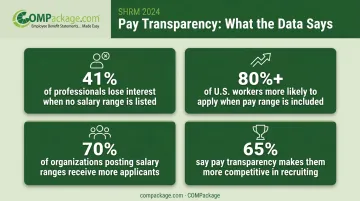
The implication: compensation management directly affects the top of your hiring funnel, not just what happens after an offer is extended.
Retain Existing Employees
Replacing an employee is expensive. Gallup estimates replacement costs at roughly 200% of salary for managers and leaders, 80% for technical roles, and 40% for frontline staff. SHRM's broader range puts it at 50%–200% of annual salary depending on the role.
That cost makes retention a financial priority — and pay is central to it. Mercer's research across 2.7 million respondents found that only 55% of employees globally believe they are paid fairly, with fair pay ranking as the second most important reason employees stay.
Compensation that lags the market — or isn't communicated clearly — creates quiet dissatisfaction. Employees who don't understand the full value of what they earn are more likely to leave for offers that appear more competitive on paper.
Motivate and Drive Performance
Base salary establishes a floor. Variable pay — performance bonuses, profit-sharing, commissions tied to measurable KPIs — connects individual effort to company outcomes.
When designed well, performance-linked pay creates accountability at every level:
- Employees see a direct line between their contributions and their earnings
- Managers have defensible criteria for differentiated pay decisions
- The organization reinforces the behaviors it actually wants to reward
Ensure Legal Compliance and Pay Equity
Compensation management has a legal dimension that's growing in complexity. Pay transparency laws are expanding rapidly: Jackson Lewis reported in 2026 that by 2027, at least a dozen states, multiple cities, and certain counties will require pay-range disclosures. Illinois and Minnesota laws took effect in 2025, with New Jersey, Vermont, and Massachusetts set to follow.
Beyond disclosure requirements, pay equity obligations under the Equal Pay Act and EEOC enforcement carry real financial exposure. The EEOC recently announced a $2.8 million settlement with LeachGarner in a pay-discrimination case — a concrete reminder that undocumented pay decisions create both legal liability and lasting reputational damage with job seekers.
Maintain Employee Morale and Internal Fairness
Employees compare their pay to peers. When internal equity breaks down — through pay compression, inconsistent merit raises, or perceived favoritism — morale erodes faster than most managers expect.
Pay compression is more common than many organizations realize. A 2024 SHRM/beqom analysis found that 53% of employers uncovered pay compression issues during compensation analysis — a situation where newer hires earn close to or more than tenured employees due to market-rate adjustments that weren't matched internally.
Clearly defined salary bands and consistent merit review processes are the primary tools for preserving trust around pay.
Strengthen Employer Brand and Reputation
How an organization pays reflects what it values. Employees who feel fairly compensated become advocates — through referrals, online reviews, and reputation-building conversations that happen long before a recruiter reaches out to a candidate.
Compensation-related dissatisfaction is now publicly visible on Glassdoor, Indeed, and LinkedIn. That visibility cuts both ways: organizations that communicate pay well can differentiate themselves, while those that don't create a recruiting liability that compounds over time.
Why Compensation Transparency Is a Critical Objective
Most employees see only their base salary on a paycheck. They don't see employer-paid health insurance premiums, 401(k) contributions, the dollar value of paid time off, or any number of additional perks the company funds on their behalf.
This creates a measurable problem. Payscale research found that 57% of employees paid at market rate and 42% paid above market believed they were underpaid. Among those who thought they were underpaid, 51% were actually paid at or above market. Worse, employees who perceive themselves as underpaid are 49.7% more likely to seek a new job within six months, even when that perception is inaccurate.
How Total Compensation Statements Close the Gap
A total compensation statement itemizes everything an employee receives: base salary, employer-paid insurance premiums, retirement contributions, paid leave value, bonuses, and additional perks. When employees see the full picture, the perception gap narrows significantly.
Consider a concrete example: an employee earning a $50,000 base salary typically receives a total compensation package closer to $71,839 when all employer-paid benefits are included. That's nearly $22,000 in additional value — health insurance, legally required contributions, paid leave, retirement savings, and supplemental pay — that a pay stub never shows.
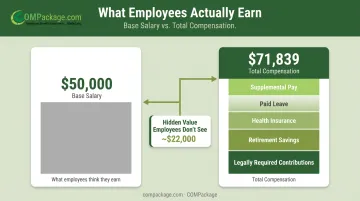
For small and mid-sized businesses competing on salary, this matters most. A company that can't match enterprise base pay may still offer a more compelling total package through flexible work, strong benefits, and retirement matching. The challenge is making that value visible to employees before they start shopping elsewhere.
Tools like COMPackage make this practical. The platform enables businesses with 5 to 5,000 employees to generate individualized total compensation reports in-house, covering over 80 benefit and perk categories (including non-quantifiable perks like remote flexibility and professional development) without outsourcing to costly service providers. An entire employee census can typically be completed in under 90 minutes.
Transparency Serves Multiple Objectives at Once
When employees understand their full compensation:
- Retention improves: employees are less likely to leave for a marginally higher base salary when they understand what they already have
- Morale increases: transparency builds trust and helps employees feel recognized, not overlooked
- Recruiting strengthens: offer letters can present total value upfront, not just a starting salary number
Types of Compensation That Support These Objectives
Direct Compensation
Monetary payments made directly to employees — base salary, performance bonuses, commissions, and profit-sharing. These are the most visible components and the easiest to benchmark against market data.
Indirect Compensation
Non-cash benefits with real monetary value: employer-paid health insurance, retirement plan contributions, paid time off, tuition reimbursement, and wellness programs. Employees routinely underestimate these costs — benefits can add 30–40% on top of base salary.
On average, indirect compensation categories break down roughly as:
| Category | Average % of Total Compensation |
|---|---|
| Insurance (health, disability, life) | ~8.8% |
| Legally required (Social Security, Medicare, workers' comp) | ~7.7% |
| Paid leave (vacation, holidays, sick) | ~6.9% |
| Retirement and savings | ~4.5% |
| Supplemental pay (bonuses, overtime) | ~2.5% |
Non-Financial Perks
Some of the most valued benefits never appear on a financial statement — but they carry real weight in hiring and retention decisions:
- Remote or flexible work arrangements
- Mentorship and career development programs
- Recognition awards and performance acknowledgment
- Learning stipends or tuition reimbursement
For employers who can't lead the market on salary, these perks can be the deciding factor for candidates weighing competing offers.
Common Challenges in Meeting Compensation Management Objectives
External Market Pressure
Compensation costs rose 3.4% year over year as of March 2026, according to the Bureau of Labor Statistics, with wages and salaries up 3.5%. Without regular benchmarking, pay ranges drift below market — and high-performers notice first.
Pay Compression
When new-hire rates or inflation adjustments outpace internal pay progression, tenured employees end up earning close to — or less than — newer colleagues. Over half of employers who run compensation analyses find this problem waiting for them. Addressing it means proactive range maintenance built into your annual compensation cycle.
Regulatory Complexity
Businesses operating across multiple states face a patchwork of minimum wage laws, pay transparency requirements, and equal pay regulations that evolve frequently. Staying compliant requires ongoing legal and HR oversight — and a compensation structure that can withstand scrutiny before it's challenged.
Tips for Achieving Your Compensation Management Objectives
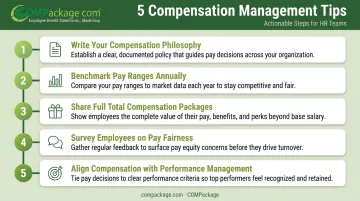
Write down your compensation philosophy before setting any ranges. Decide whether you aim to lead, match, or lag the market, and how pay connects to performance. That document anchors future decisions and gives both candidates and current employees a clear picture of how pay works at your organization.
Benchmark pay ranges at least once a year. Use compensation surveys and industry salary data to keep ranges current. Flag roles where pay has fallen significantly below market — those employees are most likely to leave.
Walk employees through their full package, not just their salary. Schedule annual reviews where managers cover every element of compensation — benefits, retirement contributions, paid time off, and more. Total compensation statements give these conversations structure. Tools like COMPackage let HR teams generate those statements in-house for the entire workforce in a matter of hours, without outsourcing a single report.
Survey employees on pay fairness — anonymously. Asking whether employees feel their pay is fair and competitive surfaces dissatisfaction before it becomes a resignation. Assign a clear owner to review results and set a deadline for responding to what you find.
Align compensation with performance management. Set clear, measurable criteria for raises, bonuses, and promotions tied to performance outcomes — so employees see a direct line between their effort and their rewards, and managers have consistent frameworks for every pay conversation.
Frequently Asked Questions
What is the purpose of compensation?
Compensation serves to reward employees fairly for their contributions, attract qualified candidates, and motivate ongoing performance. It also reflects an organization's financial capacity and strategic priorities: pay decisions should always connect to broader business goals.
What are the main objectives of compensation management?
The primary objectives include attracting qualified candidates, retaining existing employees, motivating high performance, ensuring legal compliance, maintaining internal pay equity, and strengthening employer brand. Most compensation strategies pursue all six at once.
How does compensation management affect employee retention?
Employees who feel fairly compensated and understand the full value of their package are significantly less likely to leave. Payscale research shows perceived underpayment — even when inaccurate — makes employees nearly 50% more likely to start job searching within six months.
What is the difference between direct and indirect compensation?
Direct compensation includes monetary payments such as salary and bonuses. Indirect compensation covers non-cash benefits — health insurance, retirement contributions, paid time off — that carry real monetary value but rarely appear on a paycheck. Employees often underestimate indirect compensation's worth, which is why communicating the full picture matters.
How can small businesses compete on compensation without large budgets?
Clear communication is the most underused tool smaller employers have. A well-documented total package — covering benefits, perks, and non-financial rewards — often exceeds a larger employer's offer in real value. Tools like COMPackage make generating individualized compensation statements affordable and manageable without a dedicated HR team.
What is a total compensation statement and why does it matter?
A total compensation statement itemizes every form of pay an employee receives — salary, benefits, bonuses, retirement contributions, and perks. Sharing one helps employees understand their full value, which reduces the perception gap that drives unnecessary turnover.