That's a problem for everyone involved. Employees who only see their paycheck routinely undervalue what they're actually earning. Employers, meanwhile, struggle to prove an offer is competitive when half of its value is invisible on paper. The result is often turnover that didn't need to happen — someone leaves for a "better" salary that's actually a worse total deal.
This article breaks down what a total benefits package actually includes, how to calculate its real dollar value, and the mistakes that quietly undercut even generous packages.
Key Takeaways
- Base salary is often less than 70% of what an employee actually receives in total compensation
- Health insurance, retirement contributions, and paid time off each add real, calculable dollar value
- A simple formula (salary plus monetized benefits) reveals an offer's true worth
- Outdated or generic benefits communication is one of the fastest ways to lose that value's impact
- Personalized, itemized statements strengthen recruiting pitches and retention conversations
What Is a Total Benefits Package (and Why It Matters)?
What Is a Total Benefits Package?
A total benefits package is everything of value an employee receives in exchange for their work, not just the number on their paycheck.
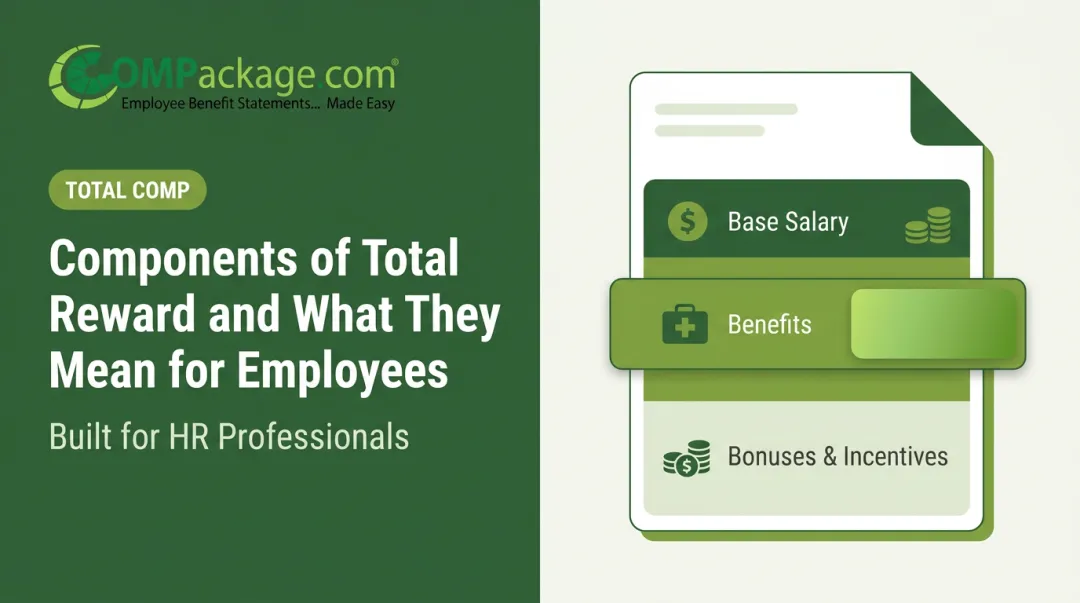
Salary is one line item. Layer on health insurance, retirement contributions, paid leave, and other perks, and you get the full picture: total compensation.
Treat it as a literal, itemizable list. Every component can be named, valued in dollars (or flagged as a non-monetary perk), and shown directly to an employee. Visibility is the point: employees can only value what they can see.
Why Understanding It Matters
For employers, the risk is straightforward: when employees can't see the full value of what they're receiving, they compare job offers on salary alone.
A competitor's offer that's $3,000 higher in base pay can look better on paper even with weaker insurance and no retirement match. Employees leave for a "raise" that, once benefits are factored in, may not be a raise at all.
For employees, understanding total compensation supports smarter decisions:
- Comparing job offers accurately instead of chasing the biggest number
- Planning household budgets around actual take-home value versus deferred benefits
- Recognizing when a "lower" salary offer is actually the stronger overall package
That awareness gap is why self-service total compensation statement tools exist. Platforms like COMPackage help small and mid-sized businesses, not only enterprises with large HR budgets, generate personalized statements that make this value visible without a consultant or homemade spreadsheets.
Key Components of a Total Benefits Package
A total benefits package isn't one line item. It's built from several distinct categories, each doing a different job in attracting, retaining, and motivating people. Not every employer offers every category. The mix depends on company size, industry, and budget.
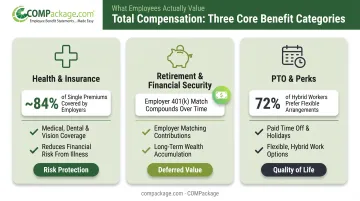
Health & Insurance Benefits
This category covers medical, dental, vision, life, and disability coverage, with the employer typically subsidizing a meaningful share of the premium.
Employer contribution levels vary by plan tier and whether dependents are covered. According to the KFF 2025 Employer Health Benefits Survey, the average annual premium for single coverage was $9,325, with employers covering roughly 84% of that cost. For family coverage, the average premium climbed to $26,993, with employers covering about 74%.
That 10-point gap between single and family coverage matters. It's often the single biggest budget lever employers pull when designing plans.
Health and insurance benefits differ from other categories in one key way: they're risk protection, not cash or deferred value. They're best suited for employees with families or ongoing health needs, and they carry real tax advantages for both sides. The main limitation is rising premiums, which force employers to balance generosity against budget.
Retirement & Financial Security Benefits
This category includes 401(k) or 403(b) plans, employer matching contributions, pensions, profit sharing, or equity.
Unlike health benefits, this is deferred value: money employees don't see today but will rely on decades from now. An employer match sounds small in isolation, but compounded annually over a 20- or 30-year career, it can grow into a substantial share of someone's eventual retirement savings.
This category is best suited for:
- Employees focused on long-term financial planning
- Tenured staff a company specifically wants to retain
- Workers who value tax-advantaged growth over immediate cash
Its strength is loyalty-building and tax-deferred growth. Its limitation is that new hires often discount it, since vesting schedules mean the "free money" isn't fully theirs for years.
Paid Time Off, Perks & Work-Life Benefits
Vacation, sick leave, parental leave, flexible or remote arrangements, wellness programs, and stipends all fall here.
Flexibility has become a major retention lever. Pew Research Center found that 46% of remote workers said they'd be unlikely to stay if their employer eliminated remote work entirely.
Among hybrid workers, 72% actively prefer a hybrid arrangement over full-time in-office or full-time remote.
This category is about quality of life, not direct or deferred financial return. It's a strong tool for attracting younger talent and work-life-balance-focused employees, with relatively low direct cost against high perceived value. These perks are hard to assign a precise dollar figure, so they tend to go unnoticed unless someone explicitly itemizes them.
How to Calculate the Total Value of Your Benefits Package
The formula itself is simple:
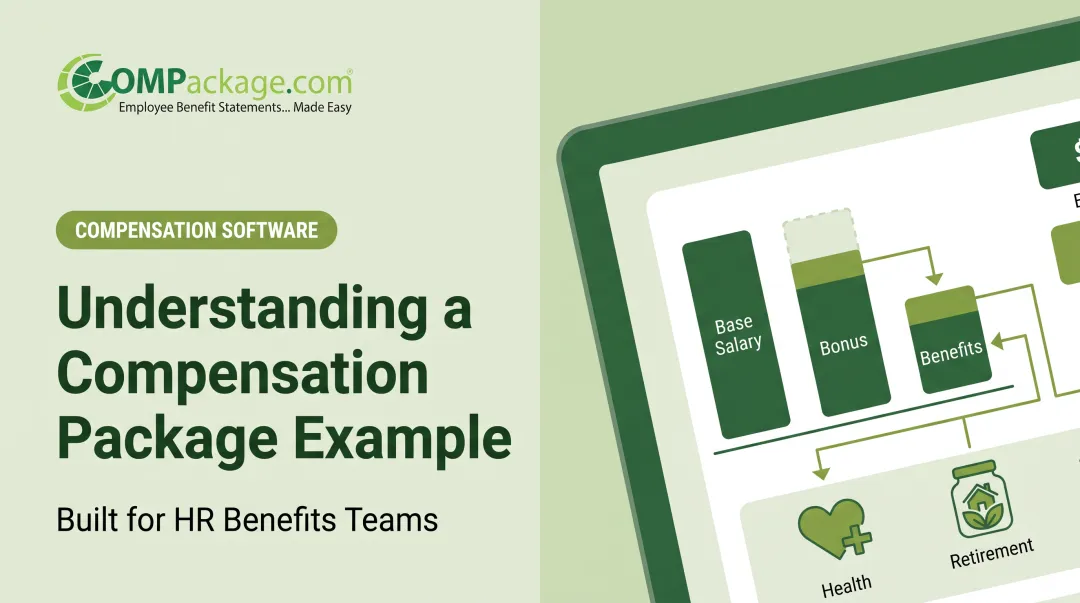
Base salary + monetized value of all benefits = total compensation value
Here's how to work through each piece.
- Health insurance — Take the employer's monthly premium contribution and multiply by 12 for the annual dollar value.
- Retirement contributions — Use the employer's actual annual match amount. To show long-term impact, illustrate how that match compounds over a multi-year career instead of treating it as a one-time figure.
- Paid time off — Divide annual salary by total working days in the year, then multiply by the number of paid days off. That gives you the dollar value of vacation, sick leave, and holidays combined.
- Non-quantifiable perks — Flexibility, culture, and career growth resist a clean dollar figure. Present them as narrative value-adds alongside the calculated totals rather than forcing an artificial price tag.
Running this manually for one employee is manageable. Doing it accurately for 50, 200, or 2,000 employees—each with different plan tiers, PTO accrual rates, and dependent coverage—quickly becomes time-consuming and error-prone.
That scale problem is what COMPackage addresses. Its Employee LOADER imports an entire employee census from an Excel file, and 13 built-in calculators auto-fill government-mandated benefits, 401(k) contributions, PTO, and insurance values.
Once initial mapping is done, a full census can be processed in under 90 minutes—work customers often say used to take days or weeks by hand.
Common Mistakes to Avoid When Evaluating or Communicating a Benefits Package
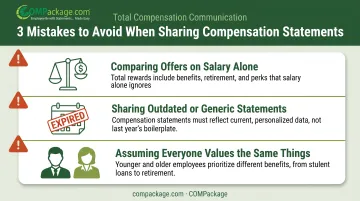
Even a genuinely strong package loses impact when it's evaluated or communicated poorly. Watch for these three patterns:
- Comparing offers on salary alone. A $2,000 salary bump means little next to a weaker health plan and no retirement match—ignoring monetized benefits can flip which offer is better.
- Sharing outdated or generic statements. A benefits summary from two open-enrollment cycles ago doesn't reflect what an employee actually has today. Statements need to stay current and specific to the individual, not the department average.
- Assuming everyone values the same things. A 25-year-old single employee and a 45-year-old parent of three don't weigh childcare stipends and retirement matching the same way. Generational and life-stage differences change what "valuable" even means.
That second point is where communication often fails. COMPackage addresses it directly by letting employers change and rerun statements throughout the year at no additional charge (for year-end reporting, quarterly updates, or performance reviews) so the numbers employees see always match reality.
Conclusion
A total benefits package spans direct pay, insurance protection, retirement security, and lifestyle-focused perks — each carrying real, calculable value once you break it down.
Employers who calculate and communicate that total value clearly tend to see stronger retention and more competitive recruiting. Employees who understand it make better-informed career and financial decisions. For both sides, the full package—not base pay alone—is what drives smarter decisions.
Frequently Asked Questions
How much is a typical benefits package worth?
Per the BLS Employer Costs for Employee Compensation report, benefits made up 31.6% of total civilian-worker compensation in March 2026, with wages at 68.4%. On a $70,000 salary, that share is roughly $32,000 in employer-paid benefits.
How do you calculate your total compensation package?
Add your base salary to the monetized value of your benefits: annual health insurance contributions, retirement match, and the dollar value of your paid time off. Non-quantifiable perks like flexibility are best noted separately rather than forced into the total.
What is included in a full benefits package?
The three core categories are health and insurance coverage, retirement and financial security benefits, and paid time off or lifestyle perks. Not every employer offers all three at the same depth.
What's the difference between total compensation and total benefits?
Total compensation includes base salary plus every benefit combined. "Benefits" refers only to the non-salary components (insurance, retirement contributions, and PTO), without the paycheck itself.
What percentage of employee compensation typically comes from benefits?
About one-third. The same BLS ECEC data puts benefits at 31.6% of total employer costs for civilian workers, so wages cover the remaining share.
How can employers effectively communicate the value of a benefits package to employees?
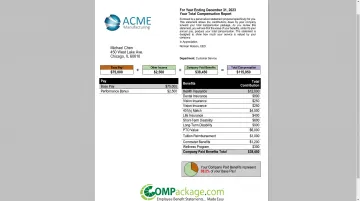
Personalized, itemized total compensation statements, delivered at least annually, make the full value visible instead of implied. Self-service tools like COMPackage let employers update those statements through the year so the numbers stay accurate as pay and benefits change.