A compensation structure is the formal system a company uses to determine base pay, bonuses, benefits, and other rewards for every role in the organization. This guide breaks down what it is, the main types you'll encounter, how to build one, and why the structure alone won't fix pay confusion.
Formal pay structures are already standard practice. 72% of surveyed North American companies report having formal base-salary range structures in place, according to the Culpepper survey reported by SHRM. If your organization hasn't built one yet, you're behind most of your peers.
Key Takeaways
- A compensation structure defines base pay, bonuses, and benefits for every role.
- Salary bands, pay grades, broadband, step structures, and market pricing are the five types.
- Building one requires job evaluation, market benchmarking, and a clear pay philosophy.
- Employees need to see their full pay picture, or a structure won't improve retention.
What Is a Compensation Structure?
A compensation structure is the strategic framework HR uses to set base salary, bonuses, commissions, benefits, and other rewards for each role. Rather than a single number or one-off decision, it operates as an ongoing system that HR maintains and updates over time.
Most structures draw on three core inputs: job evaluation, market benchmarking data, and a clear pay philosophy about where the company wants to sit relative to competitors. The breakdown below shows how these pieces come together.
Here's why it matters. A well-built structure promotes internal equity, meaning similar roles get paid similarly, and external equity, meaning your pay stays competitive with the market. It also reduces manager bias in pay decisions and helps keep the company compliant with wage laws.
HR typically owns the design and upkeep of the structure, sometimes with help from outside compensation consultants. But the structure itself should never live in isolation. It needs to tie directly back to company goals and talent strategy, not just sit in a spreadsheet nobody opens after year one.
Key Components That Make Up a Compensation Structure
Four building blocks show up in nearly every compensation structure:
- Job evaluation – Grouping roles into families or levels based on skills, responsibilities, and experience required
- Pay ranges – Setting a minimum, midpoint, and maximum for each grade or band
- Market benchmarking – Comparing your pay against similar roles in your industry and region
- Pay philosophy – Deciding whether you'll lead the market, match it, or lag behind it intentionally
Skip any one of these and the structure gets shaky. Skip market benchmarking, for instance, and you might build a perfectly equitable internal system that pays 20% below market rate for every role.
What Are the Different Types of Compensation Structures? (And the Hierarchy Behind Them)
When people talk about the "hierarchy of compensation," they usually mean how pay grades or bands are layered from entry-level roles up through executive positions within a structure. Think of it as the ladder your pay ranges climb.
Common Types of Compensation Structures
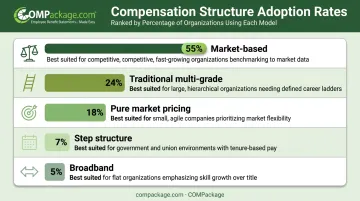
Five structure types dominate the market, and WorldatWork's 2019 survey gives a clear picture of how often each gets used.
| Structure Type | Adoption Rate | Best Suited For |
|---|---|---|
| Market-based | 55% | Companies prioritizing external competitiveness |
| Traditional multi-grade | 24% | Larger, hierarchical organizations with defined promotion paths |
| Pure market pricing | 18% | Hard-to-fill or high-demand roles |
| Step structure | 7% | Tenure-driven environments like government or education |
| Broadband | 5% | Flatter organizations with wide career levels |
WorldatWork's 2019 Survey of Salary Structure Policies and Practices allowed multiple responses, so these figures don't sum to 100%. Many companies actually blend approaches.
A quick breakdown of each:
- Market-based: Salary bands with min-mid-max ranges, priced against market data by job family. The most common structure companies use today.
- Traditional multi-grade: Many narrow, layered grades supporting step-by-step promotions.
- Pure market pricing: Pay tied directly to frequent external market data, ideal for hard-to-fill or high-demand roles.
- Step structure: Pay increases tied to tenure, common in unionized and government settings.
- Broadband: Fewer, wider pay bands, often spanning 100% or more from bottom to top of the range.
Choosing the Right Type for Your Organization
No single structure fits every company. Weigh these factors before picking one:
- Union or collective bargaining agreements – These often dictate step-based pay by contract
- Industry norms – Tech companies lean market-based; manufacturing often uses traditional grades
- Geography and cost of living – Regional pay differences matter for multi-location employers
- Growth potential – Fast-scaling companies benefit from broadband flexibility
- Talent market competitiveness – Hard-to-fill roles may need pure market pricing regardless of your default structure
How Do You Create a Compensation Structure? A Step-by-Step Overview
Building a structure from scratch sounds daunting, but it breaks down into five manageable steps.
- Set your pay philosophy first. Decide if you'll lead, match, or lag the market based on company goals, budget, and workforce needs. This decision shapes everything downstream.
- Review job descriptions and benchmark the market. Pull current job descriptions and compare them against salary survey data for similar roles, industries, and regions.
- Design pay ranges using job evaluation and market data. Set a minimum, midpoint, and maximum for each grade or band, grounded in both internal role value and external market pricing.
- Communicate the structure transparently. Employees who understand how their pay was determined trust the process more, even when the number itself doesn't change. Tools like COMPackage's total compensation statements make this easier, giving each employee a clear breakdown of salary, bonuses, and benefits in one report.
- Review and adjust regularly. Market conditions shift. WorldatWork found that 75% of companies with a set review cadence adjust pay ranges annually, so build that same cadence into your HR calendar.
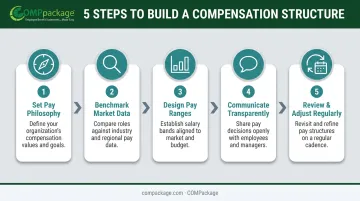
Skipping step four is the most common mistake. Companies build a technically sound structure, then never explain it to the people it affects.
Compensation Hierarchy in Practice: How Pay Structures Differ by Employee Level
Not every employee sits in the same type of pay structure, even within one company. Pay hierarchy shifts depending on level:
- Executives often sit outside standard pay structures, earning more through incentives, stock options, and RSUs than base salary. WTW reports U.S. CEO target incentives averaging 125% of base salary, with long-term incentives reaching 575% of base.
- Hourly/non-exempt employees follow fixed job rates or step-based wage schedules tied to tenure or skill. FLSA mandates 1.5 times the regular rate for overtime beyond 40 hours weekly, with the current exemption threshold at $684 per week.
- Salaried/exempt professionals usually land in grade-and-range or broadband structures, with progression tied to performance, skill growth, or promotion rather than tenure alone.
Mixing these approaches within one company is common. It simply means your compensation strategy needs to account for each group separately.
Why a Pay Structure Alone Isn't Enough: Helping Employees See Their Total Compensation
A compensation structure sets fair, defensible pay ranges internally. But that's only half the equation. Most employees only see one number: their base salary on a pay stub. They rarely see the full value of what they're actually receiving.
That gap is bigger than most HR teams assume. 51% of employees say they don't fully understand their health insurance policy, and 71% want more information about their health benefits, according to Aflac's 2024 Workplace Benefits Trends report.
That same research found 84% of employees who did understand their benefits reported high satisfaction with them.
This is exactly where the equity and transparency goals of a compensation structure can fall apart. You can build the most defensible pay ranges in your industry.
But if employees can't see the retirement match, health coverage, PTO value, and other perks layered on top of base pay, they'll undervalue their own offer.
This is the gap COMPackage was built to close. Our self-service total compensation report software helps businesses with anywhere from 5 to 5,000 employees translate their existing pay structure into a personalized, easy-to-read statement for each employee. Companies can:
- Report on over 80 benefit categories, including non-quantifiable perks
- Import employee data in bulk and generate reports for an entire company in hours, not weeks
- Rerun and update reports throughout the year at no extra charge
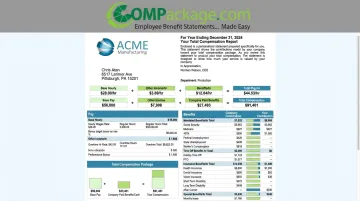
Showing employees the full picture, base pay plus benefits plus perks, turns an abstract compensation structure into something concrete they can actually feel. That's the difference between a structure that exists on paper and one that supports real retention.
Frequently Asked Questions
How do you create a compensation structure?
Start by defining your pay philosophy (lead, match, or lag the market), then benchmark roles against market data. Build pay ranges or grades from that data, then communicate the structure clearly and review it regularly.
What are the different types of compensation structures?
The main types are salary bands (grade-and-range), traditional multi-grade structures, broadband structures, step structures, and market-pricing models. Most companies use market-based approaches, sometimes blended with traditional grades.
What is the hierarchy of compensation?
It refers to how pay grades or bands are layered from entry-level roles through executive positions within a single structure. Each layer typically has its own minimum, midpoint, and maximum pay range.
What's the difference between a compensation structure and a compensation package?
A compensation structure is the company-wide framework or system used to set pay across all roles. A compensation package is one individual employee's specific mix of salary and benefits within that structure.
How often should a compensation structure be reviewed?
Most companies review their structure annually, with roughly 75% doing so on a consistent yearly cycle. Highly competitive or hard-to-fill roles often warrant more frequent market checks.
Who is responsible for designing a compensation structure?
This is typically an HR function, sometimes supported by outside compensation consultants or market survey data providers. Larger organizations may have a dedicated compensation team handling design and ongoing maintenance.