That gap creates a real problem. Employees feel underpaid. They look externally. They leave — sometimes for packages that aren't actually better once all components are counted.
Total Target Compensation (TTC) is the framework that closes this gap. It gives employers a single, honest number representing what a role is worth — base salary, variable pay, equity, and more — when an employee hits their performance targets. Understanding how to calculate it, what drives it, and how to communicate it is increasingly non-negotiable for businesses that want to compete for talent in 2026.
This guide covers everything: definition, components, calculation, key influencing factors, how TTC compares to OTE and TCC, and how to communicate it to employees effectively.
Key Takeaways
- TTC is total expected annual earnings at 100% target performance: base salary + target variable pay + annualized equity
- TTC is not the same as base salary, OTE, or total cash compensation — each serves a distinct purpose
- Pay mix varies sharply by role — sales hunters often run 50/50 base-to-variable; strategic account managers run 75/25 or 80/20
- Most employees underestimate their total pay because they only see base salary — TTC fixes that gap
- Communicating TTC to employees through personalized statements is one of the highest-ROI retention moves available
What Is Total Target Compensation?
TTC is the projected total annual earnings for a role, assuming the employee meets 100% of their defined performance targets. It combines every direct compensation component — fixed base salary, target variable pay, and the annualized value of any equity or long-term incentives.
A few important clarifications upfront:
- TTC is not guaranteed. Only base salary is. Variable and equity components depend on performance and vesting.
- TTC is not take-home pay. It's the pre-tax employer cost of the full compensation package.
- TTC is not an aspirational ceiling. It represents the expected outcome at exactly 100% attainment.
For employers, TTC anchors compensation planning to real budgets and performance expectations. For candidates, it replaces the single base salary figure with a complete picture of what the role actually pays.
That complete picture is increasingly expected. A 2025 WorldatWork report found that 82% of U.S. organizations are communicating, planning, or considering sharing individual pay ranges with employees — and with pay transparency laws now taking effect across Illinois, Minnesota, New Jersey, Vermont, and Massachusetts, the pressure is only growing. TTC gives HR teams a defensible, consistent framework for those conversations.
What Does Total Target Compensation Include?
Base Salary
Base salary is the fixed, guaranteed annual component that anchors TTC. It's paid regardless of performance, benchmarked to industry, location, experience, and role level. For most non-sales corporate roles, it's the single largest piece of TTC — providing the financial predictability employees need for everyday budgeting.
Variable Pay: Bonuses and Commissions
Variable pay covers any compensation tied to performance outcomes:
- Annual or quarterly performance bonuses
- Sales commissions
- MBO (management-by-objective) payouts
- Profit sharing distributions
The "target" figure in TTC assumes 100% quota or goal attainment. Actual earnings can run higher if targets are exceeded, or lower if they're missed. That's what makes TTC a target rather than a guarantee — and why being clear about attainment assumptions matters when communicating offers. According to BLS data, 50% of private-industry workers had access to nonproduction bonuses in 2025, with access ranging from 73% in financial services to just 28% in leisure and hospitality.
Equity and Long-Term Incentives
Equity components — Restricted Stock Units (RSUs), stock options, performance grants — appear most often in tech, startup, and executive compensation. Their annualized value is incorporated into TTC by dividing the total grant over its vesting period (more on the mechanics below).
Not every TTC package includes equity. Carta's H1 2025 data shows startup equity grants are roughly 50% smaller than they were in late 2022 — a reminder to evaluate grants carefully alongside vesting schedules and current fair market value.
Non-Cash Benefits and Perks
Some employers take TTC further by including the employer's cost of benefits in a broader total compensation statement. This is where TTC shades into "total rewards."
Both quantifiable and non-quantifiable benefits belong in a complete picture. Common examples to include:
- Health insurance and retirement contribution costs
- Paid time off (valued at daily rate)
- Flexible work arrangements
- Professional development stipends
- Wellness programs
Employees who see these line items alongside their salary often revise their sense of what they're actually earning — which is precisely why compensation statements exist.
How to Calculate Total Target Compensation
The core formula:
TTC = Base Salary + Target Variable Pay + Annualized Equity Value
Benefits and perks may be added depending on how broadly the employer defines total compensation.
Worked Example
Here's how that formula plays out for a mid-level marketing manager:
| Component | Value |
|---|---|
| Base Salary | $85,000 |
| Target Annual Bonus (20% of base) | $17,000 |
| Equity Grant ($60,000 RSU over 4-year vest) | $15,000/year |
| Total Target Compensation | $117,000 |
The equity line is calculated by dividing the total grant ($60,000) by the vesting period (4 years), yielding $15,000 annually. This is an estimate — fair market value fluctuations mean the actual realized value will differ.
Common Calculation Mistakes
Avoid these errors:
- Use 100% attainment targets, not stretch goals — TTC reflects realistic on-target performance, not best-case scenarios
- Include equity, especially in tech or startup roles where it often represents 20–30% of total pay
- Account for ramp periods — new hires in their first 3–6 months often have reduced variable pay eligibility, which affects first-year TTC
- Prorate for mid-year start dates to avoid overstating the first-year figure
Key Factors That Influence Total Target Compensation
Compensation Philosophy and Pay Mix
A company's pay philosophy determines how TTC components are weighted. Some organizations prioritize base salary stability; others favor performance upside through higher variable pay. The right balance depends on role type, company culture, and the talent market you're competing in.
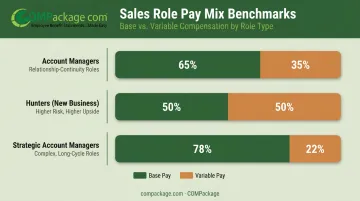
WorldatWork's research provides concrete benchmarks for sales roles:
- Account managers: ~65% base / 35% variable (relationship-continuity roles)
- Hunters (new business): ~50% base / 50% variable (higher risk, higher upside)
- Strategic account managers: 75–80% base / 20–25% variable (complex, long-cycle roles)
For non-sales roles, the balance typically tilts more heavily toward base salary, with bonuses serving as supplemental recognition rather than primary motivation.
Role Seniority and Market Benchmarks
Higher-seniority and higher-impact roles generally carry more variable pay and equity as a proportion of TTC. A VP of Sales will have a fundamentally different pay mix than a junior analyst, even if their base salaries are comparable.
Employers measure TTC against market benchmarks using salary surveys, compensation databases, and geographic cost-of-living data. Skipping this step creates real risk: structures that underpay lose candidates, while those that overshoot the market create budget pressure that's hard to unwind.
Company Size and Financial Health
Startups and SMBs often offset lower base salaries with higher equity upside or larger bonus targets. Larger, financially stable organizations tend to anchor more heavily on competitive base salaries.
Either way, TTC design must reflect what the business can realistically fund. A generous variable pay structure only works if the company can actually deliver those payouts when targets are hit.
TTC vs. OTE vs. Total Cash Compensation
These three terms are often used interchangeably. They shouldn't be.
| Metric | What It Includes | Best Used For |
|---|---|---|
| OTE (On-Target Earnings) | Base salary + target commission at 100% quota | Sales and incentive-heavy roles |
| TCC (Total Cash Compensation) | All cash pay: base, bonuses, commissions, profit sharing — no equity or benefits | Summarizing all-cash earning potential |
| TTC (Total Target Compensation) | Base + variable pay + annualized equity + (optionally) benefits | Full-package evaluation, especially in tech, executive, or equity-inclusive roles |
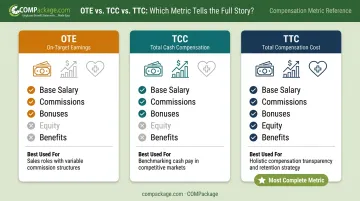
Use OTE for quota-carrying sales roles — Paylocity defines it as projected total compensation at 100% or more of performance targets. TCC, as defined by Salary.com, captures all annual cash earnings before taxes but excludes stock options, benefits, and other non-cash elements.
TTC is the most complete metric. Reach for it whenever a role includes equity, meaningful long-term incentives, or employer-paid benefits that candidates should factor into their evaluation.
How to Communicate Total Target Compensation to Employees
Designing a well-structured TTC package is only half the job. If employees don't understand what they're receiving, the investment is partially wasted.
The perception gap is real. Mercer's 2025 Global Pay Transparency Report found that employees who perceive their pay as fair are 85% more engaged and 60% more committed — but a separate WorldatWork survey found that while 75% of HR professionals believe employees are paid fairly, only 44% think employees share that view. That's a 31-point gap driven largely by poor communication, not poor pay.
What Effective TTC Communication Looks Like
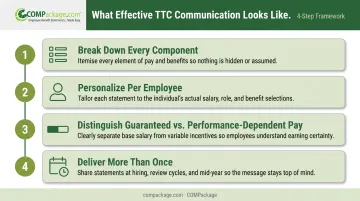
An effective total compensation statement should:
- Break down every component individually — base, target bonus, equity, employer benefits contributions, and non-quantifiable perks
- Be personalized per employee — not a generic policy document, but a statement showing each person's specific package
- Distinguish guaranteed from performance-dependent pay — employees need to understand what's certain and what requires hitting targets
- Be delivered more than once — at hiring, at annual review cycles, and after any compensation change
Producing personalized statements at scale is where many companies get stuck. COMPackage's self-service total compensation report software solves this directly: businesses of any size can generate itemized, per-employee reports in-house, covering base pay, employer benefit contributions, retirement, and non-quantifiable perks, without relying on expensive third-party consultants or paying recurring service fees.
Communication Mistakes to Avoid
- Sharing TTC only at hire and never revisiting it means employees forget the full picture within months
- Using jargon-heavy formats: if employees need an HR dictionary to understand their statement, it has failed
- Presenting a single TTC number without clarifying which portion is guaranteed versus performance-dependent creates false expectations and disappointment
Frequently Asked Questions
What does total target compensation mean?
TTC is the expected total annual earnings for a role — including base salary, bonuses or commissions, and annualized equity — when an employee meets their defined performance targets. It's a target, not a guarantee; only the base salary portion is guaranteed regardless of performance.
How is total target compensation different from base salary?
Base salary is the fixed, guaranteed portion of pay. TTC layers all variable and equity components on top of that base, giving a fuller picture of earning potential tied to performance. The gap between base and TTC reflects how much of the compensation package is performance-dependent.
What is your target compensation amount?
An individual's TTC is calculated by adding base salary, full target variable pay (bonuses and commissions at 100% attainment), and the annualized value of any equity grants. This represents expected earnings if all performance goals are met.
What is the difference between TTC and OTE?
OTE is specific to sales roles and covers base salary plus achievable commission at 100% quota. TTC is broader: it includes equity and long-term incentives on top of cash components, making it the more complete metric for evaluating roles that go beyond pure sales compensation.
What is total target compensation in Workday?
In Workday, TTC is typically a configured field or calculation that aggregates salary, bonus, commission, stock, and long-term cash plan types. Because the exact field logic is tenant-specific, check your organization's Workday report definitions for precise configuration details.
How can businesses effectively communicate total target compensation to employees?
Personalized total compensation statements are the most effective tool — breaking down salary, benefits, retirement contributions, variable pay, and perks so employees see their full package value. Tools like COMPackage let businesses generate these statements in-house without third-party service fees.