The result? Employees feel underpaid. They disengage. They leave for competitors offering marginally higher base salaries — not realizing their current package was worth more.
Fixing this isn't about sending more emails. It requires a deliberate strategy: the right message, the right channel, the right moment, and a clear picture of what employees actually receive. This guide covers a step-by-step approach to building that strategy, the variables that determine whether it works, and the mistakes that consistently undermine even well-intentioned efforts.
Key Takeaways
- Unexplained benefits get ignored — and ignored benefits drive turnover.
- Effective communication requires a year-round strategy, not an annual enrollment push.
- Multiple channels and plain language measurably improve comprehension and utilization.
- Showing employees the full dollar value of their compensation — beyond salary alone — directly strengthens retention.
- Regular feedback reveals communication gaps before they become turnover problems.
How to Communicate Employee Benefits More Effectively: A Step-by-Step Plan
Step 1: Audit Your Current Benefits Communication and Identify Gaps
You cannot improve what you have not measured. Before redesigning anything, conduct an honest audit of what you're currently sending, to whom, through which channels, and how often.
Start with utilization data. EBRI's research shows participation rates vary sharply by benefit type — 85% for health insurance, 84% for retirement plans, but only 47% for financial wellness programs. Low participation in specific benefits almost always signals a communication gap, not a lack of interest.
Then go beyond the numbers:
- Survey employees to uncover what they find confusing, what they didn't know existed, and what they wish they understood better.
- Talk to managers — they hear the questions that never make it to HR. Onboarding, open enrollment, and life events are typically where confusion concentrates.
- Review your channel mix — if you're relying on a single annual benefits guide, you already know the problem.
This audit gives you a baseline — and a prioritized list of where to focus first.
Step 2: Build a Year-Round Benefits Communication Calendar
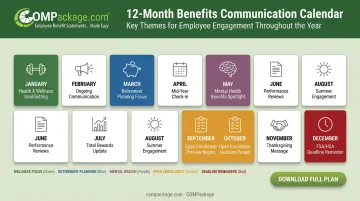
Annual-only communication consistently fails for a simple reason: employee needs change throughout the year, and information received once is quickly forgotten. A communication calendar keeps benefits visible and relevant across all 12 months.
The approach is straightforward — assign monthly themes tied to the calendar and employee needs:
- January: New year health and wellness goal-setting; encourage EAP usage
- March: Retirement planning awareness; review contribution rates
- May: Mental Health Awareness Month; spotlight mental health benefits
- September/October: Open enrollment preview; what's changing and why
- December: FSA/HSA year-end deadlines; use-it-or-lose-it reminders
MetLife's research found 68% of Gen Z employees wanted employer communication about benefits after enrollment — not only during the annual window. Year-round touchpoints improve comprehension and build trust — employees notice when benefits communication shows up in February, not just in October.
Step 3: Use Multiple Channels and Formats to Reach Every Employee
A single channel will always miss someone. Desk-based employees may engage with detailed email newsletters; frontline workers who lack regular computer access need a completely different approach.
SHRM research found 62% of HR professionals identified limited computer access as a barrier for deskless workers — yet 69% hadn't adjusted their communication strategy to account for it. Most deskless employees are receiving the same materials as office workers, just less effectively.
Matching channel to audience closes that gap:
| Employee Type | Recommended Channels |
|---|---|
| Office/desk workers | Email newsletters, intranet, online portal |
| Frontline/deskless workers | Printed summaries, manager briefings, SMS reminders |
| Remote employees | Video explainers, mobile-friendly resources, virtual Q&A |
| All employees | Short videos, comparison tables, infographics |
Visual formats deserve particular attention. A 2024 systematic review found videos outperformed written materials for health information comprehension — and benefits information is genuinely complex. A one-page visual comparison of plan options will be read. A six-page PDF often won't.
Step 4: Make Benefits Communication a Two-Way Conversation
Employees need easy ways to ask questions, flag confusion, and submit feedback — and HR needs those signals to catch what isn't landing before it becomes a retention problem.
Practical mechanisms that work:
- Run pulse surveys immediately after major communications (open enrollment, onboarding) to gauge comprehension
- Maintain a dedicated benefits inbox or FAQ page employees can access year-round
- Host live Q&A sessions during open enrollment and onboarding, where employees can ask questions they'd feel uncomfortable submitting in writing
The critical piece: act visibly on what you hear. If employees repeatedly ask the same question, that's a signal your materials need revision. Acknowledging feedback and updating communications based on it builds more trust than any polished brochure.
Key Variables That Determine How Well Benefits Communication Works
Even a solid communication plan can underperform if it ignores the factors that affect how information is received. These are the levers HR teams need to manage actively.
Language and Readability
Benefits materials are frequently written in insurance industry language — deductibles, coinsurance, COBRA, ERISA — that most employees cannot readily interpret. According to a KFF survey of insured U.S. adults, 51% had difficulty understanding at least one aspect of their insurance, including what was covered (36%) and out-of-pocket costs (30%).
The fix is plain language: familiar words, short sentences, and supportive visuals. If a term requires a glossary, define it inline. Acronyms should always be spelled out on first use — particularly for multilingual workforces.
Timing and Relevance
Information delivered at the wrong moment is information ignored. Sending retirement contribution tips to new hires who are still figuring out their health coverage is wasted effort. Benefits communication lands hardest when it aligns with the employee's current situation — new hire onboarding, a qualifying life event, or approaching a deadline.
Personalization and Audience Segmentation
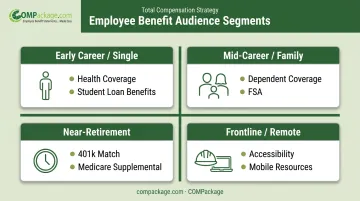
A 25-year-old single employee and a 45-year-old with three dependents have completely different benefit priorities. Sending the same message to both guarantees that at least one of them tunes out.
Segment your communications by:
- Life stage (early career, mid-career, near-retirement)
- Enrollment status (enrolled vs. waived specific benefits)
- Family situation (single, married, dependents)
- Work environment (desk, frontline, remote)
Metlife found 54% of employees wanted personalized benefit recommendations. Employees who receive relevant, targeted information are far more likely to act on it — and to feel the company understands their needs.
Consistency and Repetition
One benefits guide delivered at onboarding is not enough. People need to encounter information multiple times, through multiple formats, before it genuinely registers. Build in recurring touchpoints throughout the year, such as:
- Quarterly benefits reminders tied to seasonal events (open enrollment, FSA deadlines)
- Targeted nudges when employees experience qualifying life events
- Year-end total compensation statements that show the full picture beyond base pay
Go Beyond a Benefits List — Show Employees the True Value of Their Total Compensation
Most employees evaluate their pay by what lands in their bank account. They don't see the health insurance premium their employer covers, the retirement matching contributions, the paid leave they accrue, or the life insurance policy in their name. According to BLS data, benefits represent 30.1% of total private-industry compensation on average — but employees, as EBRI found, think it's closer to 16%.
That perception gap is the core problem — and total compensation statements are the most direct way to close it.
What a Total Compensation Statement Does
A total compensation statement translates every component of an employee's package — base salary plus all employer-paid and employer-subsidized benefits — into a single, concrete dollar figure. Instead of listing "health insurance, 401(k), PTO," it shows:
- Employer health insurance contribution: $8,400/year
- 401(k) match: $3,200/year
- Paid leave value: $6,500/year
- Life insurance: $600/year
- Total employer investment: $68,700/year (salary + benefits)
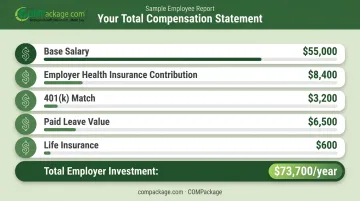
Putting a dollar figure on each item shifts how employees perceive their employer's investment. Fewer than 40% of workers know what "total rewards" means — and only 14% can explain it, per O.C. Tanner research cited by WorldatWork. A personalized statement closes that gap directly.
Making It Practical
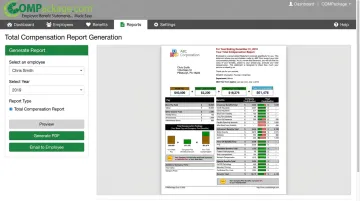
Generating individualized statements used to require an external HR consultant or a large benefits administration firm — and the associated costs put it out of reach for smaller employers. Tools like COMPackage have made that accessible for businesses of all sizes.
The platform lets HR teams generate personalized total compensation reports in-house, covering over 80 benefit categories, without outside consultants or processing fees. For small and mid-sized businesses especially, it's one of the most cost-effective ways to make the full value of an employee's package visible.
When to Prioritize Benefits Communication
While year-round communication is the standard to maintain, three specific moments demand more intensive, proactive effort — and getting these right has outsized impact.
1. New Hire Onboarding
This is the window when employees form their foundational understanding of what they receive. Whatever assumptions take hold here tend to stick. Explain benefits clearly, completely, and in plain language before habits and misconceptions set in.
2. Qualifying Life Events
Marriage, birth of a child, divorce, serious illness — these are moments when employees have the strongest motivation to engage with their benefits but often the least guidance on how to act. These situations call for proactive outreach, not waiting for employees to ask.
3. Annual Open Enrollment
This is the structured opportunity to educate, review, and drive action. EBRI found half of enrollees spent under one hour choosing their plan, and nearly a third spent under 30 minutes. That's not informed decision-making. It's a clear signal that the communication leading up to enrollment isn't doing enough work.
If your organization is experiencing high turnover, low benefit utilization, or declining satisfaction scores, treat those as signals to audit and rebuild your communication strategy.
Common Mistakes to Avoid in Employee Benefits Communication
Most benefits communication problems fall into three predictable patterns — and each one is fixable.
Treating open enrollment as the only communication moment. Limiting benefits communication to a once-a-year window ensures employees are perpetually underprepared. Benefits get forgotten and underused. Shifting to a year-round calendar with monthly themes keeps the conversation going without requiring a significant lift each time.
Using jargon-heavy, one-size-fits-all messaging. Sending the same dense benefits summary to every employee — regardless of role, life stage, or literacy level — guarantees large segments will tune out or misunderstand their options. Simplify the language. Segment the audience.
Failing to show the dollar value of benefits. Listing benefits without translating them into tangible financial worth is the single biggest missed opportunity in most benefits communication strategies. When employees see only plan names rather than a personalized breakdown of what their employer is spending on their behalf, they chronically undervalue their total package.
That undervaluation has real consequences: employees become easy targets for competitors offering a marginally higher base salary. Quantifying benefits in dollar terms is both more persuasive and more honest.
Frequently Asked Questions
How often should employers communicate employee benefits to employees?
Year-round, not just during open enrollment. Aim for at least monthly touchpoints tied to calendar events, life stages, or utilization reminders. A single annual distribution of plan documents is not a communication strategy — it's a compliance exercise.
What should an employee benefits communication plan include?
At minimum, your plan should cover:
- An audit of current communication gaps
- A year-round content calendar with monthly themes
- A defined channel mix matched to your workforce
- Audience segmentation by life stage or work setting
- A feedback mechanism to measure comprehension over time
What is the most effective channel for communicating employee benefits?
There's no single best channel. Email works well for desk-based employees; SMS, printed materials, and manager briefings reach frontline workers who lack regular computer access. A multi-channel approach consistently outperforms any single method.
How do you communicate benefits to employees who don't have regular computer access?
Use printed summaries posted in break rooms or included with pay stubs, manager-led team briefings, SMS reminders for deadlines, and mobile-friendly digital resources that employees can access on personal devices outside work hours.
What are total compensation statements and how do they help?
A total compensation statement is a personalized report showing an employee's salary alongside the full dollar value of employer-paid benefits — health insurance, retirement contributions, paid leave, and more. Putting a real number on that value changes how employees see their compensation.
How do you measure whether your benefits communication is working?
Key metrics to track include:
- Enrollment and utilization rates by benefit type
- Pulse survey results on benefits awareness and satisfaction
- Open and click-through rates on benefits-related emails
- Year-over-year voluntary turnover trends among employees who received structured benefits education