Introduction
Most employees think of their paycheck as their pay. The reality is different: base salary, health insurance, retirement contributions, paid time off, equity, and a dozen other perks often add up to 30% more than the number on the stub.
According to the 2025 EBRI Workplace Wellness Survey, workers estimate their benefits represent only 16% of total compensation, not the actual 30%.
That gap costs companies talent every day. Employees accept competing offers that look better on paper, unaware that their current package already wins the comparison. According to Payscale's 2025 Fair Pay Impact Report, employees at highly pay-transparent organizations are 59% less likely to leave than those at non-transparent ones — and SHRM reports replacing a single employee can cost 50%–200% of their annual salary.
Compensation management platforms exist to close this gap. Some communicate total rewards to employees. Others help HR teams benchmark against the market, run merit cycles, or manage global incentive programs. This guide covers the best options for 2026 across all of those use cases.
TL;DR
- What these tools do: Cover everything from total compensation statements to enterprise benchmarking and incentive planning.
- Top picks for 2026: COMPackage, CompLogix, Beqom, Pave, Salary.com CompAnalyst, Deel, and CaptivateIQ.
- What to prioritize: Ease of use, integration with existing HR/payroll systems, employee-facing communication features, and transparent pricing.
- Fastest SMB ROI: Showing employees the full value of what they already earn — before they take an offer elsewhere.
What Is Compensation Management Software?
Compensation management software helps organizations plan, communicate, and optimize everything employees receive as part of their pay: base salary, bonuses, benefits, equity, paid time off, and perks. It goes well beyond payroll.
There are two broad categories:
- Internal planning tools: help HR teams run merit cycles, model compensation budgets, benchmark pay against market data, and analyze pay equity
- Employee-facing communication tools: generate total compensation statements that show employees the full value of their package, not just their salary
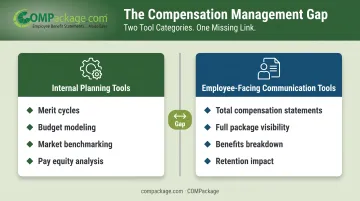
Many organizations invest in one and neglect the other. A company can run flawless merit cycles internally while employees never see that their total package is often 30–40% more valuable than base pay. That gap is why people leave.
The platforms below cover this full spectrum, from affordable self-service reporting tools designed for smaller businesses to enterprise-grade global suites built for multinational workforces.
Best Compensation Management Platforms 2026
These platforms were selected based on compensation depth, fit for different company sizes, pricing transparency, integration capability, and verified user ratings from platforms including G2, Capterra, and Software Advice.
COMPackage
COMPackage is a self-service total compensation statement platform founded by Joe Blattner, designed for companies with 5–5,000 employees. It helps organizations show employees the true value of their full compensation package without expensive consultants or lengthy implementation.
| Feature | Detail |
|---|---|
| Key Features | Self-service total compensation reports, 80+ benefit categories, Employee LOADER for bulk Excel import, 13 auto calculators, custom branding (logo + colors), non-quantifiable benefit display, free updates year-round |
| Best For | Small to mid-sized businesses (5–5,000 employees), HR consultants, benefits consultants, insurance agencies, accounting firms |
| Pricing | Annual plans starting at $149 (1–5 employees) up to $2,599 (Unlimited) and $2,999 (Professional for multi-client service providers); 30-day satisfaction guarantee |
What sets it apart: No installation, no IT team required, and pricing is published upfront. The Professional tier adds multi-client management, client sublicensing, and agency branding in report footers, purpose-built for consultants and agencies serving multiple clients. Customers from Coca-Cola and Harley-Davidson to small regional businesses report that work that once took days can be finished in a few hours, including a full company census in under 90 minutes.
CompLogix
CompLogix is a dedicated compensation planning platform built for mid-market to enterprise organizations. It covers merit cycles, bonuses, short-term and long-term incentive plans (STIP/LTIP), equity, and total rewards statements in one configurable system.
| Feature | Detail |
|---|---|
| Key Features | Merit, bonus, STIP, LTIP, equity, and total rewards statements; dedicated account representative; highly configurable plan design |
| Best For | Mid-market to enterprise organizations needing deep compensation cycle configurability and responsive support |
| Pricing | Custom quotes based on organization size; contact CompLogix directly |
What sets it apart: Every customer gets a dedicated account representative, not a ticketing queue. For teams running complex annual comp cycles, that's a meaningful difference. Software Advice lists CompLogix at 4.9/5 based on user reviews.
Beqom
Beqom is an enterprise-grade global compensation suite built for large multinational organizations. It covers salary reviews, bonuses, long-term incentives, deferred compensation, pay equity, and sales performance management in a single platform.
| Feature | Detail |
|---|---|
| Key Features | Multi-country, multi-currency compensation; AI-driven pay equity (Pay Intelligence); STIP, LTIP, and deferred comp; EU Pay Transparency Directive tools; integrates with Workday, SAP SuccessFactors, Oracle, ADP, and UKG |
| Best For | Large global enterprises (5,000+ employees) with complex regulatory requirements and dedicated compensation teams |
| Pricing | Custom enterprise pricing; contact Beqom directly |
What sets it apart: Beqom was named an Exemplary Provider in ISG's 2025 Total Compensation Management Buyers Guide. One trade-off to plan around: implementation for large enterprises typically takes 3–9 months depending on complexity, integrations, and the scope of existing compensation plans being migrated.
Pave
Pave is a real-time compensation intelligence platform that pulls benchmarking data from 8,600+ companies via direct HRIS, ATS, and equity management integrations, providing current market benchmarks rather than lagging annual survey data.
| Feature | Detail |
|---|---|
| Key Features | Real-time benchmarks from 8,600+ companies; AI job matching via Pave Agent; equity benchmarking; merit cycle planning; employee total rewards portals; 55+ country coverage |
| Best For | Mid-market tech companies (roughly 200–2,000 employees) prioritizing real-time data, equity visibility, and AI-driven pay analysis |
| Pricing | Varies by company size and selected modules; contact Pave directly |
What sets it apart: Pave's AI tool, Pave Agent, can price job families, analyze hiring competitiveness, and compare compensation across locations, grounded in live data rather than static survey exports. G2 lists Pave at 4.7/5 from 46 verified reviews.
Salary.com CompAnalyst
CompAnalyst combines extensive market salary data with pay structure design, pay equity analysis, job architecture management, and automated compensation planning. Salary.com describes CompAnalyst Market Data as trusted by 10,000+ organizations.
| Feature | Detail |
|---|---|
| Key Features | Market pricing intelligence, pay equity analysis, automated comp planning, job architecture management, advanced analytics, survey participation automation |
| Best For | Small to mid-size organizations (100–1,000 employees) formalizing or refining compensation programs using defensible market data |
| Pricing | No public list price; contact Salary.com for current rates; free trial available |
What sets it apart: Salary.com was named Overall Leader, Capability Leader, and Customer Experience Leader in the 2025 ISG Total Compensation Management Buyers Guide. G2 rates the Salary.com platform at 4.4/5 from 1,088 verified reviews.
Deel
Deel is a global HR platform operating across 160+ countries that unifies international hiring, payroll, and compensation management. For distributed workforces, it provides end-to-end comp planning: multi-currency modeling, pay equity analysis, compensation review cycles, and pay transparency compliance tools.
| Feature | Detail |
|---|---|
| Key Features | Global compensation across 160+ countries; multi-currency scenario modeling; EU Pay Transparency Directive support; native payroll integration; employee total rewards portals; workforce planning |
| Best For | Global organizations with distributed international teams needing compensation management directly connected to payroll execution |
| Pricing | Available upon request based on employee count and global footprint |
What sets it apart: Deel's compensation module connects natively to its own global payroll system, unlike most standalone compensation tools. For teams managing headcount across multiple countries, that removes a significant integration burden.
CaptivateIQ
CaptivateIQ connects sales incentive compensation management with capacity planning, quota setting, and territory design, making it the strongest option on this list for organizations where sales commission complexity is the primary challenge.
| Feature | Detail |
|---|---|
| Key Features | Incentive comp management via SmartGrid calculation engine; AI-powered sales planning via Catalyst; quota and territory planning; real-time commission visibility; enterprise workflow automation |
| Best For | Mid-market to enterprise organizations (500+ employees) with complex sales compensation structures needing planning and incentives in one platform |
| Pricing | Custom quote, per-seat pricing plus one-time setup fee; contact CaptivateIQ directly |
What sets it apart: CaptivateIQ's SmartGrid handles complex commission modeling, and Catalyst adds machine learning for predictive sales planning and incentive forecasting. G2 rates CaptivateIQ at 4.7/5 from 3,488 verified reviews.
How We Chose These Platforms
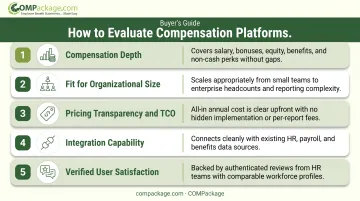
Every platform on this list was evaluated against five criteria:
- Compensation depth — does it go meaningfully beyond basic salary tracking?
- Fit for different organizational sizes — does it serve its stated target market well?
- Pricing transparency and total cost of ownership — are costs knowable before a sales call?
- Integration capability — does it connect to common HRIS and payroll systems?
- Verified user satisfaction — ratings and review counts from G2, Capterra, and Software Advice
The most common mistake buyers make: conflating compensation management with payroll software, or assuming the compensation module inside their HRIS is enough. Most embedded modules can't handle real merit cycles, don't generate employee-facing total compensation statements, and need IT for every configuration change.
Company size and use case should anchor every decision:
- SMBs typically get the fastest ROI from affordable total compensation statement tools that help employees understand what they already earn
- Mid-market organizations benefit from benchmarking and planning platforms that connect market data to merit cycles
- Enterprises with global headcount or complex incentive programs need platforms built for that scale and regulatory complexity
Conclusion
The right compensation management platform is the one that solves your most pressing problem. For some organizations, that's running complex multi-country merit cycles. For others, it's helping a sales team see their commissions in real time. For many smaller businesses, the most urgent problem is simpler: employees don't know what their total package is worth.
Before purchasing any platform, audit your current compensation communication process. If employees can't see the full picture — health insurance contributions, retirement matches, paid time off, and everything else the company provides — even a genuinely competitive package won't prevent avoidable turnover.
COMPackage addresses that gap directly. You can generate reports in hours, not weeks, with no installation required. Pricing starts at $149/year, which fits teams that need clearer compensation communication without an enterprise software budget.
Explore COMPackage's transparent pricing and self-service platform, or request a free demo to see how it works for your specific employee count and benefit structure.
Frequently Asked Questions
What are the three P's of compensation?
The three P's of compensation are typically described as Pay (base salary or wages), Perks (non-monetary benefits like PTO, flexibility, and wellness programs), and Performance-based pay (bonuses, commissions, or merit increases tied to results). Total compensation management platforms help organizations track, communicate, and optimize all three components.
What tools are used for compensation management?
Common options include total compensation statement tools (COMPackage), salary benchmarking platforms (Pave, Salary.com CompAnalyst), compensation planning software (CompLogix, Beqom), commission tools (CaptivateIQ), and HR suites with pay modules (Deel). The right fit depends on company size and the problem you need to solve.
What is the difference between compensation management software and payroll software?
Payroll software processes and disburses wages accurately. Compensation management software helps organizations plan, benchmark, communicate, and optimize the full value of employee pay, including benefits, bonuses, equity, and perks. Most businesses need both, but they serve fundamentally different functions.
How does compensation management software improve employee retention?
Employees who understand their total compensation package, not just base salary, are far less likely to leave for a perceived pay increase elsewhere. Payscale's 2025 research found employees at highly pay-transparent organizations are 59% less likely to leave than those at non-transparent ones. Tools that generate total compensation statements help close the perception gap before it triggers a resignation.
What should small businesses look for in a compensation management platform?
Prioritize transparent pricing, ease of use without requiring IT or consultants, and the ability to generate employee-facing total compensation reports quickly. A 30-day guarantee or free trial reduces risk before committing. Enterprise platforms are often overkill for smaller teams. Purpose-built SMB tools like COMPackage are built for faster setup and lower cost.
Can compensation management software help with pay transparency compliance?
Yes. Many platforms support salary range management, pay equity analysis, and reporting tied to U.S. state disclosure laws and the EU Pay Transparency Directive. Confirm which compliance features each vendor includes before you buy.