Introduction
Ask most employees what they earn, and they'll name their salary. That's it. The health insurance their employer pays thousands toward each year, the 401(k) match, the paid time off valued at their daily rate — none of it registers as "compensation" until someone puts it in writing.
This gap is more common than most HR teams realize. According to LIMRA's 2025 research, only 42% of employees say they receive total compensation statements — meaning the majority of workers are making career decisions based on an incomplete financial picture.
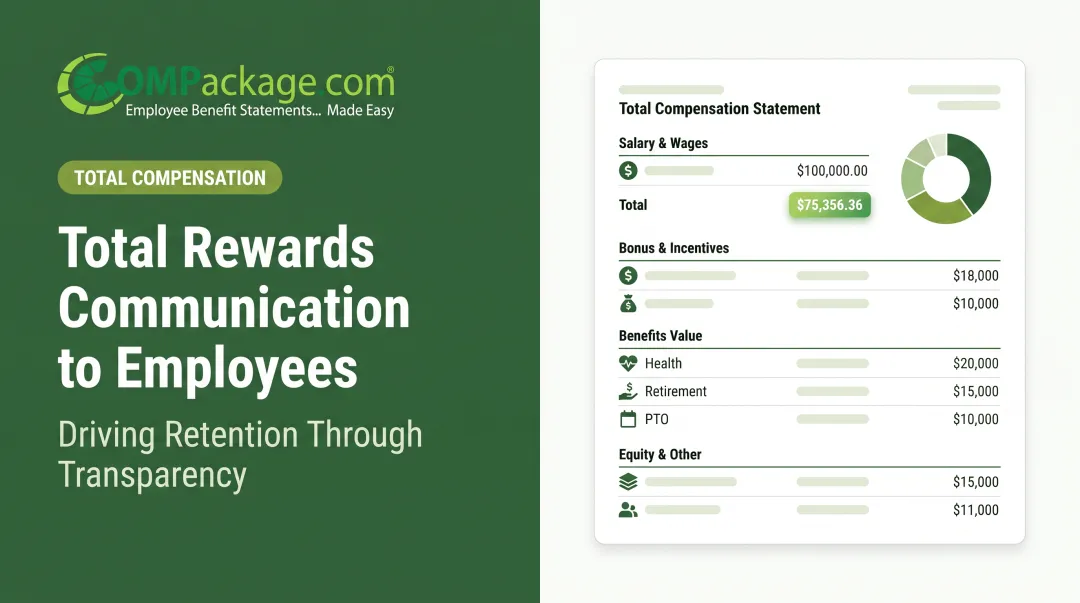
A rewards summary (also called a total compensation statement) closes that gap. It's a personalized document that shows each employee the full value of what their employer provides — salary, benefits, retirement contributions, paid time off, and more — all in one clear report. What follows is a practical guide to building one that actually gets read.
Key Takeaways
- A rewards summary documents an employee's complete compensation — cash, benefits, retirement, time off, and perks
- Employees who understand their full compensation report higher satisfaction and stronger employer loyalty
- Every component should show the employer's dollar contribution — not just take-home pay
- Companies of any size can produce professional total compensation statements without expensive consultants
What Is a Rewards Summary for Employee Compensation?
The Core Definition
WorldatWork defines total compensation statements as "personalized statements that show your employees the total value of compensation and benefits they receive from your organization." That's the clearest way to describe what a rewards summary is: a complete, per-employee accounting of everything their employer provides in exchange for their work.
It covers far more than a paycheck. The Bureau of Labor Statistics categorizes total employer compensation as wages and salaries plus benefit costs. A rewards summary consolidates all of those components into one readable document for each employee:
- Paid leave
- Supplemental pay
- Insurance
- Retirement and savings
- Legally required benefits
How It Differs from a Pay Stub
A pay stub shows net earnings for one pay period after taxes and deductions. A rewards summary shows the employer's total annual investment in that employee across every compensation category. These are fundamentally different documents serving different purposes.
A pay stub answers: "What did I take home this pay period?"
A rewards summary answers: "What does my employer actually spend on me each year?"
Understanding that distinction sets the stage for a related question: what should you actually call this document?
The Terminology
This document goes by several names:
- Total compensation statement — the clearest and most widely used term (WorldatWork, SHRM)
- Total rewards statement — an established alternative, often broader in framing
- Rewards summary — commonly used in HR conversations, though less formally defined
All refer to the same core concept: making the full value of employment visible to the employee.
The Awareness Problem
LIMRA's research reveals a striking gap. Among employees who do receive total compensation statements, 60% report a good understanding of their benefits. Among those who don't, understanding drops sharply. Separately, LIMRA found:
- 3 in 10 employees were uncertain whether their employer offered medical, dental, or vision insurance
- 50% were uncertain about non-medical offerings like mental health support or tuition assistance
The benefits are there. Employees simply don't know it — which is exactly the gap a rewards summary is designed to close.
Why a Rewards Summary Matters: Benefits for Employers and Employees
Retention
When an employee considers a job offer with a higher base salary, they're rarely comparing total packages — they're comparing numbers on an offer letter to a number on their paycheck. A rewards summary changes that calculation.
Gallup estimates that replacing one employee costs between 0.5 and 2.0 times that employee's annual salary. For a 100-person organization with a $50,000 average salary and typical turnover rates, that translates to hundreds of thousands of dollars annually. When employees can see the full value of their current package — health insurance, 401(k) matching, paid leave, and perks — they're better positioned to evaluate outside offers accurately.
Satisfaction and Engagement
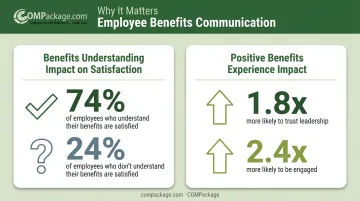
The connection between benefits understanding and employer satisfaction is striking. LIMRA found that 74% of employees who understand their benefits are satisfied with their employer, compared with just 24% of those who don't understand them.
That 50-point gap doesn't require a compensation increase to close. It requires communication. MetLife's research adds another dimension:
- Employees with positive benefits experiences are 1.8x more likely to trust company leadership
- Employees who feel both trusted and cared for are 2.4x more likely to be engaged
Recruiting Advantage
Sharing a rewards summary with job candidates makes a compensation offer more complete and compelling — a real advantage for smaller employers competing against larger organizations on salary alone.
SHRM's pay transparency research found that 73% of workers are more likely to trust organizations that are upfront about compensation details. Showing candidates the full package — not just base pay — signals that kind of transparency.
The Cost of Inaction
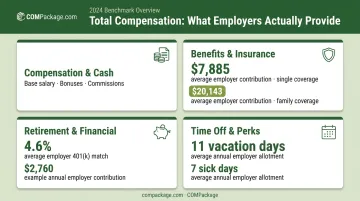
Without a rewards summary, employers are spending money on benefits that employees don't fully recognize. That's a poor return on a major investment. The average employer contributes $7,885 annually for single health coverage and $20,143 for family coverage, per KFF's 2025 Employer Health Benefits Survey — yet many employees have no idea those numbers exist. A rewards summary puts those numbers in front of employees — turning invisible spending into visible value.
What to Include in a Total Compensation Rewards Summary
A useful rewards summary is organized into clear categories so employees can scan and understand each component. COMPackage, for example, provides over 80 benefit category ideas employers can draw from — a practical starting point for businesses building their first statement.
Compensation and Cash Components
The foundation of every report:
- Base salary or hourly wages, annualized
- Overtime pay
- Bonuses: performance, signing, retention, and annual
- Commissions
- Profit-sharing distributions
Each item should show a specific dollar value. Vague entries undermine the document's purpose.
Benefits and Insurance
This is often where the biggest surprises live. Show the employer's contribution, not just the employee's premium:
- Medical insurance — employer's annual premium share
- Dental and vision insurance — employer's annual premium share
- Life insurance (employer-funded)
- Short- and long-term disability insurance
- Supplemental coverage the company funds or subsidizes
The KFF benchmark gives useful context: average employer contributions of $7,885 (single) and $20,143 (family) in 2025. Most employees have no frame of reference for these amounts until they see them on a statement.
Retirement and Financial Planning
- 401(k) employer match, shown as an annual dollar value rather than just a percentage
- HSA or FSA employer contributions
- Stock options or equity grants (where applicable)
Vanguard's 2024 data puts the average promised employer 401(k) match at 4.6% of pay. For an employee earning $60,000, that's $2,760 per year — real money most employees never account for.
Time Off and Work-Life Benefits
Dollar values apply here too, even if it doesn't feel that way at first:
- Paid vacation days — valued at the employee's daily rate
- Sick leave and holidays
- Parental leave
- Remote or flexible work arrangements — can be expressed as commute cost savings
BLS data shows private-industry workers average 11 vacation days and 7 sick days after one year of service. At an employee's daily rate, those add up quickly.
Non-Quantifiable Perks
Not everything has a dollar value, but that doesn't mean it doesn't belong in the report:
- Professional development and tuition reimbursement
- Wellness programs and gym memberships
- Employee discounts
- Company-provided equipment or meals
- Company culture and work environment
These items reinforce an employee's sense of total value and help differentiate the employer's brand, particularly for candidates weighing multiple offers.
How to Create an Effective Employee Rewards Summary
Building the Report
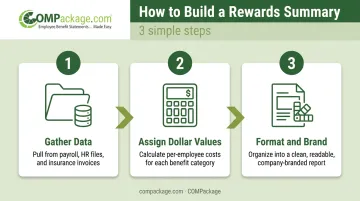
The basic process follows three steps:
- Gather data — Pull benefit cost information from payroll records, HR files, and insurance invoices
- Assign dollar values — Calculate per-employee costs for each applicable benefit category
- Format and brand — Organize the data into a clean, readable report that reflects your company's identity
For small teams, this can be done manually. For larger workforces, tools like COMPackage let employers bulk-import employee data from Excel and generate individualized reports — covering an entire workforce in a matter of hours without outside consultants or complex HR platforms.
Personalization Matters
Every report should reflect only the benefits that apply to that specific employee. A part-time worker without health coverage shouldn't receive a report listing $0 for insurance — that creates confusion rather than clarity.
Keep Reports Current
Personalized reports only stay useful if they stay accurate. Salaries shift, benefit costs adjust, and a report reflecting last year's numbers quickly loses credibility with employees. Review and update reports at minimum annually, and whenever significant benefit changes occur mid-year.
With COMPackage, updates cost nothing extra — employers can edit individual employee records or push changes across the entire workforce, then regenerate reports as needed within their subscription period. No reprinting costs, no consultant fees.
Best Practices for Sharing Your Total Compensation Statement
Pair the Document with Context
Employees who receive a rewards summary without any explanation may not know how to read it. A brief conversation, or even a short written intro, makes the difference between a document that gets filed away and one that genuinely shifts how an employee sees their compensation.
Best timing for distribution:
- Annual performance review season
- Open enrollment
- Work anniversaries or promotion conversations
- New hire onboarding
Frame It as Investment, Not Audit
The tone matters. A rewards summary should feel like: "Here is what we invest in you." Not a ledger proving compliance. Employees should walk away feeling valued — and with a clearer understanding of why their total package is worth more than a competing salary number on paper.
Collect Feedback After the First Rollout
A short survey following distribution — three to five questions — tells you what worked and what didn't. Ask whether employees found the summary helpful, easy to understand, and complete. Their answers reveal which benefits weren't on employees' radar, pointing directly to where your communication strategy needs work. Use that input to sharpen the next rollout.
Frequently Asked Questions
What is a rewards summary?
A rewards summary (also called a total compensation statement) is a personalized document employers provide to each employee that outlines the full value of their compensation beyond base salary — including benefits, retirement contributions, bonuses, paid time off, and employer-provided perks.
How do I view my rewards summary?
Employers typically deliver rewards summaries as a printed document, a PDF by email, or through an HR portal. Compensation reporting software lets employers generate and distribute personalized summaries digitally, making them easy to access on demand.
What should be included in a total compensation rewards summary?
The major categories are base salary, bonuses, health and insurance benefits (showing the employer's contribution), retirement matching, paid time off valued in dollar terms, and any additional perks or non-monetary benefits the company provides.
How often should employers send rewards summaries to employees?
At minimum annually, ideally timed to performance reviews or open enrollment. Updated summaries should also go out whenever significant benefit changes occur mid-year.
Can a rewards summary help reduce employee turnover?
Yes — when employees see the full dollar value of their compensation, they can compare outside offers more accurately. That clarity often reveals their current package is worth considerably more than the base salary figure alone, making outside offers look less appealing.
What is the difference between a rewards summary and a pay stub?
A pay stub reflects a single pay period's net earnings after taxes and deductions. A rewards summary presents the employer's total annual investment per employee across all compensation categories.