Introduction
Compensation is far more than a number on an offer letter. In a job market where candidates compare offers line by line, how you structure pay, benefits, and perks can make or break a hire.
82% of U.S. workers say they're more likely to apply for a job when the pay range is visible in the posting, according to SHRM's 2023 research on pay transparency. That's a signal: candidates want the full picture, not just a base number.
Understanding the different types of compensation helps you build a package that attracts talent without blowing your budget. This guide breaks down the four main types, shows real examples, and gives you a framework for choosing the right mix for your business.
TL;DR
- Compensation covers monetary and non-monetary rewards, not just base salary
- Four core types exist: direct/cash, equity, benefits (indirect), and non-monetary rewards
- Most competitive employers blend several types based on budget and workforce needs
- Communicating total package value boosts satisfaction more than adding new perks alone
What Is Compensation & Why It Matters
Compensation is the total monetary and non-monetary value an employee receives in exchange for their work. That's a broader definition than "pay," which typically refers only to salary or hourly wages.
Think of compensation as an umbrella. Base pay sits under it, but so do bonuses, health insurance, retirement contributions, and even flexible scheduling. HR teams use this full picture strategically — to attract candidates, keep top performers engaged, and stay competitive without overspending on cash alone.
Why it matters right now:
54% of employees said their benefits package was an important reason to stay at their job, according to WTW's 2024 Global Benefits Attitudes Survey
Among employees whose benefits actually met their needs, 82% planned to stay
Skip the strategy, and the fallout shows up fast: higher turnover, sagging morale, and a harder time competing against employers who market their full package well
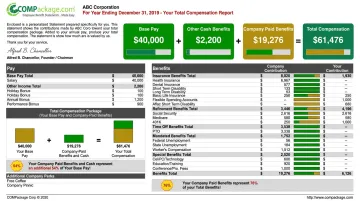
Here's the catch: many employees have no idea what their package is actually worth. They see a paycheck, not the health premium their employer covers or the retirement match sitting in the background. This is exactly the gap COMPackage's total compensation statements are built to close. Every benefit and perk gets translated into a clear dollar figure, so employees see what they're really earning, not just what hits their bank account.
Types of Compensation
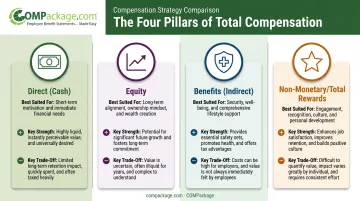
Compensation isn't one-size-fits-all. It generally breaks into four categories, based on how the value reaches the employee : as cash, as ownership, as a funded benefit, or as something intangible.
Most competitive employers don't pick just one. They layer these types together based on what their business can afford and what their workforce actually values.
Direct (Cash) Compensation
Direct compensation is money paid straight to the employee: base salary, hourly wages, bonuses, commissions, and overtime. It's the most visible and easiest-to-understand form of pay.
How it works: A fixed base wage or salary is often supplemented with variable pay. The U.S. Department of Labor requires overtime at 1.5 times the regular rate for nonexempt employees working more than 40 hours a week. Commissions and nondiscretionary bonuses tied to production or sales also factor into that regular-rate calculation.
Best suited for: Sales or production roles with measurable output, and employers who want a simple, benchmarkable pay structure.
Strengths: Predictable, easy to administer, and directly ties effort to reward.
Trade-offs: It doesn't touch non-financial needs like career growth or flexibility, and relying on cash alone as your retention lever gets expensive fast.
Equity Compensation
Equity compensation gives employees an ownership stake, such as stock options, restricted stock units (RSUs), or employee stock purchase plans (ESPPs).
How it works: Value depends on vesting schedules and how the company's stock performs, not on immediate cash. Data from Carta shows companies typically switch from stock options to RSUs around 5.5 years after incorporation, once valuations climb.
Best suited for: Startups and growth-stage companies conserving cash, and roles where long-term retention matters more than short-term output.
Strengths: Aligns employees with company performance while preserving cash flow.
Trade-offs: Value is uncertain, tax treatment gets complicated, and it's rarely practical for small, privately held businesses without a clear path to liquidity.
Benefits (Indirect Compensation)
Benefits are non-cash provisions — health insurance, retirement plans, and paid time off — that supplement direct pay without showing up in a paycheck.
How it works: Employers fund or subsidize these programs on the employee's behalf. According to BLS data from March 2026, benefits made up 30.1% of total compensation costs for private-industry workers, averaging $14.01 per hour on top of $32.60 in wages.
Best suited for: Businesses of any size, especially smaller employers competing against larger companies on a tighter cash budget.
Strengths: Improves job security and satisfaction, and often comes with tax advantages for both sides.
Trade-offs: Employees consistently undervalue benefits they can't see in dollar terms.
This is where COMPackage's platform earns its keep. Employers enter actual costs for health insurance, retirement matches, disability coverage, and dozens of other categories into a report builder. The software converts that into a specific dollar figure on each employee's statement.
In one sample report, employer-paid benefits totaled $32,138 against a $56,000 base salary, pushing total compensation to nearly $90,000. Without a statement like that, most of that value stays invisible.
Non-Monetary / Total Rewards Compensation
Non-monetary compensation covers intangible rewards: recognition programs, flexible schedules, and career development opportunities.
How it works: These elements add perceived value without hitting payroll directly. CIPD groups these under performance management, flexible working, and employee recognition.
Best suited for: Employers with tighter budgets looking to differentiate through culture, and employees who prioritize flexibility and growth over pure financial reward.
Strengths: Boosts morale cost-effectively. Gallup's longitudinal study of 3,500 employees found that well-recognized workers were 45% less likely to have left their job after two years.
Trade-offs: Hard to standardize or quantify, and it won't move the needle for employees facing genuine financial pressure.
How to Choose the Right Mix of Compensation Types
There's no universal formula. The right mix depends on your business goals, cash position, and what your specific workforce values — not just what competitors are doing.
Factors to Consider
- Business goals: A company scaling fast may lean on equity to conserve cash; a stable, mature business may lean harder on cash and benefits
- Budget and cash flow: How much can realistically go to salary versus equity or benefit subsidies right now
- Workforce demographics: Priorities shift by generation: Mercer found 64% of Gen Z said their benefits met their needs, compared to 55% of Gen X
- Industry norms: Benchmark similar roles and locations so your offer doesn't lag the market
- Scalability: A compensation mix that works at 20 employees may not hold up at 200
- Legal and tax implications: Equity grants, bonus structures, and benefit plans each carry different compliance requirements
Employee sentiment data can help fine-tune these factors, too. Pay still tops the list of reasons employees stay (48%), according to WTW's survey, but job security (41%), health benefits (36%), and flexible work (31%) aren't far behind.
Younger, remote-capable workers feel flexibility especially strongly. Pew Research found 50% of remote-capable workers under 50 said they'd likely leave if remote work ended, versus 35% of workers 50 and older.
The takeaway: build your mix around your actual people, not a generic template. Once you settle on that mix, a clear total compensation statement helps employees see the full value of what they're actually receiving.
Frequently Asked Questions
What is an example of compensation?
Salary, bonuses, commissions, health insurance, and stock options are all examples of compensation. Together, these combine to form a total compensation package rather than just a paycheck.
What are the main types of compensation?
The four main types are direct (cash) compensation, equity compensation, benefits (indirect compensation), and non-monetary or total rewards compensation. Most employers blend several types rather than relying on just one.
What is the difference between compensation and benefits?
Compensation is the umbrella term covering all monetary and non-monetary rewards an employee receives. Benefits are one specific piece of that whole — the indirect, often non-cash portion like health insurance and retirement plans.
Is compensation the same as pay?
No. Pay typically refers only to fixed salary or hourly wages. Compensation includes pay plus bonuses, benefits, equity, and other rewards.
How is compensation determined?
Compensation is typically set based on market rates for the role, job responsibilities, geographic location, and individual employee performance. Employers also weigh internal budget constraints and industry benchmarks.
What is a total compensation statement?
A total compensation statement is a report showing employees the full dollar value of their pay plus benefits, not just their salary. Self-service tools like COMPackage let businesses of any size build and update these statements in-house.