Introduction
Most employees believe their compensation equals their paycheck. That gap in perception costs employers far more than they realize.
Annual benefits — employer-provided programs like health insurance, retirement contributions, disability coverage, and paid time off — are structured on a 12-month cycle and renew each plan year. They're not perks. They're a substantial, calculable portion of what an employer pays for every worker on the payroll.
According to the Bureau of Labor Statistics Employer Costs for Employee Compensation (ECEC) report, benefits account for 30.1% of total compensation for private-sector workers. That is nearly a third of every compensation dollar spent, and it never shows up on the average paystub.
This article is for HR professionals and total compensation managers who design, administer, and communicate benefits packages. It breaks down what counts as an annual benefit, how those costs roll into total compensation, and how to make that value visible so it supports retention and recruiting instead of sitting unused on the books.
Key Takeaways
- Annual benefits reset on a 12-month plan year and form a substantial share of total compensation beyond base salary.
- A complete annual package typically covers health insurance, retirement plans, disability and life insurance, tax-advantaged accounts, and paid time off.
- Most employees underestimate the dollar value of their benefits, which creates preventable turnover risk.
- HR's role extends beyond enrollment administration to strategic planning, legal compliance, and total compensation communication.
- Total compensation reporting tools make the employer's full investment visible to employees.
What Are Annual Benefits?
Annual benefits are the suite of employer-provided programs and protections employees receive as part of their compensation package. They operate on a plan-year cycle (typically a calendar year or a defined 12-month benefit period) during which coverage limits, premium amounts, and employee elections apply.
Two distinctions matter in practice:
- Annual benefits vs. one-time benefits: A signing bonus is paid once. Annual benefits carry a recurring employer cost that resets with each plan year.
- Annual benefits vs. informal perks: Remote work flexibility or casual Fridays carry no structured employer cost. Annual benefits do, and that cost is measurable.
In everyday HR usage, "annual benefits" means an employee's full benefits package. Under IRS Code §415, "annual benefit" means the yearly retirement income payable to a defined-benefit plan participant (capped at $290,000 for 2026). This article uses the broader HR and total compensation definition.
Why Annual Benefits Matter in HR and Total Compensation
The Hidden Cost Employees Don't See
BLS data from March 2026 puts this in concrete terms:
- Private-sector workers: benefits average $14.01/hour, representing 30.1% of total compensation
- State and local government workers: benefits average $25.59/hour, representing 38.5% of total compensation
That's real money, but it doesn't appear on a pay stub. Employees rarely factor it into how they evaluate their job.
The Perception Gap
The 2025 Aflac Workforce Report found that only 42% of employees said they fully understood their health care policies, down from 49% the prior year.
Year-round benefits communication narrows that gap: full understanding rose to 51% with it, versus 38% without it.
That gap has a direct cost: employees who don't understand the value of their package evaluate job offers based on salary alone.
The Retention and Recruiting Angle
When an employee receives an offer with a $5,000 higher base salary, they may not weigh that against the employer match they'd stop capturing, the health premium differential, or the FSA contribution they'd lose. From their perspective, the new offer looks better. From a total compensation standpoint, it may not be.
HR teams that communicate benefits value clearly have a measurable advantage in retention and when competing for candidates. A well-articulated package can make a lower base salary genuinely competitive once the full picture is on the table.
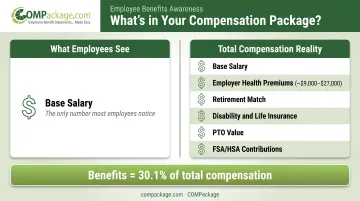
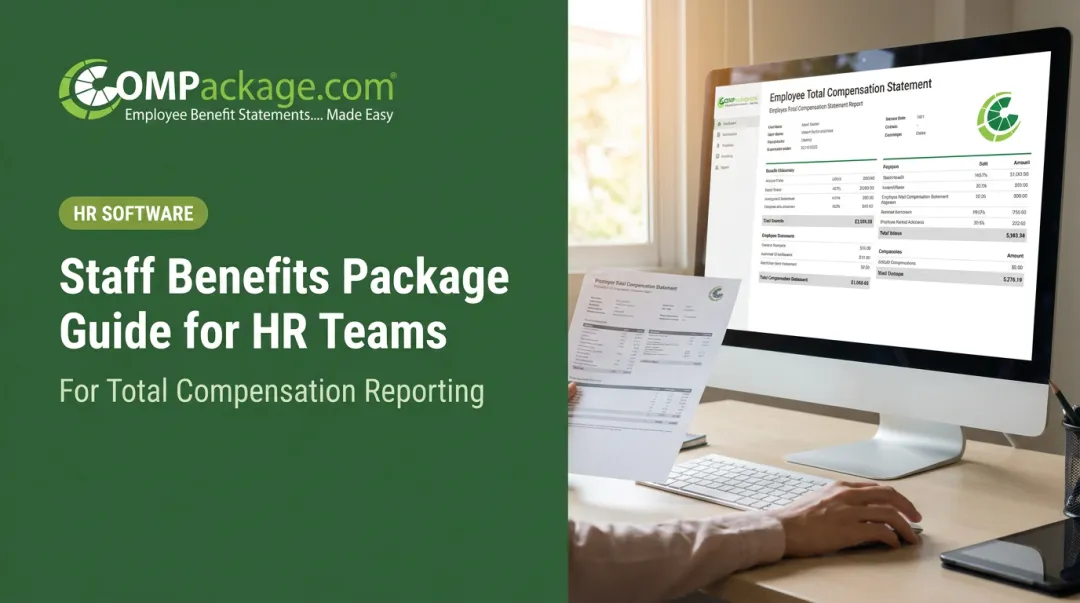
COMPackage generates personalized total compensation statements that show each employee what the employer spends on their behalf:
- Salary and employer-paid health premiums
- Retirement contributions and insurance
- Paid leave and other benefits
That visibility makes the ROI of the benefits investment plain to employees—and harder to leave on the table in a competing offer.
The Main Categories of Annual Employee Benefits
Health Insurance (Medical, Dental, and Vision)
Employer-sponsored health insurance is typically the highest-cost item in any benefits package, and most of its cost is invisible to employees.
According to the 2025 KFF Employer Health Benefits Survey, total annual premiums averaged:
- $9,325 for single coverage
- $26,993 for family coverage
Workers contributed $1,440 (single) and $6,850 (family). The employer's share of premiums is substantial, and it never appears on anyone's pay stub.
Within the plan year, employees encounter several annual benefit structures:
- Annual deductible: The 2025 KFF average for single coverage was $1,886
- Annual out-of-pocket maximum: Over 99% of covered workers have one; 72% have a maximum above $3,000
- Annual maximum (dental/vision): The yearly cap on what the insurer pays; once reached, the employee pays 100% until the period resets
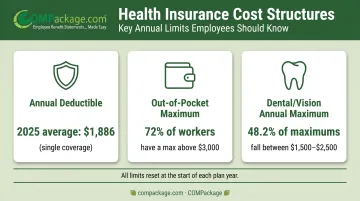
According to the American Dental Association, 48.2% of in-network dental annual maximums fall between $1,500 and $2,500.
Retirement and Savings Plans
Employer-sponsored 401(k) and 403(b) plans are deferred compensation: real money the employer contributes on an employee's behalf that compounds over time.
Key 2026 IRS figures:
- Employee elective deferral limit: $24,500 for both 401(k) and 403(b) plans
- Total annual additions (employer + employee): $72,000 under IRC §415(c)
Employees who don't contribute enough to capture the full employer match are leaving a portion of their annual compensation unclaimed. HR teams communicating total compensation should make the dollar value of the employer match explicit. It's often one of the most persuasive numbers in a benefits statement.
Disability, Life, and Ancillary Insurance
These benefits carry real employer cost but generate almost no employee awareness:
- Short-term disability (STD): Replaces a percentage of income for a defined period (typically 60–90 days) after a qualifying event
- Long-term disability (LTD): Extends income replacement beyond STD, often to age 65
- Basic life insurance: Typically expressed as a salary multiple (for example, 1× or 2× base salary), employer-paid
- AD&D: Accidental death and dismemberment coverage, often bundled with life insurance
None of these appear as dollar amounts in an employee's direct deposit. All of them have a cost the employer absorbs.
Tax-Advantaged Accounts (HSA, FSA, DCFSA)
Employer contributions to tax-advantaged accounts are direct compensation that also reduces an employee's tax burden.
2026 IRS contribution limits:
| Account | Limit |
|---|---|
| HSA (self-only) | $4,400 |
| HSA (family) | $8,750 |
| Health FSA (salary reduction) | $3,400 |
| Health FSA (maximum carryover) | $680 |
| Dependent Care FSA | $7,500 (or $3,750 if married filing separately) |
A critical distinction for benefits communication: HSA funds roll over year to year and stay with the employee after a job change. FSA funds are generally use-it-or-lose-it within the benefit period. Plans may allow limited carryover or a grace period, but not both.
Paid Time Off and Other Benefits
PTO is often undervalued in compensation conversations, but the math is straightforward: a week of PTO for an employee earning $70,000 is worth approximately $1,346. HR teams should quantify it.
Other annual benefits worth including in total compensation narratives:
- Commuter benefits and free parking
- Tuition and education reimbursement
- Wellness programs and gym subsidies
- Employee assistance programs (EAPs)
- Company-provided technology (phones, laptops)
COMPackage supports over 80 benefit and perk categories, including non-monetary items like free parking, company meals, and professional memberships. That helps HR teams build a complete picture rather than stopping at health insurance and retirement.
How HR Manages the Annual Benefits Enrollment Process
Annual enrollment is typically a one-to-two week window during which employees elect or re-elect their benefits for the coming plan year. The window is brief. The preparation is not.
Strategic Planning and Vendor Finalization
HR's pre-enrollment workload includes:
- Reviewing prior-year enrollment data and claims experience
- Evaluating plan design changes and cost-sharing adjustments
- Negotiating with insurers and vendors to finalize pricing
- Setting a project timeline with milestones for system configuration, communications, and go-live
Most organizations begin this process two to four months before open enrollment begins.
Employee Communication and Education
Employees who don't understand their options tend to default to last year's elections, even when a different plan would serve them better. Effective enrollment communication uses multiple channels:
- Email announcements and deadline reminders
- Intranet or benefits portal resources
- Printed materials for workforces with limited computer access
- Live or recorded information sessions
Enrollment season is also the ideal moment to distribute total compensation statements. When employees see the full dollar value of what they're electing — not just the premium deduction on their paycheck — their understanding and appreciation of the package changes. COMPackage reports can be generated or refreshed at any point during the year, so HR teams can time delivery to coincide with enrollment communications.
Compliance and Legal Notices
Annual enrollment carries specific federal disclosure requirements. Key notices and their timing:
| Notice | Timing |
|---|---|
| Medicare Part D creditable coverage | Annually before October 15 |
| CHIPRA employer notice | Annually to employees in applicable states |
| ACA Summary of Benefits and Coverage | With enrollment materials and at renewal |
| WHCRA notice | At enrollment and annually |
| QDIA notice (retirement plans) | At least 30 days before each plan year |
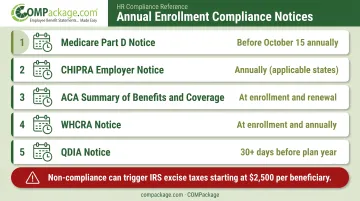
Failures to satisfy group health plan requirements can trigger IRS Form 8928 excise taxes, with minimums of $2,500 per affected beneficiary for uncorrected failures and $15,000 for more-than-de-minimis failures. Compliance is not optional.
Post-Enrollment Audit and Follow-Up
Once enrollment closes, the work continues:
- Audit all elections for accuracy and eligibility compliance (for example, an employee enrolled in a non-HDHP plan cannot contribute to an HSA)
- Reconcile data feeds to carriers and vendors
- Resolve discrepancies before the first payroll of the new plan year
- Encourage employees to verify their first paycheck reflects the correct deductions
Errors caught early are far cheaper to correct than errors discovered months later during a compliance audit.
Common Misconceptions About Annual Benefits
Misconception 1: Compensation equals salary. This is the most costly misconception in benefits management. Employees who evaluate their package by base pay alone consistently undervalue what they have. They leave for offers that look stronger on paper but may be equivalent or weaker in total compensation. HR teams that never correct this perception leave a retention lever untouched.
Misconception 2: "Annual benefit," "annual benefit limit," and "annual maximum" all mean the same thing. They don't. A quick reference:
- Annual benefits (general HR usage): the full employer-sponsored benefits package
- Annual maximum (dental/vision): the cap on insurer payments per benefit period
- Annual benefit (pension law/IRS §415): the yearly retirement income payable from a defined-benefit plan
- Annual benefit period: the 12-month plan year during which limits and elections apply
Using imprecise language in benefits communication confuses employees and creates compliance exposure. Precision matters.
Misconception 3: Annual enrollment is administrative, not strategic. For HR and total compensation professionals, enrollment season is one of the highest-leverage moments of the year. It's the window to reinforce the employer's investment and steer workers toward coverage that actually fits their situation. Done well, enrollment also makes the full value of the compensation package visible. Teams that treat it as a checkbox exercise miss the retention and engagement value it can deliver.
Frequently Asked Questions
What does "annual benefits" mean?
"Annual benefits" refers to the employer-sponsored programs (health insurance, retirement contributions, disability coverage, and more) that form part of an employee's compensation package. They're set on a 12-month benefit period for coverage limits, premiums, and employee elections.
What benefits can be given to employees?
Major categories include health insurance (medical, dental, vision), retirement plans with employer matching, disability and life insurance, and tax-advantaged accounts (HSA, FSA, DCFSA). Paid time off and extras like commuter assistance, tuition reimbursement, and wellness programs are common too.
What is an annual benefit limit?
An annual benefit limit (also called an annual maximum) is the cap on what a benefits provider will pay within one plan year. It's most common in dental and vision plans. Once that cap is reached, the employee pays 100% of costs until the benefit period resets.
How do annual benefits factor into total compensation?
Total compensation includes base salary plus every employer-paid benefit: health premiums, retirement contributions, insurance, and paid leave. Benefits can represent 30% or more of what an employer spends per worker, but employees rarely see that value unless you share it in a total compensation statement.
When do annual benefits reset?
Most annual benefits reset at the start of each plan year, often January 1 for calendar-year plans. At that point, deductibles, annual maximums, and FSA balances renew (with limited FSA carryover rules). The specific reset date depends on the employer's chosen benefit period.
What is the difference between annual benefits and an annual benefits enrollment period?
Annual benefits are the actual programs and coverage an employee receives. The annual benefits enrollment period is the one-to-two-week window each year when employees elect or update their benefits choices for the upcoming plan year. One is what you get; the other is when you choose it.