Introduction
Picture an employee earning $55,000 a year who believes that's roughly what their job is worth to their employer. In reality, once you add health insurance, 401(k) matching, paid leave, payroll taxes, and other benefits, the employer's actual investment often tops $75,000 or more. That gap isn't unusual — it's the norm.
According to 2025 MetLife data, only 57% of employees fully understood what their benefits covered, and 72% wanted benefit communications tailored to their individual needs. When employees can't see the full picture, they're more likely to feel underpaid — even when they're not.
A compensation statement solves that problem. This article explains what a compensation statement is, how it differs from a pay stub, what to include, and how to create one efficiently.
What Is a Compensation Statement?
A total compensation statement is a personalized annual document that summarizes everything an employee receives from their employer (both cash payments and non-cash benefits) over the course of a year. You'll also see it called a "total rewards statement" or "total benefits statement."
Its purpose is communication rather than payroll processing. A compensation statement isn't generated by your payroll system and won't show up in anyone's bank account. It's designed to show employees the employer's complete financial investment in them, including costs the employee never directly receives but benefits from.
Is It a Legal Requirement?
No. U.S. private employers are not federally required to provide total compensation statements. The FLSA governs wage-and-hour recordkeeping, and the DOL confirms it does not require employers to provide pay stubs, let alone a comprehensive annual compensation summary. ERISA requires specific plan disclosures like Summary Plan Descriptions, but those aren't the same thing.
That said, adoption remains surprisingly low. Payscale's 2022 Compensation Best Practices Report found that only 40% of organizations provided a total rewards statement, while 55% did not. Despite being optional, compensation statements are widely recommended by HR professionals as one of the most cost-effective tools for improving employee retention and satisfaction.
Compensation Statement vs. Pay Stub: Key Differences
These two documents serve very different purposes. Confusing them is easy — but the distinction matters.
A pay stub is a payroll document tied to a specific pay period. It shows:
- Gross earnings for that period
- Federal, state, and local tax withholdings
- Deductions (health premiums, retirement contributions, garnishments)
- Net take-home pay
A compensation statement is an annual document with a much broader scope. It covers:
- All direct cash compensation for the full year
- Employer-paid benefits that never appear in a paycheck
- Perks and non-cash contributions the employer makes on the employee's behalf
The simplest way to think about it: a pay stub answers "What did I get paid this week?" A compensation statement answers "What is my employment relationship worth over the full year?"
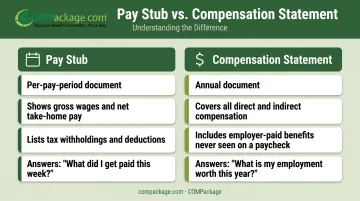
Use the pay stub for paycheck details. Use the compensation statement when you need the full annual value of the job.
What Does a Compensation Statement Include?
Compensation statements organize their content into two primary categories: direct compensation and indirect compensation. The specific line items vary by employer and by individual employee, but both categories belong on every statement.
Direct Compensation
Direct compensation covers all cash-based payments made to the employee. Common line items include:
- Base salary or hourly wages
- Overtime pay
- Performance bonuses and incentive pay
- Commissions
- Paid time off value (calculated using the employee's daily or hourly rate multiplied by eligible paid days)
Indirect Compensation
Indirect compensation covers employer-paid costs that benefit the employee but aren't received as take-home pay. This category is where most employees are surprised. Common components include:
Insurance and retirement
- Employer contributions to medical, dental, and vision insurance
- 401(k) or retirement plan matching
- Employer-paid life and disability insurance
- HSA, FSA, and HRA contributions
Legally required costs
- Employer share of FICA taxes (Social Security at 6.2% and Medicare at 1.45%)
- Workers' compensation insurance premiums
Additional benefits and perks
- Tuition or education assistance
- Childcare assistance
- Employee assistance programs (EAPs) and wellness programs
- Perks like company vehicles, mobile phones, or relocation assistance
According to the BLS Employer Costs for Employee Compensation report (March 2026), benefits represent 30.1% of total employer compensation costs in private industry. That breaks down roughly as:
| Benefit Category | % of Total Compensation |
|---|---|
| Health insurance | 7.3% |
| Paid leave | 7.6% |
| Legally required (FICA, workers' comp) | 7.2% |
| Retirement and savings | 3.4% |
| Supplemental pay | 4.1% |
For context on real dollar values: KFF's 2025 Employer Health Benefits Survey reported average employer premium contributions of $7,940 for single coverage and $21,005 for family coverage on HSA-qualified plans. Vanguard's 2025 data found the average employer 401(k) match promise at 4.6% of pay.
Non-Quantifiable Benefits
Not every benefit has a clean dollar figure, and it can still belong on the statement. Many employers include acknowledgments of:
- Remote or hybrid work flexibility
- Career advancement and promotion opportunities
- Professional development programs
- Employee discount programs
- Parental leave policies
- Workplace culture perks
These reinforce the full picture of employment even when an exact dollar value can't be assigned.
Illustrative Example
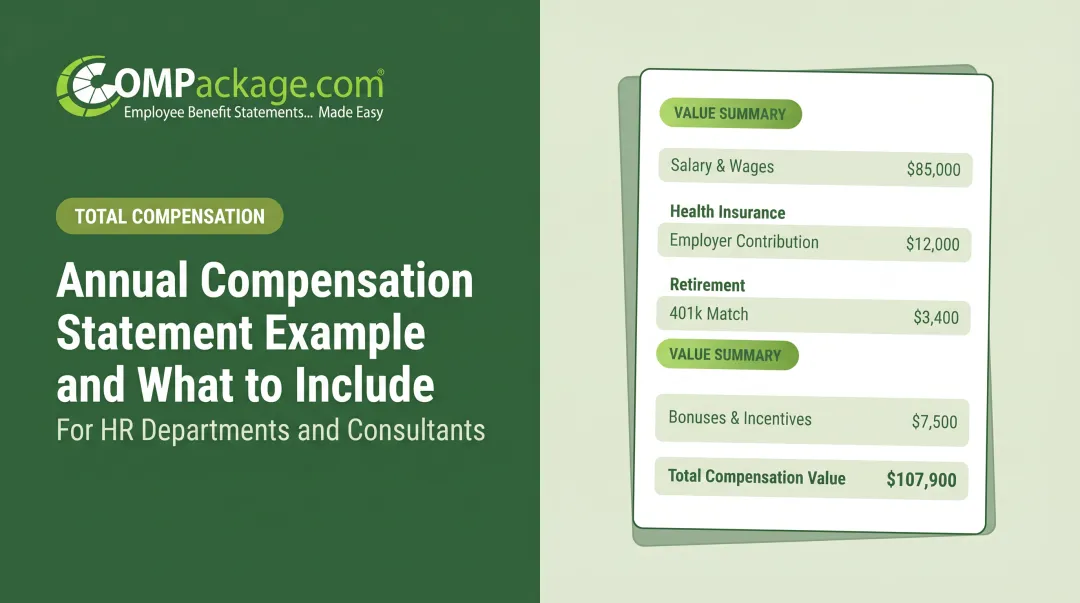
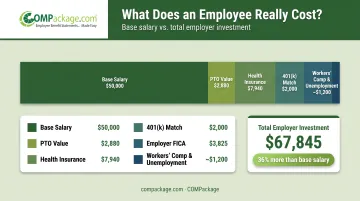
Here's how a $50,000 base salary can add up:
| Component | Annual Value |
|---|---|
| Base salary | $50,000 |
| PTO value (15 days @ $192/day) | $2,880 |
| Health insurance (employer share) | $7,940 |
| 401(k) match (4% of salary) | $2,000 |
| Employer FICA taxes (7.65%) | $3,825 |
| Workers' comp & unemployment | ~$1,200 |
| Total employer investment | ~$67,845 |
That's a package worth 36% more than the base salary — none of it visible in a weekly paycheck.
Benefits of Sharing Compensation Statements with Employees
Closing the Pay Perception Gap
Payscale's 2025 Fair Pay Impact Report found that 68% of employees paid at or above market rate still believed they were underpaid. A compensation statement closes that gap by replacing assumptions with documented facts.
Employees who perceive their pay as unfair are 45% more likely to look for another job, according to the same report. Employees at highly pay-transparent organizations are 59% less likely to leave. Compensation statements won't fix pay that's actually below market, but they can prevent employees from undervaluing packages that are genuinely competitive.
Transparency and Trust
Sharing compensation data reduces speculation. It also frees up HR and payroll teams from repeatedly fielding questions about "what the company really pays." When employees have the document in hand, they can answer those questions themselves.
In Payscale's employer survey, 46% of employers rated themselves at the lowest level of pay transparency, yet 60% said they wanted to reach a higher level. Compensation statements are a direct, low-cost step in that direction.
Recruiting Advantage
Some employers share compensation statements alongside offer letters so candidates can see the full value of what's being offered — not just the salary line. This is particularly effective for small and mid-sized businesses that can't match the base salaries of larger competitors but offer strong total packages.
A candidate comparing a $70,000 salary at a large company to a $63,000 offer at a smaller firm might read those offers very differently with full package details in hand. Generous health coverage, a strong 401(k) match, and flexible PTO can push the smaller firm's real value well above $80,000.
Engagement and Benefit Utilization
MetLife found that employees who understood and were satisfied with their benefits were 1.4 times more likely to feel engaged and 1.2 times more likely to be productive. When employees actually use their wellness programs, mental health benefits, and PTO — rather than leaving them on the table — they tend to perform better and stay longer.
How to Create a Total Compensation Statement
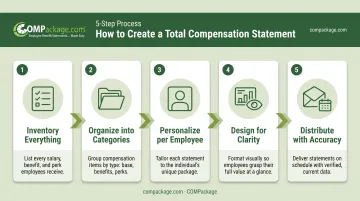
Step 1 — Inventory Everything You Offer
List every form of compensation you provide, from base wages to minor perks, and assign a dollar value wherever possible. Don't skip anything just because it doesn't appear on a paycheck. Employer-paid FICA taxes, workers' comp premiums, and EAP subscriptions all count.
Step 2 — Organize into Direct and Indirect Categories
Group line items under "Direct Compensation" and "Indirect Compensation" headers. Each item should list its name and corresponding annual dollar value, with a clear total at the bottom. Keep the structure consistent across all statements.
Step 3 — Personalize for Each Employee
Every statement must reflect that specific employee's actual package. A single parent with family health coverage has a very different statement than a single employee on an individual plan. Benefits that don't apply to a given employee shouldn't appear on their statement at all.
Step 4 — Design for Clarity
Use charts, graphs, or simple visual layouts to make the document easy to scan. Include the employee's name and relevant details. Add plain-language explanations for any complex benefit items. A brief cover note explaining what the statement is, and why you're sharing it, helps employees engage with it rather than ignore it.
Step 5 — Distribute with Intention and Accuracy
Share statements annually. The best timing is usually after merit reviews are finalized, so employees see base pay changes in context. Just before open enrollment also works well, when people can make benefit elections with the full compensation picture in front of them.
Accuracy is non-negotiable. A single calculation error can undermine confidence in the entire document.
If building statements by hand is eating too much time, COMPackage is a self-service total compensation statement platform built for in-house use. Teams often finish an entire workforce in under 90 minutes, compared with the days or weeks manual reports can take.
Capabilities that speed the work include:
- More than 80 benefit category ideas
- Automated calculators for mandated benefits, insurance, time-off, and 401(k)
- Bulk employee data import from Excel
- Custom branding with your logo and colors
Potential Drawbacks and How to Address Them
Compensation statements build trust when they are accurate and well framed. Handled poorly, they can spark comparison, pushback, or doubt. Here is how to stay ahead of the most common issues.
Employee Pay Comparisons
Some employees will compare statements with colleagues. That risk is manageable if you prepare before you distribute:
- Confirm genuine pay equity across similar roles first
- State upfront that the statement is a transparency tool, not a raise debate
- Train managers on how to answer comparison questions calmly and consistently
Misinterpretation as Anti-Raise Justification
Employees sometimes read a statement as code for "you're already well paid, so stop asking." Address that head-on:
- Explain the purpose clearly when you share the document
- Keep performance reviews and raise processes consistent and fair
- Make sure base pay is competitive on its own merits
Accuracy Pressure
Even small errors can undercut trust in the statement and the employer. Protect accuracy before anything goes out:
- Use standardized processes or software to cut calculation mistakes
- Double-check every figure against payroll and benefits source data
- Fix issues before distribution—post-send corrections are much harder to recover from
Frequently Asked Questions
Can you give an example of a compensation statement?
A compensation statement for an employee with a $55,000 base salary might include $8,000 in employer health insurance, $2,200 in 401(k) matching, $4,200 in PTO value, and $4,208 in employer FICA taxes. That brings total employer investment to roughly $73,600, with each component listed by name and a grand total at the bottom.
What is the difference between a compensation statement and a pay stub?
A pay stub is a per-pay-period document showing gross wages, tax withholdings, and net take-home pay. A compensation statement is an annual document covering all direct and indirect compensation, including employer-paid benefits, retirement contributions, and payroll taxes that never appear on the paycheck.
Are employers legally required to provide total compensation statements?
No. In the U.S., private employers are generally not required by federal law to provide compensation statements. Doing so is widely recommended as a best practice for improving retention, transparency, and employee satisfaction, but the obligation doesn't exist at the federal level.
How often should a total compensation statement be issued?
Annual distribution is standard. The best timing is after merit and bonus decisions are finalized, so employees see their complete package in context, or just before open enrollment so they can make benefit elections with full information.
What is the difference between direct and indirect compensation?
Direct compensation is cash paid to the employee: wages, bonuses, commissions, and PTO payouts. Indirect compensation covers employer-paid benefits and costs that don't appear as take-home pay, such as health insurance premiums, retirement contributions, and employer payroll taxes.
How does a compensation statement help with employee retention?
Most employees underestimate what their employer actually spends on them. When someone considers leaving for a job paying $5,000 more in base salary, a compensation statement can show them that the new offer may not actually be worth more once total benefits are compared. Closing that perception gap reduces unnecessary turnover.