Introduction
Ask most employees what they earn, and they'll quote their paycheck. That number tells only part of the story.
Base pay is just one slice of what a company actually invests in each person. Health coverage, retirement matches, paid time off, and bonuses often add thousands of dollars in value that never shows up on a pay stub.
When employers don't spell this out, employees underestimate what they're worth. That gap fuels preventable resignations and makes it harder to win candidates against competing offers.
According to WTW's 2024 Global Benefits Attitudes Survey, benefits have become 50% more important as a reason employees accept a job since 2017.
This guide breaks down what total compensation includes, how it differs from salary, and gives you a step-by-step formula with a real worked example.
Key Takeaways
- Total compensation combines direct pay (salary, bonuses, commissions) with indirect pay (benefits, PTO, perks)
- Two job offers with identical salaries can differ by thousands once benefits are factored in
- Employees who understand their full package negotiate better and feel more valued
- Manually calculating this across a whole workforce is slow and error-prone
What Is Total Compensation?
Total compensation is the complete sum of monetary and non-monetary rewards an employee receives in exchange for their work. It's not just the number on their offer letter.
Think of it as everything an employer spends to keep someone on payroll: wages, cash incentives, insurance premiums, retirement contributions, and even the dollar value of unused vacation days.
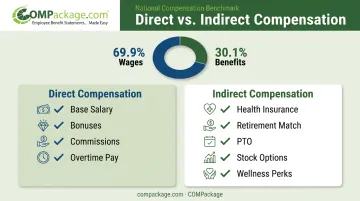
According to the Bureau of Labor Statistics, wages and salaries account for 69.9% of private-industry compensation costs, while benefits make up the remaining 30.1%. On average, that's $32.60 per hour in wages versus $14.01 per hour in benefits nationally. That's a national employer-cost benchmark, not a guarantee for any individual employee, but it illustrates how much value sits outside the paycheck.
Direct compensation is the cash an employee sees directly, usually through payroll. It includes:
- Base salary or hourly wages: the guaranteed foundation of pay
- Bonuses: performance, holiday, or signing bonuses
- Commissions: variable pay tied to sales or targets
- Overtime pay: premium pay for hours beyond the standard schedule
Indirect compensation covers everything an employer provides that isn't a straight paycheck deposit:
- Health, dental, and vision insurance premiums paid by the employer
- Retirement contributions, such as a 401(k) match
- Paid time off, including vacation, sick days, and holidays
- Stock options or equity grants for eligible roles
- Wellness perks and professional development budgets
- Other fringe benefits like commuter subsidies or childcare assistance
Some perks, like flexible schedules or remote work, don't come with a clean dollar figure. That doesn't mean they're worthless. They're still worth listing on a compensation statement, even without a specific number attached.
Total Compensation vs. Base Salary
While salary is a fixed, guaranteed number, total compensation captures the entire financial picture, including variable pay and non-cash benefits.
Here's why the distinction matters in practice:
| Element | Base Salary | Total Compensation |
|---|---|---|
| Guaranteed amount | Yes | Partially |
| Includes bonuses/commissions | No | Yes |
| Includes insurance value | No | Yes |
| Includes retirement match | No | Yes |
| Includes PTO value | No | Yes |
Example: Two candidates each get offered a $65,000 salary. Candidate A's employer covers 100% of health premiums and offers a 4% 401(k) match. Candidate B's employer covers only 50% of premiums and offers no match. Same salary, but Candidate A's total compensation could easily run $6,000-$8,000 higher per year.
A related term, "total rewards," often gets confused with total compensation, but it's broader in scope. Total rewards includes compensation and benefits, plus intangibles like career growth, recognition, and workplace culture. Total compensation, by contrast, sticks strictly to pay and benefits with an assignable dollar value—don't use the terms interchangeably when building a statement.
Why Total Compensation Matters
Understanding the full package benefits both sides of the employment relationship.
For employers:
- More accurate budgeting since benefit costs are tracked alongside pay
- Stronger recruiting positioning against competitors offering similar salaries
- Better retention when employees see the full value of staying
For employees:
- Accurate comparison between competing job offers
- Better personal financial planning
- Stronger footing when negotiating raises or new offers
Communication is the piece companies skip most often, and it costs them. Mercer's Health on Demand 2025 study surveyed over 18,000 employees globally. It found that 83% of employees who received engaging benefit communications knew where to find their benefit information, compared to just 37% who didn't. Employees can't value what they don't understand, and a clear total compensation statement is often the easiest way to close that gap.
How to Calculate Total Compensation
The formula is simple, even if the components take some digging:
Total Compensation = Direct Pay + Indirect Compensation
Step 1: Add Up Direct Pay
Total every dollar the employee receives directly:
- Base salary or annual hourly wages
- Bonuses paid during the year
- Commissions earned
- Overtime pay
Step 2: Assign Value to Indirect Compensation
This is the harder part. For each benefit, calculate the employer's actual cost:
- Insurance premiums the company pays on the employee's behalf
- Retirement match contributions (annual dollar amount)
- PTO value (daily rate × number of PTO days)
- Stock option value, if applicable
- Any other perks with a definable cost
Add direct pay and indirect compensation together for the final figure. Here's how it looks in practice.
Worked example: Sarah is a marketing coordinator earning a $60,000 base salary plus a $3,000 annual bonus.
| Component | Annual Value |
|---|---|
| Base salary | $60,000 |
| Bonus | $3,000 |
| Direct Pay Subtotal | $63,000 |
| Health/dental/vision premiums (employer share) | $9,000 |
| 401(k) match (3% of salary) | $1,800 |
| PTO (15 days at $230.77/day) | $3,462 |
| Wellness stipend | $500 |
| Indirect Compensation Subtotal | $14,762 |
| Total Compensation | $77,762 |
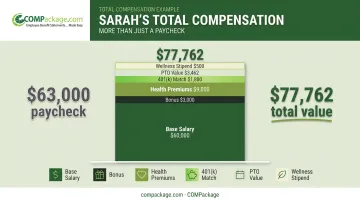
Sarah's actual paycheck reflects $63,000. Her true value to the company is nearly $14,800 higher.
Running this math for one employee is manageable. Running it accurately for 50, 150, or 500 employees, each with different benefit elections, PTO balances, and bonus structures, turns into a spreadsheet nightmare fast.
Simplify Total Compensation Reporting with COMPackage
Most small and mid-sized businesses know this math matters. Few have the time or budget to calculate it for an entire workforce.
Hiring an outside consultant to build compensation statements can get expensive quickly, and the reports go stale the moment a benefit changes. That's the exact gap COMPackage was built to close.
COMPackage is self-service total compensation statement software that lets businesses generate accurate, professional employee reports in-house, often in a single day, without paying ongoing service provider fees.
Founder Joe Blattner built the company on a simple idea: employees and employers both benefit when the full value of a paycheck is visible and understood.
Features built specifically for the calculation process include:
- 80+ benefit category options, covering far more than standard insurance and retirement lines
- Bulk employee data import from Excel spreadsheets, so you're not entering figures one employee at a time
- Auto calculators that speed up manual entry for common benefit values
- Custom branding, including your company logo and color scheme, so reports look like they came from your HR team
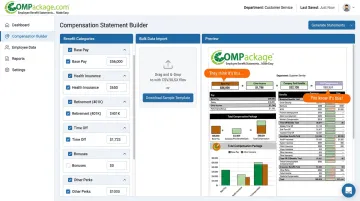
Whether you're running reports for five employees or five hundred, the goal is the same: show people what they're actually earning, without the manual grind.
Frequently Asked Questions
What is the meaning of total compensation?
Total compensation is the full package of direct pay and indirect benefits an employee receives in exchange for their work. It goes beyond salary to include bonuses, insurance, retirement contributions, and other perks.
How do you calculate total compensation?
Add all direct pay components (salary, bonuses, commissions, overtime) to the dollar value of indirect benefits (insurance, retirement match, PTO, perks). The formula is direct pay plus indirect compensation.
What is included in total compensation?
Total compensation includes base pay, bonuses and commissions, employer-paid insurance premiums, retirement contributions, paid time off, and other benefits like stock options or wellness perks.
Is total compensation the same as salary?
No. Salary is one fixed component of pay. Total compensation includes salary plus all additional cash incentives and benefits, giving a much fuller picture of an employee's actual earnings.
Why is total compensation important?
Showing the full value of a pay package helps employers recruit and retain talent. Employees also gain a clearer picture of what they're really earning beyond the paycheck.
What is a total compensation statement?
A total compensation statement itemizes an employee's direct and indirect compensation—salary, bonuses, benefits, and perks—in one document. Tools like COMPackage let companies generate these reports in-house quickly and affordably.