Introduction
"Total rewards" and "total compensation" get used interchangeably in HR conversations all the time. They're not the same thing — and that confusion has real consequences.
When an employee thinks their compensation is just their paycheck, they're undervaluing everything else their employer provides. When a business owner equates total rewards with a salary number, they're missing the retention levers that matter most to their team.
According to Mercer's 2025 Health on Demand study, only 33% of employees without engaging benefits communications said they understood the value of their employer-provided benefits. Among those receiving clear, engaging communication, that number jumped to 84%.
This article breaks down both terms clearly: what each one includes, how they relate, where they differ, and how to communicate both so employees see the full value—and you improve retention and recruiting.
Key Takeaways
- Total compensation covers everything with a dollar value: salary, bonuses, equity, and employer-paid benefits.
- Total rewards expands that picture with career development, recognition, flexibility, and well-being.
- Total compensation answers what you pay; total rewards answers why employees stay.
- Employees who can't see the full picture tend to undervalue their jobs and leave.
- For smaller businesses especially, communicating total rewards is a low-cost way to compete.
What Is Total Compensation?
Total compensation is the complete monetary value of everything an employer provides in exchange for an employee's work. It's the quantifiable, dollar-denominated side of the employment relationship.
According to BLS data from December 2024, the average private-industry worker costs employers $44.67 per hour in total compensation. That breaks down to $31.47 in wages and salaries (70.5%) and $13.20 in benefits (29.5%). That means nearly $1 in every $3 an employer spends doesn't show up in an employee's paycheck.
Core Components of Total Compensation
| Component | What It Includes |
|---|---|
| Base salary | Fixed, regularly scheduled pay (hourly or salaried) |
| Variable pay | Bonuses, commissions, performance incentives, shift differentials |
| Equity | Stock options or ownership stakes (where offered) |
| Health & insurance benefits | Medical, dental, vision, disability, life insurance (employer-paid portion) |
| Retirement contributions | 401(k) match, pension contributions |
| Other financial perks | Tuition reimbursement, transportation stipends, cell phone, parking |
Keep these scope limits in mind:
- Variable pay and equity are only part of total compensation when the employer actually offers them. Not every package includes both.
- Benefits represent a significant share of employer cost; at companies with 1–99 employees, BLS data shows benefits average 25.8% of total compensation.
- Total compensation does not include non-monetary experiences. Career development, flexible schedules, recognition, and culture belong to the broader total rewards framework.
The Most Common Misconception
Many employees, and some managers, assume total compensation equals base salary. That understates the full package.
HR teams use total compensation data for market benchmarking, pay equity analysis, and the true cost of employment. Unless that full picture is communicated clearly, employees compare a paycheck to an offer letter and draw the wrong conclusion.
What Is Total Rewards?
Total rewards is a strategic framework that encompasses total compensation and extends beyond it. WorldatWork defines it as a portfolio spanning compensation, benefits, well-being, career growth, and recognition — everything an organization offers that employees perceive as valuable, including elements that can't be assigned a dollar amount.
The Five Pillars of Total Rewards
- Compensation and benefits — Base pay, variable pay, health coverage, and retirement contributions
- Work-life balance — Paid time off, flexible scheduling, remote work, and caregiver support
- Career development — Training, mentorship, tuition help, and clear advancement paths
- Recognition — Awards, peer shout-outs, and performance celebrations
- Well-being and culture — Mental health resources, wellness programs, purpose, and inclusion
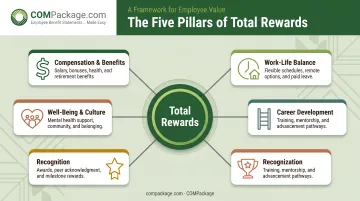
Some of these elements are quantifiable — a gym membership reimbursement or wellness stipend has a clear dollar value. Others aren't — a flexible schedule, a supportive manager, or a team that genuinely collaborates. Both carry real perceived value.
Put simply, total compensation is what shows up in the paycheck and benefits package. Total rewards is the fuller picture of why someone joins and stays.
Why Non-Monetary Rewards Matter
Deloitte's 2024 Gen Z and Millennial Survey covered more than 22,000 respondents across 44 countries. Key findings:
- Purpose was important to workplace satisfaction and well-being for 86% of Gen Z and 89% of millennials
- 44% of Gen Z and 40% of millennials had rejected an employer — citing poor work-life balance, insufficient mental health support, and noninclusive practices
- Despite this, cost of living was their top concern, and 56% of Gen Z reported living paycheck to paycheck
Pay still matters. Competitive compensation is the floor, not the ceiling. Once base pay is in a reasonable range, non-monetary total rewards are what set one employer apart from another.
Total Rewards vs. Total Compensation: Key Differences
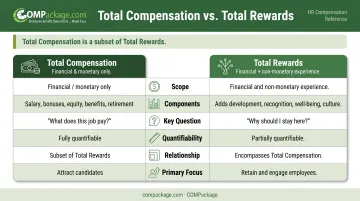
The core distinction: total compensation is a subset of total rewards, not a competing concept.
- Total compensation asks: "What am I paid?"
- Total rewards asks: "What is it like to work here?"
Side-by-Side Comparison
| Dimension | Total Compensation | Total Rewards |
|---|---|---|
| Scope | Financial and monetary only | Financial + non-monetary experience |
| Components | Salary, bonuses, equity, benefits, retirement | All of compensation + development, recognition, well-being, culture |
| Employee question it answers | What does this job pay? | Why should I stay here? |
| Primary HR function | Benchmarking, pay equity, cost of employment | Attraction, engagement, and retention strategy |
| Non-monetary elements | No | Yes |
| Measurability | Fully quantifiable | Partially quantifiable |
Timing Also Differs
Total compensation is typically discussed at two moments: the job offer and the annual review. Total rewards is an ongoing, lived experience — employees encounter it every day through how they're managed, whether their growth is supported, and whether they feel recognized.
That timing gap changes how you communicate each one. A compensation number gets shared once a year. A total rewards strategy needs to stay visible and reinforced year-round.
Where "Benefits" Fits In
Three terms create frequent confusion. Here's how they nest:
- Benefits = non-cash financial offerings (health insurance, retirement, paid leave)
- Total compensation = direct pay + benefits (everything with a dollar value)
- Total rewards = total compensation + development, recognition, well-being, and culture
Benefits are a component of both total compensation and total rewards, not a synonym for either.
Why the Distinction Matters for Employers
The Retention Risk of Communicating Only Compensation
Employees who see only their base salary are missing a substantial portion of what their employer actually invests in them. That gap creates real risk: an employee who feels underpaid may leave even when their total package is competitive.
Gallup's research places the cost of replacing one employee at a conservative one-half to two times their annual salary. Work Institute's 2023 Retention Report separately estimated replacement at roughly 33% of base pay. Either way, turnover is expensive. If people leave because they don't understand what they already have, that cost is avoidable.
Work Institute's 2023 Retention Report also found that career factors (18.7%) and job design factors (12.4%) ranked ahead of total rewards and pay (11.9%) as reasons employees left in 2022. Higher pay alone won't fix exits driven by weak development, poor job fit, or bad management. Employers need to communicate and improve the full total rewards picture, not compensation alone.
The Recruiting Advantage
Candidates comparing job offers are almost always comparing base salaries, the number on the offer letter. Employers who surface the full package (health coverage, retirement match, PTO, flexibility, development opportunities) gain an edge, especially when base pay isn't top-of-market.
The Small Business Case
For companies with 5–200 employees, this distinction is particularly important. BLS data shows that benefits represent 25.8% of total compensation at small establishments, a real investment that often goes unseen.
A 20-person company paying $55,000 in base salary to an employee may be investing $70,000–$75,000 or more when employer-paid benefits, retirement contributions, and other costs are factored in. If that employee never sees the full number, they compare $55,000 to a competitor's $60,000 offer. The math looks worse than it is.
For smaller employers who can't always match enterprise salaries, putting that full dollar value in front of employees—through a clear total compensation statement—is one of the cheapest retention levers available.
How to Communicate Total Compensation and Total Rewards
Best Practices for Employers
- Start at recruiting, not onboarding. Share the full picture before an offer is accepted, not after. Candidates making comparisons need complete information, not just a salary figure.
- Use personalized statements. A generic benefits summary lands softer than a document with this employee's salary, employer health contribution, 401(k) match, and PTO value.
- Speak plainly. Plain-language narratives alongside the numbers help employees connect the document to their actual experience. A table of dollar amounts without context is easy to ignore.
- Communicate year-round. When benefits change, pay is adjusted, or a new program launches, reinforce the message. Don't rely on one annual statement to carry the full load.
- Quantify what you can; name what you can't. Flexible scheduling and a strong culture don't convert to dollars. But they can be named, described, and shown alongside the monetary totals so employees see the complete picture.
Total Compensation Statements: What They Are and Why They Work
Those practices work best when every employee can see the full package in one place. A total compensation statement puts the employer's investment into a clear document: base pay, employer-paid benefit contributions, retirement matching, and the value of additional perks, so people understand what they earn beyond the paycheck.
COMPackage helps teams put that into practice. The software lets businesses of any size build personalized total compensation reports in-house, without consultants or third-party processing waits.
Employers can draw on more than 80 preprogrammed benefit and perk categories, including:
- Health insurance and 401(k) contributions
- Parking, cell phones, and paid time off
- Other cash and non-cash perks specific to each employee
For a 30-person company, reports for the full team can be done in under 90 minutes. Pricing starts at $149 per year for small teams and scales by headcount up to $2,599 for unlimited employees. The Professional version ($2,999/year) adds multi-client management for benefits consultants, HR advisors, and insurance agencies.
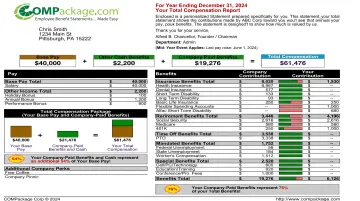
Reports can also name non-quantifiable benefits—flexibility, recognition programs, or development opportunities—next to the dollar totals so nothing gets left out.
Frequently Asked Questions
What is the difference between total rewards and total compensation?
Total compensation covers everything with a measurable dollar value: salary, bonuses, equity, employer-paid benefits, and retirement contributions. Total rewards adds non-monetary elements such as career development, recognition, work-life balance, and well-being. In short, total compensation is what you pay; total rewards is what employees experience.
What is included in total compensation?
Total compensation includes base salary, variable pay (bonuses, commissions, incentives), equity where offered, employer-paid health and insurance benefits, retirement contributions such as a 401(k) match, and other financial perks (tuition aid, stipends, or phones).
What are the five components of total rewards?
The five pillars are: (1) compensation and benefits, (2) work-life balance, (3) career development, (4) recognition, and (5) well-being and culture. Together, these capture everything employees value about working somewhere — not just the financial package, but the day-to-day experience.
Is total rewards the same as a total compensation package?
No. Total compensation is one part of total rewards. Think of total compensation as the financial foundation and total rewards as the full structure on top of it, including development, recognition, flexibility, and culture.
How can employers communicate total rewards and total compensation effectively?
Combine personalized total compensation statements with clear communication during recruiting and onboarding. Make each statement specific to the employee (not a generic summary) and reinforce the full picture throughout the year, not only at annual review.
Why does communicating total rewards matter for employee retention?
Employees who only see base salary often underestimate what their employer invests in them, which makes outside offers look stronger than they are. Sharing the full picture, monetary and non-monetary, closes that gap and gives people accurate information when they decide whether to stay.