That gap is a real problem. Many employers struggle to communicate the true value of a job offer or a current role beyond the base salary line on a paycheck. Meanwhile, employees make career decisions—accepting offers, negotiating raises, deciding whether to leave—based on incomplete information.
This guide breaks down what full compensation actually means, what belongs in the calculation, and how to work out the number yourself. Whether you're an HR leader trying to prove your benefits package is competitive, or an employee sizing up two job offers, you'll walk away with a formula you can actually use.
Key Takeaways
- Full compensation = direct pay (salary, bonuses, commissions) + indirect pay (benefits, retirement, perks)
- The core formula: Total Compensation = Direct Pay + Indirect Compensation
- Benefits alone can add roughly 43% on top of wages for the average U.S. worker
- Use the full compensation number to recruit stronger, budget accurately, and negotiate with clearer numbers
- Paychecks omit benefits, so most employees underestimate what they actually earn
What Does Full Compensation Mean?
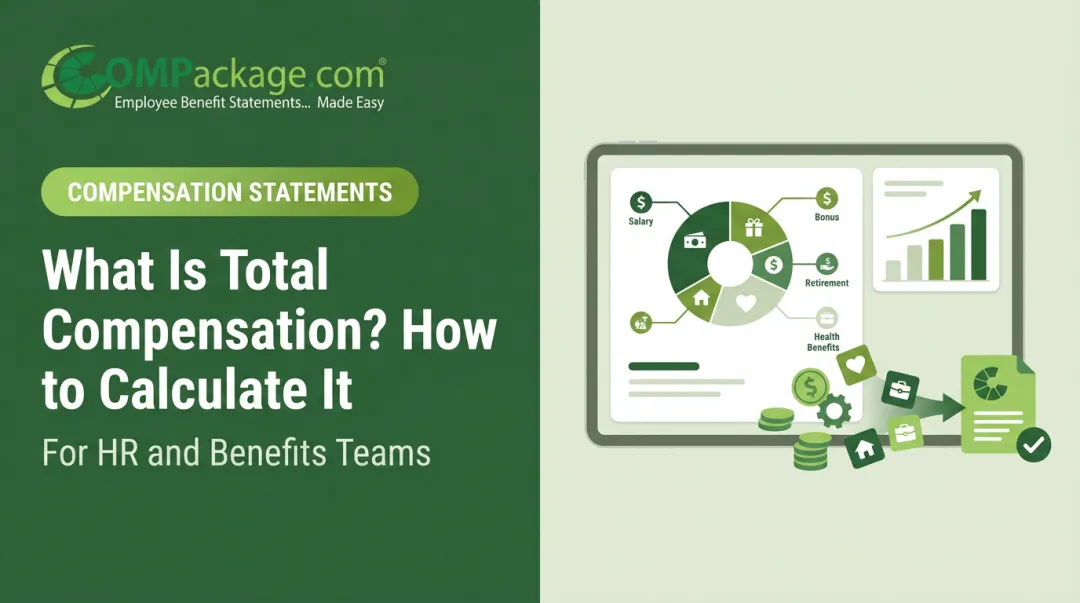
Full compensation is the complete value an employee receives in exchange for their work. Not just wages, but every monetary and non-monetary form of pay combined.
The Bureau of Labor Statistics defines total compensation as employer costs for wages and salaries plus benefits. That definition is clear on paper; the components underneath it are what most people miss.
You'll often hear "full compensation," "total compensation," and "total rewards" used interchangeably in HR conversations. There's a real distinction worth knowing:
| Term | What it includes |
|---|---|
| Total/full compensation | Wages and salaries plus employer-paid benefit costs |
| Total rewards | Compensation plus well-being, career growth, and recognition |
Total rewards is the bigger umbrella term. Total compensation sits inside it.
Full Compensation vs. Base Salary
Base salary is one line item, not the whole story. According to BLS data, private-industry benefits cost employers $14.01 per hour on top of $32.60 per hour in wages, meaning benefits add roughly 43% above wages alone.
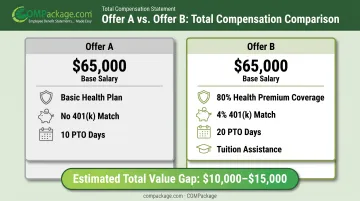
Here's why that math matters in practice. Picture two job offers, both listing a $65,000 base salary:
- Offer A: Basic health plan, no 401(k) match, 10 PTO days
- Offer B: Employer covers 80% of health premiums, 4% 401(k) match, 20 PTO days, plus tuition assistance
Same salary on paper. Potentially $10,000-$15,000 apart in real value. Anyone comparing these offers by salary alone is making a decision blind.
What's Included in a Full Compensation Package?
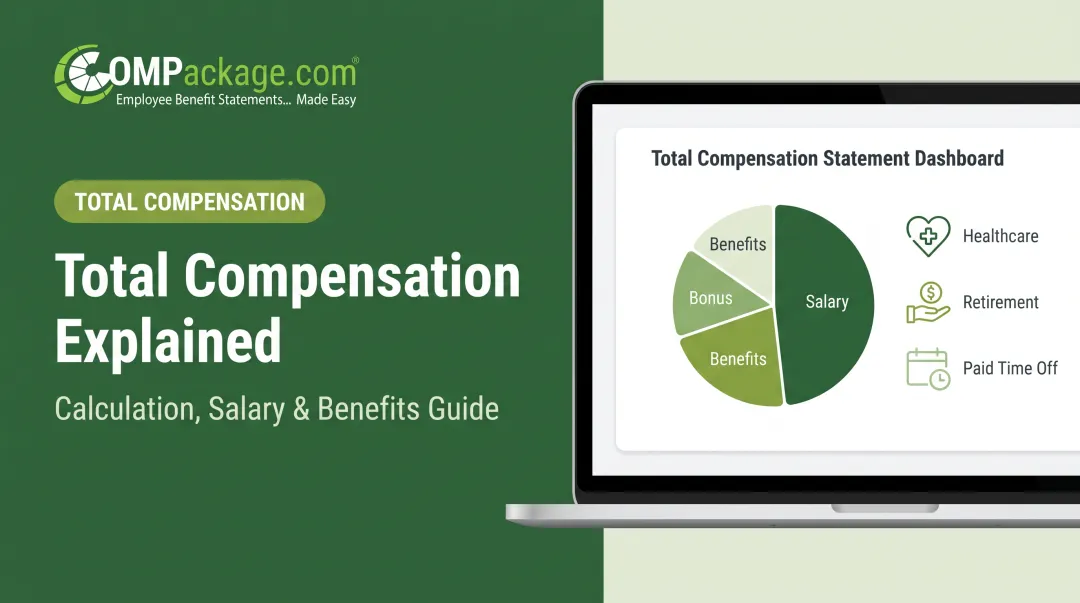
A full compensation package breaks into two buckets: direct compensation (cash you receive directly) and indirect compensation (benefits and other non-cash value your employer provides). Here's how each one shakes out.
Direct Compensation
This is the money that shows up as cash, whether in a paycheck or a bonus deposit:
- Base or hourly pay — your standard wage before anything else is added
- Commissions — performance-based pay tied to sales or targets
- Bonuses and incentives — annual, quarterly, or spot bonuses tied to performance
- Overtime pay — premium pay for hours beyond the standard workweek
SHRM's compensation framework also groups differential and incentive pay under this direct category. Equity and stock options belong here too, according to WorldatWork's compensation taxonomy, not under benefits as some assume.
Indirect Compensation
Indirect compensation covers benefits and other non-cash value that isn't paid out as cash. The core items:
- Health, dental, and vision insurance — employer-paid premium contributions
- Retirement contributions — 401(k) matching or employer contributions
- Paid time off — vacation, sick, and holiday pay, valued at your daily rate
Beyond the essentials, a strong package often includes:
- Tuition or professional development support
- Wellness program stipends or resources
- Life or disability insurance contributions
One caveat: culture, flexibility, and growth opportunities add real value even when nobody assigns them a dollar figure. A great manager or a genuinely flexible schedule doesn't show up on a spreadsheet. Ask anyone who's had both, and they'll tell you it matters.
How to Calculate Your Full Compensation
The formula is straightforward:
Total Compensation = Direct Pay + Indirect Compensation
The math is simple. Gathering accurate numbers for every benefit category takes the real work. Here's the process, step by step.
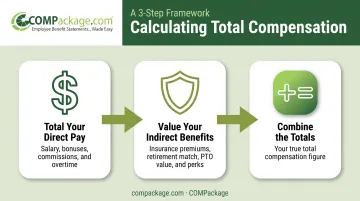
Step 1: Total Your Direct Pay
Add every direct pay source for the period you're calculating (typically annual):
- Base salary or hourly wages × hours worked
- Bonuses and incentive pay received or expected
- Commissions earned
- Overtime pay
Step 2: Value Your Indirect Benefits
This step takes more digging. Use actual employer cost data where possible:
- Insurance premiums: What your employer pays monthly toward health, dental, and vision (check your benefits enrollment paperwork)
- Retirement match: Employer 401(k) contribution as a dollar amount, not just the percentage
- PTO value: Number of PTO days × your daily pay rate
- Other perks: Tuition assistance, wellness stipends, employer-paid life insurance, and similar line items
Step 3: Combine the Totals
Add your direct and indirect figures together for the full compensation number.
Example: Sarah earns a $70,000 base salary plus a $5,000 annual bonus.
- Direct pay: $70,000 + $5,000 = $75,000
- Employer health insurance contribution: $8,400/year
- 401(k) match (4% of salary): $2,800
- PTO value (15 days at $269/day): $4,035
- Other perks (wellness stipend, cell phone): $600
Indirect total: $15,835
Sarah's full compensation: $90,835 — roughly 30% more than her salary alone suggests.
Doing this math for one employee is manageable. Doing it for 200 employees by hand is a different story. You end up hunting down insurance quotes, calculating PTO rates one person at a time, and maintaining spreadsheets that break the moment someone updates a benefit.
That scale problem is where self-service total compensation statement software like COMPackage earns its keep. It includes 12 built-in auto calculators for government-mandated benefits, 401(k) contributions, time-off value, and insurance costs. You can generate figures for an entire employee census in hours instead of weeks.
Why Understanding Full Compensation Matters
The value of knowing your full compensation number cuts both ways: for the business writing the paycheck and the person cashing it.
For Employers
Full compensation visibility drives real decisions:
- Budgeting: You can't plan compensation spend accurately if benefits costs live in a different spreadsheet than salaries.
- Recruiting: A candidate comparing your $65,000 offer to a competitor's $70,000 offer needs to see your full package to make a fair comparison.
- Retention: MetLife's research found employees who feel cared for are 1.3 times more likely to stay loyal and 1.2 times more likely to be productive.
Those retention gains only show up when employees actually know what they're being offered.
For Employees
Knowing your real number changes how you negotiate. Walking into a raise conversation armed with your full compensation figure, not just your salary, shifts the conversation from "give me more money" to "here's what I bring and here's what I'm worth."
It also reframes job-offer comparisons and the decision to switch employers entirely. A lateral salary move that comes with worse benefits might actually be a pay cut.
The Pay Transparency Push
State laws are accelerating this shift. Colorado and Washington now require benefits information in covered job postings, not just salary ranges. California and New York require pay ranges, though their current statutes don't mandate benefits disclosure in postings. Employers are being pushed to break out total compensation rather than lead with base salary alone.
How to Communicate Full Compensation to Employees
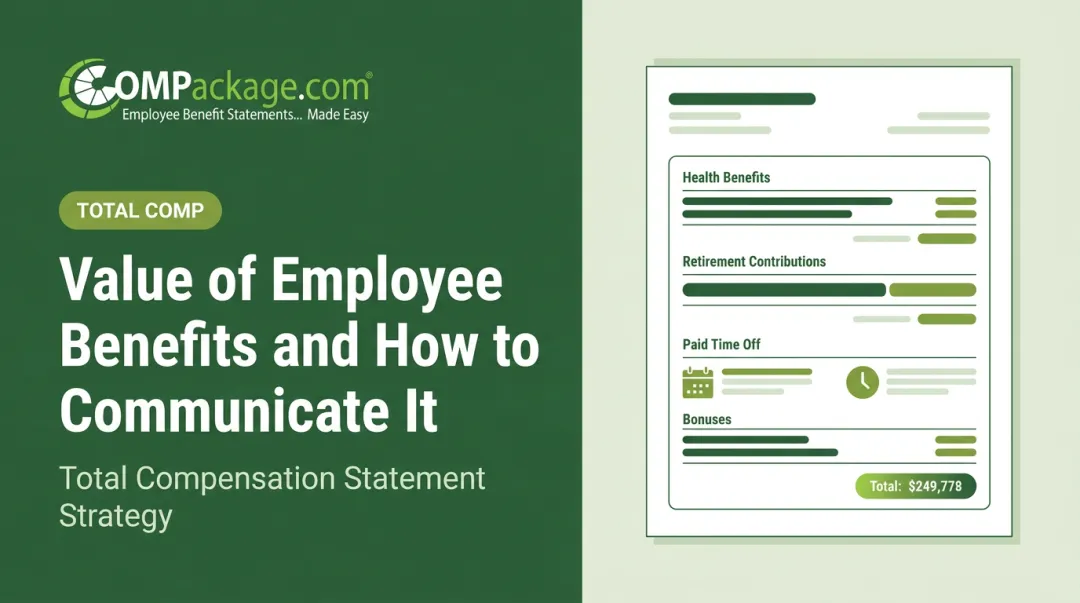
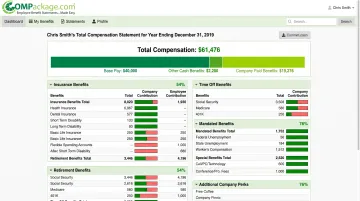
Most HR teams use a Total Compensation Statement: a single document showing an employee's complete package, from salary to insurance value to retirement contributions.
The challenge has always been cost and effort. Building these by hand for a workforce takes days. Outsourcing to a third-party provider can run into the tens of thousands of dollars for a mid-sized company.
COMPackage's self-service platform was built to solve this. It lets businesses with 5 to 5,000 employees create customized, branded compensation statements in-house, including company logo, colors, and non-quantifiable benefits like culture and flexibility.
Pricing scales with company size, starting at $149 per year for 1-5 employees up to $2,599 per year for unlimited employees, with a separate $2,999 Professional tier for consultants managing multiple clients.
How the platform works in practice:
- Employee LOADER imports workforce data from Excel, cutting record creation from 5-10 minutes per employee down to bulk import in minutes
- 80+ preprogrammed benefit categories cover health insurance and PTO, plus easy-to-miss items like parking, cell phone stipends, and holiday bonuses
- Statements can be updated or rerun throughout the year at no extra cost, which helps with mid-year benefit changes or performance review cycles
Best Practices for Rolling Out Statements
- Update at least annually, or immediately after any pay or benefits change
- Keep the format simple. Employees should understand their value in under two minutes of reading
- Include non-quantifiable perks alongside dollar figures so employees see the full picture, not just priced line items
- Time distribution strategically. Many companies pair statements with year-end reviews or open enrollment
Frequently Asked Questions
What does full compensation mean?
Full compensation is the total value an employee receives for their work, combining direct pay (salary, bonuses, commissions) with indirect compensation (benefits, retirement contributions, perks). That full figure is what matters—not the paycheck line alone.
How do I figure out my total compensation?
Add up all direct pay sources (salary, bonuses, commissions, overtime), then estimate the dollar value of your indirect benefits (insurance, retirement match, PTO value, perks). Combine the two totals for your full compensation figure.
What is the difference between total compensation and total rewards?
Total compensation covers direct pay plus benefits. Total rewards is broader, adding recognition, career development opportunities, and workplace culture into the mix alongside compensation.
Does full compensation include bonuses and stock options?
Yes. Bonuses count as direct compensation. Stock options and other equity are usually treated as direct or long-term compensation, depending on how the organization structures them.
How often should employers update total compensation statements?
At least once a year, and immediately after any change to pay, benefits, or role. Outdated statements can undercut trust if the numbers no longer match reality.
Why do employees underestimate the value of their benefits?
Because benefits aren't itemized on a paycheck. Employees see a salary number every pay period but rarely see a dollar figure for insurance contributions, PTO value, or retirement matching unless someone shows it to them directly.