Introduction
Most employees know their base salary. Their HR team sees something much broader: health insurance premiums, retirement contributions, paid leave, bonuses, wellness stipends, and a range of other benefits that never appear on a pay stub.
This disconnect has real consequences. Gartner's 2022 research found that only 32% of employees believe their pay is fair, and perceived pay inequity correlated with 15% lower intent to stay — a problem that better compensation communication can directly address.
Total compensation software bridges this gap. Instead of leaving employees to guess, HR teams can generate clear, personalized reports showing everything an employee actually receives.
The right platform depends entirely on who's using it. Enterprise suites built for salary band modeling and equity grants serve different needs than self-service statement tools designed for a 50-person company. This article compares the top platforms worth evaluating, organized by who they're actually built for.
TL;DR
Key takeaways at a glance:
- Total compensation software helps HR teams manage and communicate the full value of employee pay — not just base salary
- Look for personalized statement generation, bulk data import, and clearly published pricing before committing to any platform
- Enterprise tools like HRSoft, CompUp, and Pave suit complex multi-tier comp structures
- COMPackage and Compease offer full-featured options that serve SMBs more cost-effectively
- Poor compensation communication is a leading — and often overlooked — driver of employee turnover
- The best platform isn't the most feature-rich — it's the one that matches your size, budget, and use case
What Is Total Compensation Software?
Total compensation software is a dedicated HR technology category that helps organizations manage and communicate the complete value of what employees earn. That includes base salary, bonuses, health benefits, retirement contributions, paid leave, perks, and non-monetary benefits — presented in a single, structured format.
This category is distinct from adjacent HR tools:
- Payroll software processes and distributes payments
- HRIS platforms manage employee records, onboarding, time tracking, and benefits administration
- Total compensation software is purpose-built to show employees what they're truly earning and help HR build and distribute compensation reports efficiently
As Gartner's compensation management category definition confirms, these are distinct systems — compensation tools manage reward decisions and communication, not HR recordkeeping or payroll processing.
The market splits into two broad segments:
| Segment | Who It's For | Typical Features |
|---|---|---|
| Enterprise platforms | Mid-to-large organizations | Salary benchmarking, equity modeling, pay equity analytics, HRIS integration |
| Self-service statement tools | SMBs (5–5,000 employees) | Affordable report generation, bulk import, benefit customization |
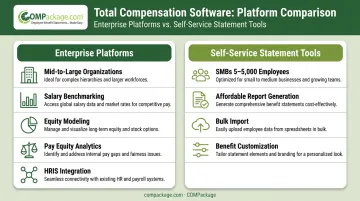
Knowing which segment fits your organization before evaluating options saves both time and budget.
Top Total Compensation Software for HR Teams Worth Comparing
These platforms were selected based on five criteria:
- Feature depth and benefit category coverage
- Ease of use and setup time
- Pricing transparency and published rates
- Suitability by company size
- Quality of personalized total compensation reports for employees
COMPackage
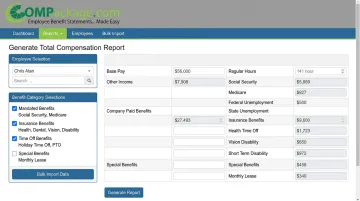
COMPackage is the world's first self-service total compensation report solution, built to make full-featured compensation reporting accessible and affordable for businesses with 5 to 5,000 employees — without costly implementation fees or reliance on outside service providers. Customers include Coca-Cola, Harley-Davidson, Tito's Vodka, and the Frank Lloyd Wright Foundation.
Designed from the ground up for HR teams and service providers who need to generate reports fast, in-house, and at a fraction of enterprise software costs. The Employee LOADER bulk import tool processes an entire employee census in a matter of hours. With 80+ benefit categories, 12 auto-calculators, and per-employee benefit filtering, reports stay accurate and relevant — not padded with line items that don't apply.
| Feature Area | Details |
|---|---|
| Key Features | Self-service report generation, Employee LOADER for bulk import, 80+ benefit categories, 12 auto-calculators, custom branding, non-quantifiable benefits display |
| Pricing | Clearly published subscription pricing; no hidden fees; 30-day satisfaction guarantee; free mid-year report changes |
| Best For | Small to mid-sized businesses (5–5,000 employees), HR consultants, benefits consultants, payroll providers, and insurance agencies |
HRSoft
HRSoft is a full-featured compensation management platform for organizations with complex pay structures — salary management, bonus administration, long-term incentive tracking, and total rewards communication under one roof.
Built for audit-ready compliance, HRSoft includes AI-assisted modeling (HRSoft Intelligence) and native integrations with SAP SuccessFactors, UKG, and Oracle HCM. It's a strong fit for financial services, healthcare, and manufacturing enterprises running multi-component review cycles.
| Feature Area | Details |
|---|---|
| Key Features | Total compensation planning, bonus & LTI management, AI modeling, compensation statements, pay-for-performance tools |
| Pricing | Custom/tiered subscription; contact HRSoft for a quote |
| Best For | Mid-to-large enterprises with complex, multi-component compensation structures requiring HRIS integration and audit trails |
CompUp
CompUp is a compensation management platform for HR and Total Rewards teams that want structured salary band management, pay equity analysis, and employee-facing total rewards communication on one platform. Used by 100+ companies across 140+ countries.
CompUp combines compensation cycle management with DEIB insights and pay equity reporting — valuable for organizations navigating pay transparency requirements. Enterprise plans start at $3 per employee per year, making it one of the few platforms with published per-employee pricing at scale.
| Feature Area | Details |
|---|---|
| Key Features | Compensation band management, pay equity analysis, total rewards statements, DEIB insights, compensation cycle management |
| Pricing | Starting at $3 per employee/year (published); enterprise plans available |
| Best For | Mid-to-large organizations building structured, transparent, and scalable compensation programs across multiple roles and geographies |
Pave
Pave is a compensation benchmarking and planning platform that aggregates real-time market data from thousands of companies — sourcing data from 9,000+ organizations according to Gartner — helping HR teams benchmark salaries and communicate total rewards with current, defensible data.
Unlike traditional annual salary surveys, Pave continuously updates its benchmarking data. A free Market Data Lite tier covers US base salary and new-hire equity benchmarks for organizations with 1–200 employees. Paid plans scale to enterprises with 75,000+ employees.
| Feature Area | Details |
|---|---|
| Key Features | Real-time benchmarking, salary band management, budget planning, total rewards communication, free benchmarking access |
| Pricing | Modular pricing; free benchmarking tier available (1–200 employees); contact Pave for paid plans |
| Best For | Organizations that prioritize real-time benchmarking accuracy, from early-stage companies to global enterprises |
Compease
Compease (now owned by Navari, formerly HR Performance Solutions) is a cloud-based compensation management tool that helps organizations build equitable, competitive pay systems through job evaluation, salary benchmarking, merit increase modeling, and equal pay analytics.
Purpose-built for pay-for-performance strategies, Compease includes an equal pay dashboard that helps HR teams proactively identify and close demographic pay gaps — a practical choice for organizations prioritizing fairness alongside operational efficiency.
| Feature Area | Details |
|---|---|
| Key Features | Merit increase modeling, pay-for-performance tools, equal pay analytics, market-aligned salary structures, salary benchmarking |
| Pricing | Custom pricing based on organization size and structure; contact Navari directly |
| Best For | Small to mid-sized organizations seeking affordable pay equity tools and structured merit-based pay management |
Key Features to Look for in Total Compensation Software
Before evaluating any platform, get clear on which features actually matter for your team's situation.
Personalized, Employee-Specific Report Generation
This is the core function, and it's different from a payroll summary or an HR data dashboard. A proper total compensation report shows everything an employee receives — from salary to benefits to perks — in plain language they can actually understand. If a platform can't produce individualized reports cleanly, nothing else on the feature list matters.
Bulk Data Import
HR teams at companies with 50+ employees can't manually build individual reports one by one. Look for tools with Excel-based employee loaders or automated import workflows that let you process your entire census in hours. COMPackage's Employee LOADER is designed specifically for this, allowing HR teams to go from raw data to complete reports without a week of manual entry.
Benefit Flexibility and Customization
The best platforms let HR include only the benefits specific to each employee — not a generic template that shows irrelevant line items to everyone. Look for:
- 80+ supported benefit categories (including non-monetary perks)
- Ability to display non-quantifiable benefits (flexible schedules, remote work options)
- Mid-year edits at no additional cost
HRIS and Payroll Integration (for Larger Organizations)
Enterprises running complex review cycles benefit from platforms that connect natively with their existing HR systems — eliminating manual data entry and keeping compensation data accurate across all systems. HRSoft, CompUp, and Pave all offer meaningful integration capabilities.
Pricing Transparency and Security
Look for software with clearly published pricing and no hidden implementation fees. For smaller HR teams without dedicated IT, these specifics matter most:
- Cloud-hosted with no installation required
- Transparent, tiered pricing by employee count
- 30-day satisfaction guarantee from the vendor
How We Chose These Tools
These platforms were evaluated on:
- Ability to generate complete, personalized total compensation reports
- Suitability across company sizes (from 5-employee businesses to global enterprises)
- Transparent or accessible pricing
- Ease of use for HR teams without technical backgrounds
- Track record with real customers
The most common mistake HR buyers make: confusing enterprise compensation management suites with purpose-built total compensation statement tools. Both serve important functions — but they solve different problems.
| Tool Type | Primary Purpose | Examples |
|---|---|---|
| Enterprise comp management | Salary bands, equity grants, merit cycles, compliance | HRSoft, CompUp, Pave |
| Total comp statement tools | Communicate the full value of compensation to employees | COMPackage |
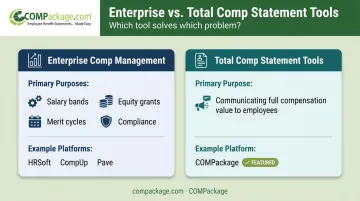
Overpaying for salary band modeling software when you actually need employee-facing compensation statements — or choosing a basic statement tool when you need equity administration — is an avoidable mistake, if you know which problem you're actually solving.
Conclusion
The right total compensation software isn't the one with the longest feature list. It's the one that fits your organization's size, budget, and primary goal — whether that's helping employees understand the full value of their package to reduce turnover, or managing complex multi-tier pay cycles across geographies.
That fit starts with honest evaluation. Before committing to any platform, assess ease of implementation, pricing transparency, integration requirements, and whether you'll realistically use the features you're paying for. Platforms that get you started quickly — without expensive consultants or lengthy onboarding — deliver value faster.
For small and mid-sized businesses that need an affordable, self-service solution up and running in a day, COMPackage offers clearly published pricing, no installation, and the ability to generate reports for your entire team in hours. If showing employees the full value of what they earn is your priority, it's a straightforward place to start.
Frequently Asked Questions
What is the best compensation management software for HR?
The best platform depends on your company's size and goals. Enterprises with complex pay structures may prefer HRSoft, CompUp, or Pave. Small and mid-sized businesses looking for an affordable, self-service total compensation statement tool will find COMPackage a strong fit — with clearly published pricing and no implementation complexity.
What does total compensation mean in HR?
Total compensation covers everything an employee receives for their work: base salary, bonuses, health insurance, retirement contributions, paid leave, and non-monetary perks. Communicating this full picture matters for retention — employees who only see their paycheck routinely undervalue what they actually receive.
What features should I look for in total compensation software?
Prioritize personalized report generation; benefit category flexibility (80+ categories); bulk data import for processing your full census efficiently; and transparent pricing with no hidden fees. Larger organizations should also evaluate HRIS integration capabilities.
How does total compensation software help reduce employee turnover?
Competing job offers that pay slightly more on paper can look attractive when employees only see their base salary. Total compensation software gives HR a way to show the complete picture, so employees are less likely to leave for offers that appear better on salary alone but aren't worth more overall.
Can small businesses use total compensation software?
Yes. Several platforms are specifically designed for smaller organizations. COMPackage supports companies with as few as 5 employees and allows HR teams to generate reports for their entire workforce in hours, at a fraction of what enterprise solutions cost.
Is total compensation software different from payroll software?
Yes — they serve distinct functions. Payroll software processes and distributes employee pay. Total compensation software communicates the full value of what employees receive, including benefits, perks, and employer contributions that never appear on a paycheck. Many organizations use both.