Compensation and rewards are two overlapping but distinct HR concepts. Together, they shape whether employees feel valued, whether they stay, and whether they perform at their best. This guide covers both clearly: what each means, how they differ, what a total rewards strategy looks like, and why communicating all of it to employees is one of the most cost-effective retention moves a business can make.
Key Takeaways
- Compensation is the fixed pay and benefits employees receive by contract — not something they earn through extra achievement.
- Rewards differ: variable, performance-driven incentives that motivate above-and-beyond work.
- Total rewards strategies combine both with non-monetary elements like career growth and recognition.
- Benefits alone make up over 30% of employer compensation costs, yet most employees undervalue them.
- Clear total compensation communication is one of the lowest-cost ways to cut turnover.
What Is Compensation?
Compensation is the full set of financial and non-financial rewards an employer provides in return for an employee's time, skills, and effort. It covers far more than the paycheck. Employers need that full picture to retain talent; employees need it to judge their market worth.
Compensation breaks into two broad categories: direct and indirect.
Direct Compensation
Direct compensation is the cash employees receive. It includes:
- Base pay: fixed salary or hourly wage paid on a regular schedule, regardless of performance
- Variable pay: bonuses, commissions, and overtime that rise or fall with performance, hours, or company results
- Equity compensation: stock options and profit-sharing that give employees a stake in long-term company success (common in startups and executive roles)
Indirect Compensation (Benefits)
Benefits are non-cash forms of compensation that carry significant dollar value, even when employees rarely count them as pay.
Common benefit categories include:
- Health, dental, and vision insurance
- Retirement plan contributions and 401(k) matching
- Paid time off (vacation, sick leave, holidays)
- Life insurance and disability coverage (short- and long-term)
- Social Security, Medicare, and workers' compensation contributions
That last category, legally required contributions, surprises many employees who don't realize their employer pays into these on their behalf.
The scale of benefits shows up clearly in the data. According to the Bureau of Labor Statistics Employer Costs for Employee Compensation (ECEC) report, benefits represent 30.1% of total compensation costs for private-industry workers, or roughly $14 of every $46.60 in total hourly employment cost.
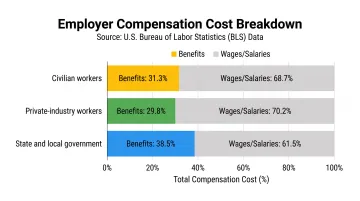
For someone earning $60,000 in base salary, that share often means $25,000+ more in employer-paid costs they may never see itemized.
What Are Rewards?
Rewards are incentives given in recognition of achievement, contribution, or exceptional performance. Unlike compensation, they aren't guaranteed. They're earned, and that distinction is exactly what makes them work as motivational tools.
Financial Rewards
Financial rewards include performance bonuses, merit raises, commissions, and cash incentive plans. What separates them from base pay isn't just variability: it's the signal they send. When a bonus is tied to a measurable outcome, employees understand that specific behaviors produce specific results. That clarity reinforces a performance culture in ways that a salary increase rarely does.
Non-Financial Rewards
Not all rewards come with a dollar sign, and some of the most powerful ones don't.
Intrinsic rewards, the internal sense of pride, purpose, and accomplishment employees feel from meaningful work, cost the company nothing but carry real motivational weight. Employees who feel their work matters outperform those who don't, full stop.
Extrinsic non-financial rewards are tangible but non-cash acknowledgments of contribution:
- Public recognition programs and employee awards
- Extra paid time off
- Flexible scheduling and remote work options
- Professional development and training opportunities
- Promotions and expanded responsibilities
These matter more than many managers realize, particularly for employees who aren't driven primarily by money.
The Role of Recognition
Recognition can be formal (employee of the month, structured award programs) or informal (a manager's genuine acknowledgment, a peer shout-out). Either way, it remains one of the most underused tools in the rewards toolkit.
The data is stark. According to Gallup and Workhuman's 2024 research, 55% of U.S. employees received either no recognition or recognition that met none of five core quality standards. Employees who received high-quality recognition were 65% less likely to be actively looking for another job — and nine times more likely to be engaged at work.
That's a significant retention lever most companies aren't pulling.
Compensation vs. Rewards: What's the Real Difference?
The distinction comes down to purpose and predictability.
Compensation is transactional and baseline. It fulfills the employment contract. Employees can count on it: scheduled, fixed (or at least predictable), and not contingent on exceptional behavior. It meets financial and security needs.
Rewards are motivational and contingent. They celebrate achievement and drive discretionary effort, the extra mile employees choose to give rather than the minimum the contract requires. They address recognition, achievement, and self-esteem needs.
Here's a simple side-by-side:
| Attribute | Compensation | Rewards |
|---|---|---|
| Nature | Fixed / contractual | Variable / earned |
| Purpose | Financial security and baseline fulfillment | Motivation, recognition, performance |
| Frequency | Regular and scheduled | As earned / as merited |
| Examples | Salary, benefits, paid leave | Bonuses, merit raises, recognition, extra PTO |
| Employee expectation | Expected and relied upon | Appreciated but not assumed |
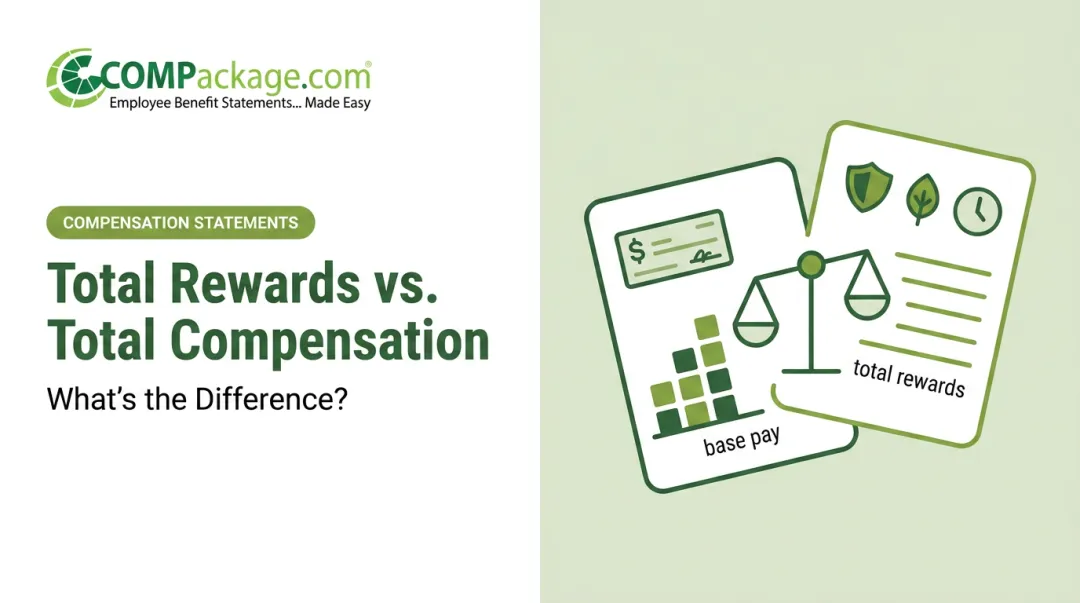
Compensation keeps employees from leaving; rewards give them a reason to stay engaged and perform. Mix the two up, and you end up funding programs that never deliver the outcome you designed them for.
What Is a Total Rewards Strategy?
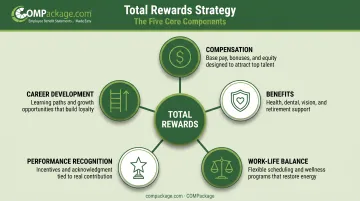
A total rewards strategy is the full package an employee receives in exchange for their contribution: pay, benefits, and every other part of the value proposition that answers Why work here?
The five core components of a total rewards strategy are:
- Compensation — base pay, variable pay, and equity
- Benefits — insurance, retirement, paid leave, and legally required contributions
- Work-life balance programs — flexible scheduling, remote work, wellness programs, and mental health support
- Performance recognition — formal and informal reward programs that acknowledge contribution
- Career development — training, mentorship, advancement opportunities, and skill-building
Pay alone no longer wins talent. Gallup's 2025 research on why U.S. employees take new jobs found that work-life balance and personal well-being (59%) ranked above pay or benefits (54%) as a "very important" consideration when evaluating a new role.
Employers who compete on salary alone are playing a losing game. A clear total rewards strategy shows candidates and employees the full value of working there—not only what hits their paycheck.
Why Compensation and Rewards Matter for Your Business
Getting this wrong is expensive. Gallup estimates employee replacement costs at 40% of annual salary for frontline workers, 80% for technical professionals, and 200% for leaders and managers. For a mid-sized company experiencing even modest turnover, those figures add up fast.
Beyond retention, well-designed compensation and rewards structures drive measurable outcomes:
- Higher employee engagement and discretionary effort
- Reduced absenteeism and presenteeism
- Stronger performance and productivity
- Better candidate attraction during recruiting
Fairness and transparency matter as much as the numbers. When employees perceive inequity, or simply don't understand the full value of what they receive, dissatisfaction follows even if the package is objectively competitive.
Perception matters as much as reality. An employee who doesn't know that their employer pays $12,000 a year in health insurance premiums on their behalf may genuinely feel underpaid, even if total compensation is above market.
Trust erodes not just from bad packages, but from opaque ones.
How to Make Sure Employees Understand Their Full Compensation Value
The Perception Gap Problem
Most employees evaluate their compensation based on take-home pay. They see the number on their pay stub and compare it to what they think they could earn elsewhere, without factoring in health insurance, retirement contributions, employer payroll taxes, paid leave, or any of the other indirect compensation their employer provides.
MetLife's 2024 Employee Benefit Trends Study found that 62% of employees were not completely confident they knew about all the benefits available to them. If employees don't know a benefit exists, it contributes nothing to their sense of value or their reason to stay.
Total Compensation Statements: The Practical Fix
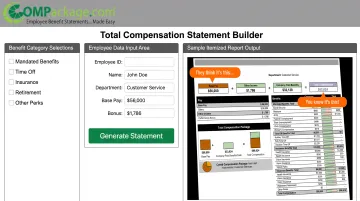
A total compensation statement is an itemized document (or digital report) that lays out every element of what an employee receives: salary, bonuses, employer-paid insurance premiums, retirement contributions, paid leave value, payroll tax contributions, and non-cash perks. Shown in total dollar terms, it puts a clear number on benefits employees often overlook.
Consider a straightforward example: an employee earning $56,000 in base salary might see $32,000+ in employer-paid benefits when everything is itemized. Their total compensation is closer to $90,000 once those benefits are counted. That's a very different conversation.
Building statements like this by hand is slow. Self-service software lets HR produce them in-house without a service bureau or weeks of spreadsheet work.
Where COMPackage Fits In
COMPackage is a self-service total compensation statement platform built specifically for businesses with 5–5,000 employees. HR teams and business owners can generate individualized, fully itemized compensation reports in-house, without outsourcing or long manual prep cycles.
Key capabilities include:
- 80+ preprogrammed benefit categories covering insurance, retirement, paid leave, legally required contributions, and special perks
- Employee LOADER for bulk import from Excel, allowing a full census to be processed in under 90 minutes
- Custom branding with company logo and report colors
- Mid-year report updates at no additional charge
- Non-quantifiable benefits can be included alongside dollar-value items
Pricing starts at $149/year for companies with up to 5 employees, scaling to $2,599/year for unlimited employees. A Professional tier at $2,999/year supports benefits consultants, insurance agencies, and accounting firms managing multiple client accounts.
COMPackage also offers a 30-day unconditional money-back guarantee. If you're not satisfied for any reason, a full refund is processed within seven business days.
Frequently Asked Questions
What is the difference between compensation and rewards?
Compensation is the fixed, contractual package — salary, benefits, and paid leave — that employees receive for their work. Rewards are variable, performance-based incentives designed to recognize achievement and motivate continued high performance. Compensation is expected; rewards are earned.
What is compensation and reward management in HR?
Compensation and reward management is the HR function that designs, administers, and communicates pay structures, benefits, and recognition or incentive programs. The goal is to attract, retain, and motivate employees with a coherent, competitive total package.
What does R&R mean in HR?
R&R stands for Recognition and Rewards — the component of a total rewards strategy focused on acknowledging employee contributions. It includes both formal programs (awards, bonuses, structured recognition) and informal appreciation to drive engagement and reduce turnover.
What are examples of employee rewards in the workplace?
Financial rewards include performance bonuses, merit raises, and commissions. Non-financial rewards include public recognition, extra paid time off, flexible work arrangements, career development opportunities, and promotions. The most effective programs typically combine both types.
Why is it important to communicate total compensation to employees?
Employees who only see their base salary routinely undervalue their full package, which fuels dissatisfaction and raises turnover risk. Communicating total compensation transparently helps employees recognize the actual investment the company makes in them — often significantly higher than they assume.
What is a total compensation statement?
A total compensation statement is an itemized report showing every component of an employee's package — salary, bonuses, benefits, employer contributions, and perks — expressed in total dollar value. It closes the gap between what employees think they earn and what the employer actually spends on them.