Introduction
Most employees think of their paycheck as their compensation. That's it.
What they don't see is the employer-paid health insurance premium averaging $9,325 per year for single coverage, the 401(k) match, the paid time off converting to thousands of dollars annually, or the dozen other benefits their employer funds on their behalf.
This blind spot is expensive for both sides. Employees feel underpaid despite competitive packages, and employers watch people leave for offers that only look better because they're better explained.
Total rewards communication is the strategy that closes this gap. Done well, it's one of the most cost-effective levers available for improving retention, satisfaction, and trust without raising base salaries. This guide covers what it is, why it matters, what to include, and how to do it effectively.
Key Takeaways
- Employees who can't see their full package underestimate total pay and leave for weaker offers.
- Benefits are 30.1% of private-industry compensation on average, yet most employees only see base pay.
- Effective communication needs personalization, consistent timing, and multiple channels year-round.
- A personalized total compensation statement is the most direct way to show the full pay picture.
- Businesses of any size can do this affordably, without a large HR team or consultants.
What Is Total Rewards Communication?
Total rewards communication is the structured, ongoing process of informing employees about every element of their compensation. Total rewards communication is the structured, ongoing process of informing employees about every element of their compensation. That includes:
- Base pay and bonuses
- Health and retirement benefits
- Paid time off and wellness programs
- Non-monetary perks such as flexibility, development opportunities, and remote work
The key word is ongoing. Many employers treat this as a once-a-year task : an open enrollment email or a benefits booklet buried in the onboarding packet. That approach doesn't work. Employees forget, don't read carefully, or never connect the information to their own situation.
Done intentionally, that communication shapes how employees perceive their value throughout the employment lifecycle: when they're hired, when they get a raise, when they're considering other offers, and every performance review in between.
Why Communicating Total Rewards Matters
The Perception Gap Is Real
According to the Bureau of Labor Statistics, benefits represent 30.1% of private-industry compensation, averaging $14.01 per hour on top of wages. Most employees have no idea that number exists, let alone that it applies to them specifically.
The result: 1 in 3 US employees believe they're underpaid relative to peers, according to SHRM. At the same time, only 57% of employees fully understand what their benefits cover, per MetLife's 2025 nationally representative study. That gap is a communication failure, not a pay shortfall.
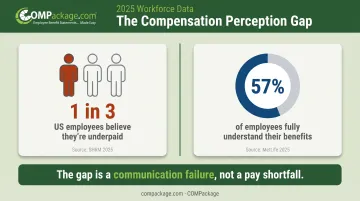
When employees don't understand the full picture, they fill in the blanks with their take-home pay. The rest disappears.
What the Engagement Data Shows
The MetLife research found that employees who understood and were satisfied with their benefits were 1.4x more likely to feel engaged and 1.2x more likely to report being productive. Mercer separately reports that employees who perceive their pay as fair show 85% higher engagement and 60% higher commitment than those who don't.
Neither of these outcomes requires spending more money on compensation. They require communicating what already exists, clearly and consistently.
Turnover Has a Price Tag
Gallup estimates replacement costs at roughly:
- 200% of salary for managers and leaders
- 80% for technical professionals
- 40% for frontline employees
Gallup also found that 42% of voluntary departures were preventable. Among employees who left, 45% said no manager had discussed their job satisfaction in the prior three months.
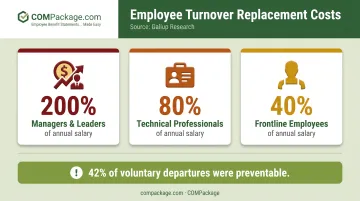
That conversation gap matters. An employee who doesn't know their $52,000 salary comes with another $18,000 in employer-funded benefits is weighing a $62,000 offer somewhere else against $52,000, not $70,000. They're making a decision based on incomplete data.
The Recruiting Angle
Pay transparency also affects candidate decisions before someone even joins. SHRM research found more than 80% of US workers are more likely to apply when a job posting includes a salary range — and among employers who list ranges, 70% reported more applications and 66% reported higher applicant quality.
The same logic extends to the full offer. A smaller employer that clearly communicates its total compensation package (health premiums paid, retirement match, PTO value, perks) can make an offer look significantly more competitive than a higher base salary with vague or unstated benefits elsewhere.
What to Include When Communicating Total Rewards
A strong total rewards communication covers every dollar the employer spends on behalf of the employee, plus non-monetary benefits worth acknowledging.
Direct Compensation
- Base salary or hourly wage
- Overtime, shift differentials, or guaranteed bonuses
- Overtime, shift differentials, or guaranteed bonuses
- Commissions, incentives, or other variable pay
Employer-Paid Benefits (Break Out the Dollar Amounts)
- Health insurance: Employers cover avg. 84% of single ($7,885) and 74% of family ($20,143) premiums (KFF 2025). Employees rarely know these figures.
- Dental and vision insurance contributions
- Disability and life insurance premiums
Retirement and Financial Benefits
- 401(k) employer match, quantified annually (avg. 4.6% of pay, Vanguard 2025)
- Pension contributions, profit sharing, or stock options where applicable
- Pension contributions, profit sharing, or stock options where applicable
- Employer HSA or FSA contributions, when offered
Paid Time Off and Leave
- Assign a dollar value to holidays, vacation, sick time, parental leave, and personal days
- COMPackage sample reports often itemize holidays, sick, and vacation at $5,000–$7,000+ per year
- Employees rarely treat PTO as compensation, yet it has real cash value
Additional Perks and Non-Monetary Benefits
- Tuition reimbursement, professional development, and conference fees
- Wellness stipends, employee assistance programs
- Cell phone, technology, transportation, or commuter benefits
- Remote work or flexible scheduling (acknowledge even without a dollar figure)
Common Challenges in Total Rewards Communication
Complexity and Jargon
Benefits involve technical language: deductibles, vesting schedules, HSA contribution limits, ERISA compliance. Translate those terms into plain language instead of defining every one. "Your employer contributes $657 per month toward your health insurance premium" is more useful than "you are enrolled in the PPO plan with a $2,000 deductible."
Plain-language summaries with actual dollar figures cut through confusion faster than any glossary.
One Size Rarely Fits All
Different employees prioritize different parts of their package. Younger workers often care more about career development and flexibility. Others prioritize healthcare or retirement.
WorldatWork found managers underestimated how much employees valued flexibility by 14 percentage points, benefits by 8 points, and PTO by 6 points. That gap between what employers assume and what employees actually value is significant.
Segmented communication, or better yet personalized statements, addresses this directly.
Information Overload
Total rewards updates compete with dozens of other internal messages. MetLife found 65% of employees want benefits communication throughout the year, and 54% want personalized recommendations, not a single annual blast. Timing, channel mix, and personalization determine whether the message is actually read.
Best Practices for Communicating Total Rewards Effectively
Use Multiple Channels and Consistent Timing
No single channel reaches everyone. An effective strategy layers:
- Onboarding materials — set expectations from day one
- Annual statements — timed around performance reviews or open enrollment
- Manager conversations — one-on-ones and career development discussions
- Email reminders — after salary changes, new benefit additions, or annually
- Company intranet — accessible year-round for reference
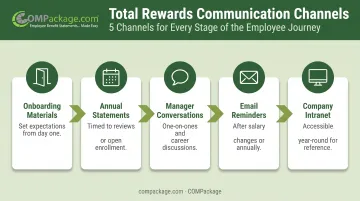
Relying on a once-a-year email means most employees will forget what they received within weeks.
Personalize the Message
Generic communications tell employees what the company offers. Personalized communications show each employee what they receive.
A benefits overview that says "we offer health insurance and a 401(k) match" does far less than a statement built for one person.
Show the employee: your employer paid $7,885 toward your health insurance this year, and $2,340 into your 401(k) on your behalf. That specificity changes how people perceive their compensation.
Train Managers to Reinforce It
WTW found that 84% of employers use managers as a pay-communication channel, but only 38% say they educate managers effectively.
Managers are often the most trusted source of information for employees, yet most lack the tools or talking points to discuss compensation beyond base salary.
Providing managers with a one-page summary of total rewards components, along with basic talking points for performance reviews, closes this gap without a major training investment.
Keep It Simple and Visual
- Use plain language — avoid plan names, acronyms, and HR jargon
- Present totals visually: a chart showing salary vs. total compensation lands faster than a paragraph
- Always include a clear next step — where to view the full statement, ask questions, or learn more
How Total Compensation Statements Simplify the Process
A total compensation statement is a personalized report that shows each employee the full dollar value of their compensation package in one document. It eliminates the "I had no idea" moment that leads good employees to underestimate their pay and start looking elsewhere.
The practical impact is real. An employee earning $55,000 in salary may actually receive $72,000 or more once health premiums, 401(k) match, PTO, and other employer-paid benefits are counted. Seeing that full figure often shifts how they view their pay and their employer. COMPackage customers have reported that fringe benefits add between 42% and 52% to annual compensation in their own reports.
What COMPackage Delivers
COMPackage was built specifically to make this process accessible for businesses that don't have large HR teams or consultant budgets. The platform covers over 80 benefit and perk categories, including:
- Health, dental, vision, and disability insurance
- Retirement and 401(k) contributions
- Legally required benefits (Social Security, Medicare, workers' comp, unemployment insurance)
- Paid leave (holidays, vacation, sick, personal)
- Technology, transportation, cell phone, and meal benefits
- Education, training, and professional development
- Non-quantifiable benefits (flexible schedule, remote work provisions)
Beyond category coverage, the platform is built for speed and accuracy:
- Personalized reports show only the benefits that apply to each employee
- Auto-calculators handle mandated benefits, insurance, time-off values, and 401(k) contributions
- Employee LOADER bulk-imports from any Excel file so you can map columns and load hundreds of records in minutes
- Company branding, logo, and custom colors produce professional statements without design work
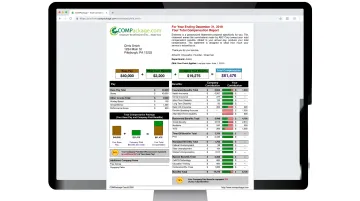
A small business can typically finish reports for its entire workforce in under 90 minutes.
Pricing That Works at Any Scale
| Employee Count | Annual Price |
|---|---|
| 1–5 | $149/year |
| 1–15 | $299/year |
| 16–25 | $399/year |
| 26–50 | $699/year |
| 51–100 | $999–$1,199/year |
| 101–200 | $1,699–$2,099/year |
| Unlimited | $2,599/year |
| Professional (multi-client) | $2,999/year |
The Professional version is built for insurance agencies, benefits consultants, HR firms, and accounting practices that offer total compensation reporting as a client service. It includes:
- Unlimited statements across unlimited clients
- Separate client file management
- Customizable templates for different languages and currencies
All plans include a 30-day satisfaction guarantee with a full refund if you're not satisfied, for any reason.
Frequently Asked Questions
How do you explain total rewards to employees?
Break down every element of compensation (salary, employer-paid benefit premiums, retirement contributions, PTO value, and perks) into clear dollar amounts. A personalized statement that shows each individual their specific package is far more effective than a general overview of what the company offers.
What should be included in a total rewards statement?
Include base pay, employer-paid health/dental/vision premiums, retirement and 401(k) match, the annualized value of PTO and leave, bonuses, and any extra perks. The goal is a complete picture, not just a salary line.
How often should employers communicate total rewards?
At minimum, annually , ideally around performance reviews or open enrollment. Reinforce with touchpoints during onboarding, after pay changes, and whenever new benefits are introduced. MetLife found 65% of employees want communication throughout the year, not just at enrollment.
Why do employees undervalue their compensation packages?
Employees typically see only their take-home pay after taxes and deductions. Employer contributions to health insurance, retirement plans, and paid leave are invisible unless someone explicitly shows the dollar amounts. Transparent, itemized communication closes that gap.
What is the difference between total rewards and total compensation?
Total compensation refers to direct monetary pay : salary, bonuses, and equity. Total rewards is broader, also encompassing non-monetary elements like recognition, career development, work-life balance, and well-being support. Both matter; total rewards communication covers all of it.