Introduction
Picture this: you have two job offers on the table. The first pays $75,000 with no benefits. The second pays $65,000 but includes employer-paid health insurance, a 401(k) match, and 15 days of PTO. Which one is actually worth more?
Most people instinctively grab the higher number. Many leave money on the table as a result.
A compensation package is the complete picture of what an employer provides in exchange for your work. Salary is part of it, but only one part. According to the Bureau of Labor Statistics' Employer Costs for Employee Compensation data, benefits account for 30.1% of total compensation costs for private-industry workers. Nearly a third of what workers "earn" never shows up on a paycheck.
Below, you’ll see what a compensation package includes, how to tally its real value, and why employers who show the full picture retain people longer.
Key Takeaways
- Compensation packages include salary plus benefits, bonuses, retirement contributions, equity, and perks
- Benefits represent roughly 30% of total employment costs for private-sector workers
- A $65,000 salary with strong benefits can outperform a $75,000 cash-only offer
- Employees who don't see the full picture often job-hop for marginal salary gains
- Total compensation statements close the visibility gap for employees and employers alike
What Is a Compensation Package?
A compensation package is the total value an employer provides to an employee in exchange for their work. That means every form of pay, benefit, and perk, not just the base wage.
This definition matters in two contexts. Candidates need it when evaluating a job offer, and employees need it over time as benefits keep accumulating—often without anyone tracking the full value.
Why the Full Package Matters More Than Salary Alone
The salary line in an offer letter is visible and concrete. Everything else is harder to see, which is exactly the problem.
Benefits are a substantial part of the picture. BLS data from March 2026 shows:
| Workforce Group | Wages/Salaries | Benefits |
|---|---|---|
| Civilian workers | 68.4% | 31.6% |
| Private-industry workers | 69.9% | 30.1% |
That split also changes significantly by company size. At establishments with fewer than 100 workers, benefits represent 26.3% of compensation. At companies with 500 or more employees, that figure climbs to 35.2%.
A large employer's package has more hidden value than a small one's. Comparing offers across company sizes means looking past the salary column.
Geography, industry, and role level create further variation. A manufacturing company's package looks different from a hospitality employer's. A director-level offer looks different from an hourly frontline position. The compensation package concept accounts for all of it; the salary number accounts for none of it.
Does a Compensation Package Include Salary?
Yes — salary is part of a compensation package. But "compensation package" is the whole pie; salary is one slice.
Here's the terminology that trips people up:
| Term | What It Means |
|---|---|
| Base pay / base salary | Fixed, guaranteed cash pay |
| Direct compensation | All cash payments: base pay plus bonuses and commissions |
| Total compensation | Cash plus employer benefit costs (health, retirement, insurance) |
| Total rewards | Total compensation plus intangibles such as career development, culture, and recognition |
A Concrete Comparison
Using the 2025 KFF Employer Health Benefits Survey, here is how two sample offers compare once employer health coverage is added:
- Offer A: $75,000 salary + $0 benefits = $75,000
- Offer B: $65,000 salary + $7,885 employer single health contribution = $72,885
On salary alone, Offer A still leads by $2,115. That gap ignores 401(k) match, PTO value, bonuses, and other benefits. Add a modest 4% retirement match ($2,600) and Offer B moves ahead—before any performance bonus is counted.
Salary answers only part of the question. Total compensation is what makes two offers comparable.
What Are the Typical Components of a Compensation Package?
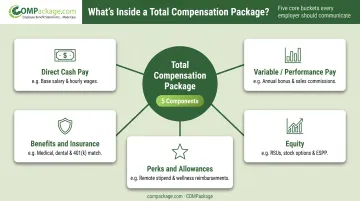
Most compensation packages fall into five buckets:
- Direct cash pay — base salary or hourly wages
- Variable / performance-based pay — bonuses, commissions, profit sharing
- Benefits and insurance — health, retirement, disability, life, PTO
- Equity — stock options, RSUs, and ownership grants
- Perks and allowances — remote work stipends, tuition reimbursement, flexibility
Direct Cash and Variable Pay
Base salary is the foundation: the fixed annual or hourly amount guaranteed regardless of company performance.
Variable pay layers on top of that. Common forms include:
- Annual performance bonuses — typically expressed as a percentage of base salary
- Signing bonuses — one-time payments at hire
- Retention bonuses — payments tied to staying through a defined period
- Commissions — common in sales roles, where variable pay can easily double base salary
- Profit sharing — distributions tied to company earnings
For sales roles especially, base salary may represent only 50–60% of total cash earnings once commissions are counted. Two salespeople with identical $60,000 bases can have drastically different total compensation depending on their variable structure.
Benefits, Insurance, and Paid Time Off
This is where the real hidden value lives.
Health insurance is the biggest single item for most employees. The 2025 KFF Employer Health Benefits Survey reports average annual employer contributions of $7,885 for single coverage and $20,143 for family coverage. Those amounts never appear on a paycheck; they go directly from employer to insurer.
Retirement plans: Vanguard's 2025 report, using 2024 plan data, found an average employer 401(k) match promise of 4.6% of pay (median: 4.0%). On a $65,000 salary, a 4.6% match equals roughly $2,990 per year deposited into an employee's retirement account.
Disability and life insurance round out this category. Access rates vary significantly by employer size:
| Establishment Size | Life Insurance Access | Short-Term Disability Access |
|---|---|---|
| Fewer than 100 workers | 42% | 31% |
| 100–499 workers | 72% | 53% |
| 500+ workers | 87% | 68% |
Paid time off belongs in the same benefits conversation and is quantifiable too. Divide annual salary by 260 working days to get a daily rate, then multiply by PTO days. For a $65,000 salary, each day off is worth $250. Fifteen PTO days equals $3,750 in annual value.
Equity and Additional Perks
Equity compensation, including stock options and restricted stock units (RSUs), is most common at startups and publicly traded companies. Vesting schedules typically span four years, so the full value isn't realized immediately. For candidates evaluating startup offers with below-market salaries, equity can be the deciding factor—but only if the company's trajectory supports it.
Workplace perks have expanded considerably. Common examples:
- Remote-work or home-office stipends
- Professional development and training budgets
- Tuition reimbursement
- Childcare assistance
- Gym memberships or wellness stipends
- Flexible scheduling
Some benefits resist dollar quantification: a strong culture, recognition programs, career mentorship. COMPackage's platform allows employers to include non-quantifiable benefits like these on compensation reports alongside monetary figures, giving employees a more complete picture of everything they're receiving.
A Real-World Compensation Package Example
Here's what a mid-level employee's package actually looks like when you run the numbers:
| Component | Annual Value | Source |
|---|---|---|
| Base salary | $65,000 | Given |
| Employer health contribution (single) | $7,885 | 2025 KFF Survey |
| 401(k) employer match (4.6% of salary) | $2,990 | 2025 Vanguard Report |
| PTO value (15 days × $250/day) | $3,750 | BLS / salary calculation |
| Annual performance bonus target (10%) | $6,500 | WorldatWork 2023 |
| Estimated total compensation | $86,125 | — |
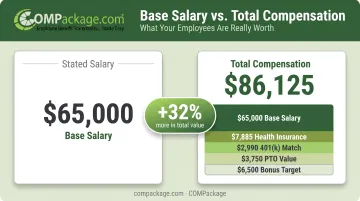
That $65,000 salary becomes an $86,125 total compensation package — 32% more than the stated salary.
The Hidden Value Problem
None of the $21,125 above shows up on a paycheck. The employee only sees deposits tied to the $65,000 base salary. The employer is spending substantially more.
That gap creates a perception problem: employees feel underpaid relative to the market when, in many cases, their full package is competitive. Total compensation statements close the gap by putting a real dollar value on every benefit in one place.
This is what drives unnecessary job-hopping. A competitor offers $70,000 with a vague benefits description, and an employee leaves, only to discover that the new employer's health premiums are higher, the 401(k) match is smaller, and the PTO is less generous.
How the Picture Changes by Company Size
Package mix also shifts with company size:
- Startups: Lower base, potential equity upside, flexible but leaner traditional benefits
- Large enterprises: Stronger health and retirement, structured PTO — benefits often 35%+ of total comp cost
- Small businesses: More weight on flexibility, culture, and non-cash perks that still carry real value
How to Calculate Your Total Compensation Value
Follow these steps to calculate a concrete number:
- Start with annual base salary: your fixed gross pay
- Add target bonus: express as a dollar amount, not a percentage
- Add employer health contribution: ask HR or check your benefits summary for the employer's share of your premium
- Add 401(k) employer match: salary × match percentage (e.g., $65,000 × 4% = $2,600)
- Add PTO value: annual salary ÷ 260 working days × number of PTO days
- Add employer-paid insurance premiums: disability, life, and other employer-paid coverage
- Acknowledge equity: note vesting schedule and estimated value, but keep it separate from cash totals
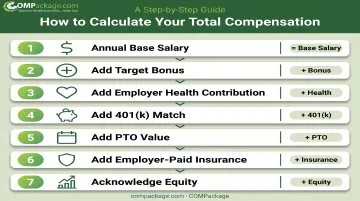
Equity is the one component you can't reduce to a single reliable number. Vesting schedules and share price swings make precise valuation difficult. Factor it into your thinking, but don't anchor decisions on an unvested figure.
Why Most People Skip This Calculation
The data is scattered. Base salary lives in the offer letter, health premiums sit in the benefits guide, and retirement details hide in a separate enrollment document. Nobody hands you a single page that adds it up.
That's the gap a total compensation statement fills: one document showing every component in dollar terms where possible. Tools like COMPackage let employers generate personalized total compensation reports for every employee automatically, so no one has to hunt down figures across multiple sources.
For employees evaluating an offer: request a written benefits summary before comparing two offers on salary alone.
For HR leaders: benchmark your total compensation figures against BLS Employer Cost data and industry salary surveys to confirm you're competitive on the full package, not just base pay.
Why Employers Should Communicate Total Compensation to Employees
Employees who can't see the full value of their compensation assume they're underpaid. That assumption drives turnover, and turnover is expensive.
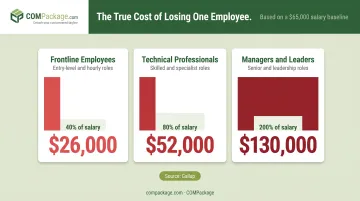
Gallup estimates replacement costs at 40% of salary for frontline employees, 80% for technical professionals, and roughly 200% for managers and leaders. On a $65,000 position, losing one technical employee costs the company upward of $52,000 in recruiting, training, and lost productivity.
When employees can see that their employer pays $7,885 toward health insurance, matches 4% of salary into a 401(k), and provides PTO worth thousands of dollars a year, the full package comes into focus. Against that total, a competitor's $5,000 salary bump looks far less compelling.
What a Total Compensation Statement Should Include
A well-constructed statement consolidates everything into a single, personalized document:
- Base salary and any variable pay (bonuses, commissions)
- Employer-paid benefit contributions (health, dental, vision)
- Retirement match amounts in dollar terms
- Employer-paid insurance premiums
- PTO value expressed as dollars
- Equity, with vesting schedule noted
- Non-monetary perks and their context
Deliver these at performance reviews and year-end, when employees are already weighing their value. That timing makes the employer's real cost—and the employee's full package—harder to overlook.
Where COMPackage Fits
COMPackage was built specifically for this problem. Founded by entrepreneur Joe Blattner, it's designed so companies with 5 to 5,000 employees can generate individualized total compensation statements in-house, without outsourcing to expensive service providers.
Key features relevant to small and mid-sized businesses:
- Over 80 preprogrammed benefit categories for insurance, retirement, PTO, mandated benefits, and perks
- Employee LOADER bulk-imports data from Excel (100 employees in minutes)
- Auto-calculators for mandated benefits, 401(k) contributions, time-off value, and insurance
- Non-quantifiable perks (flexible work, recognition programs) shown beside dollar figures
- Custom branding with company logo and report colors
- 30-day full refund guarantee
Annual licensing starts at $149 for companies with up to 5 employees, scaling to $2,599 for unlimited employees. A Professional version at $2,999 per year supports HR consultants, benefits advisors, and insurance agencies managing multiple client accounts.
One annual license fee is a small stake next to the cost of losing a single employee who never saw how much their employer was already contributing.
Frequently Asked Questions
What are the typical components of a compensation package?
A compensation package typically includes base salary, variable pay (bonuses, commissions, profit sharing), employer-paid health and retirement benefits, paid time off, equity compensation, and workplace perks. The specific mix varies by employer size, industry, and role level.
Can you give me an example of a compensation package?
A $65,000 base salary plus employer-paid single health coverage ($7,885), a 4.6% 401(k) match ($2,990), 15 days of PTO ($3,750), and a 10% annual bonus target ($6,500) totals roughly $86,125. That's about 32% above the stated salary.
What is the difference between salary and compensation?
Salary is the fixed cash component of pay. Total compensation is broader: it includes all monetary and non-monetary value an employer provides, such as health benefits, retirement contributions, bonuses, equity, and perks.
What is a total compensation statement?
A total compensation statement is a personalized document that consolidates every component of an employee's pay into a single report. It covers salary, employer-paid benefits, retirement contributions, bonuses, and perks so employees can see the full value of their employment beyond the paycheck.
How can small businesses offer competitive compensation packages?
Small businesses can compete by emphasizing non-salary benefits like flexibility, professional development, and strong culture, and by clearly communicating the full value of what they offer. Tools like total compensation statements make it easy to show employees benefits they might otherwise overlook.
Are benefits always included in a compensation package?
Benefits are a standard component of most packages, but the specifics vary widely. Some employers offer only legally required minimums; others provide extensive voluntary benefits. Always request a written benefits summary to understand what's actually included before comparing offers.