This isn't a compensation failure. It's a communication failure.
According to Gartner's 2022 research, only 32% of employees believe their pay is fair, and those who perceive pay as inequitable have 15% lower intent to stay and are 13% less engaged. Many of these employees are receiving market-rate compensation — they just don't know it.
This article covers how to build a compensation communication plan, what to communicate, how to deliver the message, and how to prepare managers — so employees see the full picture of what they actually earn.
Key Takeaways
- A documented compensation communication plan defines who shares what, when, and through which channels.
- Employees need to understand more than base salary — every benefit carries a measurable dollar value most employees never see.
- Sharing your compensation philosophy removes the "black box" perception and builds trust.
- Managers must be trained as confident messengers before any employee conversations happen.
- Total compensation statements give each employee a clear, personalized view of what they actually earn.
Why Compensation Communication Fails (and What It Costs)
Most companies default to communicating one number: base salary. Everything else — employer-paid insurance premiums, retirement matching, paid leave, wellness stipends, tuition reimbursement — stays invisible on a paycheck stub. The result is a perception gap where employees measure their "pay" against a fraction of what the employer actually provides.
This gap is expensive.
The Cost of Getting It Wrong
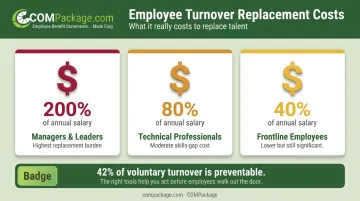
Gallup estimates replacement costs at roughly 200% of salary for managers and leaders, 80% for technical professionals, and 40% for frontline employees. Gallup also found that 42% of voluntary leavers said their manager or organization could have done something to prevent their departure — meaning nearly half of turnover is avoidable.
The benefits gap alone is substantial. According to MetLife's 2025 research, only 57% of employees fully understand what their benefits cover, while 72% want more tailored benefits communications. When employees don't understand their benefits, they don't value them — and they don't factor them into compensation comparisons.
The Good News: Communication Alone Moves the Needle
Improving communication — without changing actual pay — can measurably shift how employees feel about their compensation.
Gartner found that only 38% of employees understand how their pay is determined. When organizations educated employees on pay determination, employee trust increased by 10% and pay-equity perceptions improved by 11%. That's a meaningful shift — no salary adjustment required.
For many organizations, the real gap isn't in what they pay — it's in what employees actually understand about it.
Start With a Compensation Communication Plan
Before any conversation happens, you need a written compensation philosophy. This document defines:
- What the company values and how it approaches pay
- Where you target against the market (at, above, or below median)
- What factors influence individual pay (role, experience, performance, location)
- How pay ranges are structured and reviewed
This philosophy becomes the backbone of every compensation conversation. Without it, managers improvise, employees speculate, and trust erodes. WorldatWork data shows only 63% of organizations maintain a written compensation philosophy — meaning more than a third are operating without one.
Decide Who Owns the Communication
In companies with dedicated HR, the HR team owns the communication strategy. In smaller businesses without that infrastructure, responsibility falls to the CEO or department heads. Either way, ownership must be explicitly assigned. Ambiguous ownership is how compensation messaging goes silent.
Managers are equally critical. Since employees typically bring pay questions to their direct supervisor first, managers must be briefed and aligned before any communication reaches staff — not after. Once ownership is clear, the next step is building a consistent rhythm for when those conversations happen.
Set a Communication Schedule
A one-time conversation at hire is insufficient. Compensation should be revisited at minimum annually, tied to natural events:
- Annual review or merit cycle — primary touchpoint for raises, adjustments, and full total compensation reviews
- New hire onboarding — full walkthrough of the compensation package, not just the offer letter number
- Promotions or reclassifications — explain what changed and why
- Plan changes — any modification to benefits or bonus structures warrants proactive communication
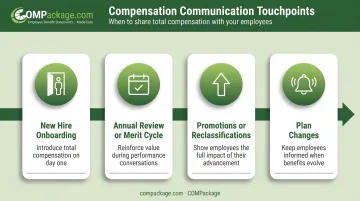
Waiting for employees to raise questions puts you in a defensive position. Proactive communication sets expectations early — and keeps them from forming on their own.
Know Your Audience
A first-year employee's compensation conversation looks different from a senior manager's. Sending the same generic overview to your entire workforce often means it resonates with no one. Segment your messaging by:
- Role or level — executives need different context than individual contributors
- Tenure — new hires need education; long-tenured employees need reassurance
- Pay band — employees near the top of their range have different concerns than those with room to grow
What to Communicate to Employees About Their Compensation
Effective compensation communication covers three layers:
- The company's compensation philosophy — the "why" behind pay decisions
- The individual's total compensation breakdown — every dollar, itemized
- External market context — where their pay falls relative to the market
Each layer addresses a different question employees have — and leaving any one out invites doubt to fill the gap.
Share the Compensation Philosophy
Explaining how roles are benchmarked, what performance factors are considered, and how pay ranges are structured gives employees a concrete framework for understanding their pay — not just a promise that it's fair.
Gartner's data reinforces this: when employees understand how pay is determined, trust increases by 10%. Without that context, employees fill the gap themselves — Gartner found 43% of employees discuss pay with colleagues and 45% consult third-party salary sites at least once a year. When your company stays silent, employees piece together their own picture — usually from sources with less accurate or relevant data.
Communicate the Full Compensation Package
Most companies pay significantly more than employees realize — and fail to show it. The Bureau of Labor Statistics reported that as of March 2026, benefits represent 29.4% of total employer compensation costs — averaging $14.50 per hour on top of wages. Employees rarely see this number.
Every compensation conversation should itemize:
- Base salary
- Annual bonuses or incentive pay
- Employer-paid health, dental, and vision insurance premiums
- Retirement plan contributions and any matching
- Paid time off (converted to a dollar value)
- Life insurance and disability coverage
- Wellness stipends or employee assistance programs
- Tuition reimbursement or professional development funding
- Any other perks with a tangible dollar value
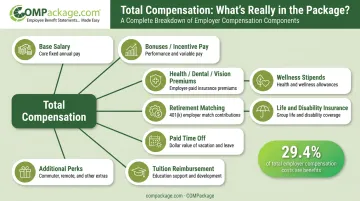
Total compensation statements are the most practical tool for making this visible. COMPackage's total compensation report software generates personalized, itemized compensation reports for each employee quickly and affordably — without requiring expensive service providers or outsourcing. The platform supports over 80 benefit categories, meaning even the less obvious perks get captured and communicated.
Include Market Data to Reinforce Fairness
Sharing relevant benchmarking data alongside individual compensation details turns "we pay fairly" from a claim into evidence. When an employee can see that their salary falls at or above the market midpoint for their role and location, the abstract concept of fair pay becomes concrete.
Use anonymized, aggregate data. Never compare one employee's pay directly to a colleague's — that triggers pay equity complaints and erodes the trust you're trying to build.
Acknowledge Non-Monetary Value
Flexible work arrangements, career development opportunities, a stable work environment, and positive culture add real value even without a direct dollar figure. These elements belong in compensation conversations too. They won't replace transparency about dollars, but including them — especially in writing — signals that your company accounts for the full employee experience, not just the paycheck.
How to Deliver Compensation Messages Effectively
Face-to-Face Conversations
Compensation decisions — raises, reclassifications, flat outcomes — should always be communicated in person or via video call for remote employees. Never by email alone.
Three reasons this matters:
- Managers can explain context and rationale, not just deliver a number
- Employees have space to ask questions and process the information
- It demonstrates that the decision was made thoughtfully, not mechanically
Do: Use plain language. Tie the outcome to the compensation philosophy and relevant factors. Stay focused on facts.
Don't: Express personal disagreement with the decision ("I tried to get you more"). Don't compare the employee to peers. Don't leave the outcome ambiguous.
Written and Documented Communication
Some things must always be in writing:
- Compensation offer letters for new hires
- Annual total compensation summaries
- Written notice of pay changes or promotions
- Bonus or commission statements
Written documentation creates a reference point that reduces confusion and protects both parties. It also reinforces that the process is consistent and intentional — not ad hoc.
Team-Level Meetings
All-hands or team meetings work well for communicating company-wide compensation philosophy and structure — not individual figures. When run well, these sessions reduce speculation, answer common questions, and create space for honest conversation.
Format matters as much as content here:
- Informal settings (working lunches, casual Q&As) tend to generate better questions than formal presentations
- Employees ask what they're actually thinking when the setting feels low-stakes
- Prepare for common questions about pay bands, equity, and timing in advance
Communicate Difficult Outcomes With Empathy
Money is personal — and the tone of a compensation conversation carries as much weight as the decision itself.
When communicating no raise or a disappointing outcome:
- Acknowledge the employee's perspective directly
- Explain the rationale without vague language or blame-shifting
- Give a concrete picture of what a different outcome would require next cycle
Saying "here's exactly what would need to happen for a different result" gives employees agency — something "the budget just wasn't there this year" never does.
Train Your Managers to Carry the Message
WorldatWork and Mercer data from 2020 shows 83% of employees receive pay communications through individual discussions with their supervisor — yet more than 60% of organizations report that managers are not trained to effectively deliver those conversations.
That gap is where compensation communication breaks down.
What Managers Should (and Shouldn't) Say
Without clear guidance, managers default to improvisation. That often erodes trust rather than building it.
Say this:
- "Here's how your pay was determined and what factors we considered."
- "This is where your role falls in our pay range and how that compares to the market."
- "Here's what the path looks like if you want to move toward a different outcome."
Don't say this:
- "I wanted to give you more but they wouldn't let me."
- "I don't really know how they decided this — you'd have to ask HR."
- "Your colleague in the same role is making X, so..."
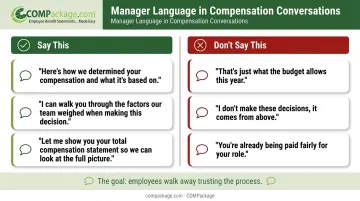
The difference between these responses isn't just tone — it's whether the employee walks away trusting the process or questioning it.
Create a Clear Escalation Path
Not every compensation question can be resolved at the manager level, and that's fine. What matters is having a defined path when escalation is needed:
- Who the employee contacts beyond their manager
- What information they should bring to that conversation
- When they can expect a response
Timely follow-through is just as important as the initial conversation. A manager who says "I'll find out and get back to you by Thursday", and actually does, builds more trust than one who promises and disappears.
Frequently Asked Questions
What is compensation communication?
Compensation communication is how employers explain pay and benefits decisions — what employees receive, how those decisions are made, and what their total compensation is worth beyond base salary.
What are the four types of compensation?
The four main types are: direct compensation (base salary and bonuses), indirect compensation (benefits like health insurance and retirement plans), non-monetary compensation (flexible work, development opportunities), and equity-based compensation (stock options or profit sharing ).
Can an employer tell you not to talk about compensation?
Generally, no. The National Labor Relations Act protects most private-sector employees' right to discuss wages and working conditions with coworkers. Employers cannot legally prohibit these conversations, even if a confidentiality policy exists — with limited exceptions for supervisors and certain excluded worker categories.
How often should you communicate compensation decisions to employees?
At minimum, annually during performance review cycles. Best practice includes discussions at hiring, promotions, role changes, and whenever the compensation philosophy or plan structure is updated. One conversation at hire is not enough.
What should be included in a compensation communication plan?
A solid compensation communication plan covers:
- The company's pay philosophy and how decisions are made
- Who owns each communication and when it's delivered
- A recurring schedule tied to review cycles and role changes
- What information employees receive at each touchpoint
- Which channels (1:1, written, platform) suit each message type
How do you communicate a raise — or no raise — to an employee?
Both conversations should happen face-to-face, with rationale tied to your pay philosophy, market data, and performance factors — not vague answers or deflection. For no-raise situations, close with a concrete description of what a different outcome would require next cycle.