Introduction
An employee opens their offer letter, sees a salary number, and mentally files that away as "what I make." Health insurance, 401(k) match, paid time off — none of it registers as real money.
That gap in perception is expensive. For HR leaders and business owners, confusing total job benefits with total employee compensation muddies recruiting pitches, budgeting decisions, and retention strategy.
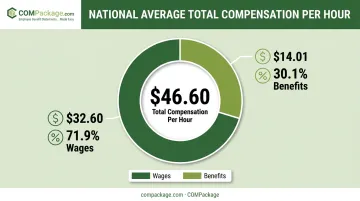
The numbers explain why this matters. According to the Bureau of Labor Statistics' Employer Costs for Employee Compensation report, benefits made up 30.1% of total compensation costs for private-industry workers based on the latest available data. That works out to $14.01 per hour in benefits on top of $32.60 in wages.
That's nearly a third of an employee's total pay package hiding in plain sight. This article breaks down both terms, shows how they connect, and helps you apply the distinction to real business decisions.
Key Takeaways
- Total employee compensation combines base pay, bonuses, and the value of every benefit
- Job benefits are non-wage extras like insurance, retirement, and PTO that skip a paycheck
- Employees routinely undervalue their own pay when benefits aren't spelled out in dollars
- Itemizing both figures gives companies a real edge in recruiting and retention
Total Job Benefits vs. Total Employee Compensation: Quick Comparison
Here's how the two terms compare side by side:
| Category | Total Job Benefits | Total Employee Compensation |
|---|---|---|
| Definition | Non-wage extras provided alongside salary | The complete value an employee receives for their work |
| What's Included | Paid leave, insurance, retirement contributions, legally required benefits | Base pay, incentives/equity, plus all benefits combined |
| Tax Treatment | Largely non-taxable or non-wage | Mix of taxable wages and non-taxable benefit value |
| Primary Use Case | Recruiting talking points, benefits plan design | Compensation benchmarking, total rewards statements, budgeting |
The short version: one is a slice, the other is the whole pie. Keep reading to see how each piece functions on its own before we bring them back together.
What Are Total Job Benefits?
Total job benefits are the non-wage compensation employers provide on top of a paycheck. The BLS treats benefits as a distinct labor cost category from wages precisely because they don't show up as cash, but they still cost real money and carry real value for employees.
The Five Core Categories
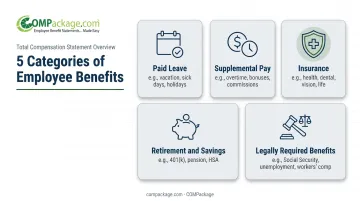
The Department of Labor's ECEC framework groups benefits into five buckets:
- Paid leave: vacation, holidays, sick days, personal time
- Supplemental pay: overtime, shift differentials, nonproduction bonuses
- Insurance: health, dental, vision, life, and disability coverage
- Retirement and savings: 401(k) matches, pensions, defined-contribution plans
- Legally required benefits: Social Security, Medicare, unemployment insurance, workers' comp
In practice, employees see this list translate into things like tuition assistance, daycare support, and relocation help: the tangible perks that show up in an offer letter but never in a pay stub.
Why Benefits Affect Retention
A well-structured benefits package isn't just a nice-to-have. Turnover is genuinely expensive. According to Gallup's research on preventable turnover, replacement costs run as high as 200% of annual salary for managers, roughly 80% for technical professionals, and around 40% for frontline workers.
Losing employees who feel underpaid (even when their benefits are competitive) hits the bottom line hard.
Use Cases of Total Job Benefits
Benefits carry the most weight in early-stage recruiting conversations: job postings, offer letters, and salary negotiations. A candidate comparing two offers often weighs the benefits line just as heavily as the base number.
The data backs this up. WTW's 2024 Global Benefits Attitudes Survey found that 54% of employees stayed with their employer specifically because of its benefits package.
That number climbs in industries where benefits are part of the culture: healthcare, tech, and government roles tend to attract benefits-conscious candidates who scrutinize insurance and retirement offerings closely.
What Is Total Employee Compensation?
Total employee compensation is the complete value an employee receives for doing their job: base pay, plus bonuses or incentives, plus the dollar value of every benefit layered on top.
A simple rule of thumb: if an employee pays tax on it directly, it's likely wage compensation. If not, it's probably a benefit. That distinction helps separate the two categories quickly when building out a statement.
Total compensation breaks down like this:
Base Pay + Bonuses/Incentives + Value of Benefits = Total Compensation
At the national level, this formula plays out consistently. Private-industry workers averaged $46.60 per hour in total compensation as of March 2026 — $32.60 in wages and $14.01 in benefits, per the same BLS ECEC data cited earlier. That's the figure finance teams and boards actually care about, not just the wage line.
Total compensation is the figure used for:
- Compensation benchmarking against market rates
- Annual budgeting and headcount planning
- Board and finance reporting on labor costs
Use Cases of Total Employee Compensation
HR consultants, benefits brokers, and payroll providers lean on total compensation figures constantly when advising clients on competitive pay structures. It's hard to tell a client they're underpaying without accounting for the full package.
Total compensation statements also show up during recruiting and annual reviews to answer the question employees rarely ask out loud: "What am I really getting paid?"
That gap is real: many employees recognize only 50% to 65% of their actual total compensation when they look at a paycheck alone, based on internal data from companies using compensation reporting tools like COMPackage. Spelling out the other half changes how people feel about their job.
Total Job Benefits vs. Total Employee Compensation: How They Work Together
Total job benefits sit inside total employee compensation as one component of the larger package. Think of compensation as the container and benefits as one of the ingredients inside.
Situational guidance:
- Highlight benefits breakdowns when recruiting entry-level or benefits-sensitive candidates
- Present full total compensation figures during retention conversations, raises, and internal equity reviews
- Combine both figures in annual compensation statements to reinforce total value
A Common Scenario
Picture a mid-sized company with a genuinely competitive benefits package: solid health coverage, a decent 401(k) match, generous PTO. Yet exit interviews keep citing "better pay elsewhere."
Leadership digs in and finds the disconnect: employees never saw a dollar figure attached to their benefits. They compared their salary line against a competitor's salary line and walked, without ever factoring in the thousands of dollars in coverage and contributions they'd be leaving behind.
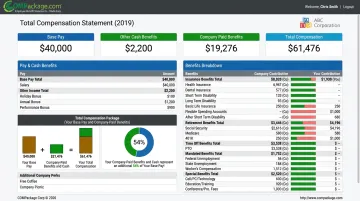
The fix many businesses land on is individualized total compensation statements. Rather than paying a third-party provider a hefty annual fee to generate these reports, a self-service platform like COMPackage handles it differently. Companies build and update statements in-house, often within a single business day.
When employees can see the complete picture (salary plus every benefit dollar attached to it) perceived value tends to rise, and so does loyalty. If exit interviews at your company sound similar, it may be worth exploring what a self-service total compensation reporting solution could do for your retention numbers.
Conclusion
Total job benefits and total employee compensation aren't competing concepts. One is simply a piece of the other: benefits are the non-wage extras that make an offer attractive, while total compensation reflects the complete dollar value of wages and benefits combined.
Treating these terms as interchangeable creates confusion. Understanding how they relate lets HR teams and business owners communicate pay accurately.
Getting this distinction right delivers concrete payoffs:
- Sharper recruiting pitches that highlight real value
- Compensation budgets built on accurate benchmarks
- Measurable retention gains when employees see their full earnings picture
Closing that gap keeps good employees from leaving over pay they never fully understood, and boosts morale in the process. A clear, itemized total compensation statement, the kind platforms like COMPackage generate, makes that understanding easy to deliver.
Frequently Asked Questions
What are employee benefits?
Employee benefits are non-wage compensation , such as insurance, retirement contributions, paid time off, and similar perks, provided on top of an employee's salary. They don't appear as cash in a paycheck but carry real financial value.
What are examples of employee benefits?
Common examples include health, dental, and vision insurance, 401(k) plans, paid time off, tuition reimbursement, and life or disability insurance. Many employers also offer perks like daycare assistance or relocation support.
What are the four types of benefits?
The Department of Labor groups benefits into paid leave, insurance, retirement and savings, and legally required benefits like Social Security. Supplemental pay is often considered a related fifth category.
Is total compensation the same as total benefits?
No. Total compensation includes benefits plus base pay, bonuses, and incentives. Benefits are one component of the total figure, not the whole amount.
How do you calculate total employee compensation?
Add base pay, bonuses or incentives, and the dollar value of all benefits provided. The formula is straightforward: Base Pay + Bonuses/Incentives + Value of Benefits = Total Compensation.
Why should employers show employees their total compensation package?
Employees often think only about base salary and miss the value of their benefits. Showing the full package improves perceived value, boosts satisfaction, and supports better retention outcomes.