Getting compensation right early isn't about paying the most. It's about building a principled system that lets you attract talent, retain people, and scale without unraveling messy decisions down the road.
Key Takeaways
- Total compensation extends far beyond base salary: benefits alone average 30.1% of total pay, yet most workers estimate it's only 16%
- Set your compensation philosophy before your first hire, not after a problem surfaces
- Starting salary is your highest-stakes decision — future raises compound from that baseline
- The first 10 hires collectively shouldn't exceed 10% of the equity pool
- Comp structure should match what actually motivates performance — it differs by role
What "Total Compensation" Really Means
Most founders think about compensation in terms of cash. That's a recruiting disadvantage — especially when you're competing against better-funded companies on salary alone.
According to March 2026 BLS data, benefits represent 30.1% of total private-industry compensation. Yet the EBRI's 2025 Workplace Wellness Survey found workers believe benefits account for only 16% of their total pay. That's nearly double the actual value — and it's where early-stage founders can win recruiting battles without raising salaries.
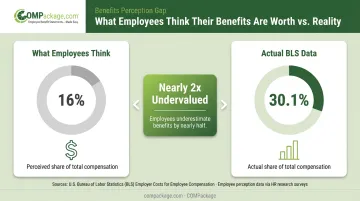
The Perceived vs. Actual Value Gap
A candidate comparing two offers may choose a competitor with a higher base without realizing your total package is worth more. The only way to close that gap is to make the full picture visible.
Total compensation includes:
- Base salary
- Equity grants and vesting upside
- Health, dental, and vision insurance (employer contribution)
- Retirement contributions (401(k) match)
- Paid time off — vacation, holidays, sick days
- Bonuses and signing payments
- Professional development stipends, tuition support, and certifications
- Technology stipends, parking, and transportation benefits
- Remote work flexibility and non-quantifiable perks
When cash is constrained, founders can strategically offset lower salaries with clearly communicated benefits and equity upside — but only if candidates can actually see what's in the package.
Making the Full Package Tangible
Tools like COMPackage allow founders to generate total compensation statements that itemize every element of an employee's package. A sample report might show an employee earning $63,408 in direct pay — but with employer benefit contributions factored in, their total compensation reaches over $102,000. That $39,000 difference doesn't show up anywhere in a standard offer letter.
For early-stage founders without a dedicated HR team, COMPackage's self-service model makes this practical to execute. Key capabilities include:
- Over 80 preprogrammed benefit categories
- Automated calculators for employer-side costs (payroll taxes, insurance, 401(k) matching)
- Candidate-ready reports built in hours, not days
Setting Your Compensation Philosophy Before Your First Offer
A compensation philosophy is a documented set of principles that guides how your company thinks about pay — what you value, how you balance cash vs. equity, where you'll sit in the market, and how you'll handle raises and promotions.
Think of it as a decision-making tool, not a bureaucratic exercise.
According to compensation advisor Matt Knopp, quoted in First Round Review, founders often feel they don't need a philosophy at 10 or 15 employees — but creating one at that stage prevents far more expensive problems shortly after.
The Four Questions Your Philosophy Must Answer
Before your first hire, document your answers to these:
- What market percentile will you target? (e.g., 50th percentile for most roles, 75th for mission-critical hires)
- What's your cash/equity split philosophy? Early-stage typically means lower cash, meaningful equity upside
- Will you negotiate, or set fixed offers? Fixed ranges are more equitable and defensible
- How will you reward top performers outside annual cycles? Build flexibility in before you need it
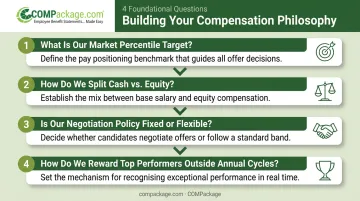
Salary Tiers From Day One
Even with 10 employees, define 3–4 experience levels — junior, mid, senior, principal. This gives you a framework to promote people without inventing new comp structures on the fly, and it makes career conversations more transparent and defensible.
Internal Equity Is Non-Negotiable
Before extending any offer, compare the proposed salary against what current employees in similar roles earn. Payscale's 2026 Compensation Best Practices Report found that 33% of organizations cite pay compression as a driver of unfair pay perceptions. A new hire earning more than a tenured employee in the same role creates resentment quickly — and it's far easier to prevent with a clear pay structure than to repair after the fact.
How to Determine Starting Salaries Without Over- or Under-Paying
Starting salary is the single most consequential compensation decision you make for any employee. Future raises, equity refreshes, and promotion bumps are typically calculated as percentages of the base — so the number you set compounds across the entire employment relationship.
Benchmarking Sources Worth Using
Don't guess. Use actual market data:
| Source | Best For |
|---|---|
| Pave Market Data | Startup-specific salary and equity bands by role and level |
| Carta | Real-time data from 130,000+ employees across 2,250+ startups |
| Radford/Aon | Venture-backed and tech-company benchmarking |
| Levels.fyi | Market signal for software roles (crowdsourced, treat accordingly) |
Pull the 25th, 50th, and 75th percentile data for each role. A fully qualified candidate typically lands near the midpoint.
Key Factors Before You Set a Number
- External market data — what does the market pay at each percentile for this role?
- Candidate readiness — are they operating at full function or still developing?
- Internal equity — what are peers in similar roles earning today?
- Budget and runway — what's sustainable across 18–24 months?
- Recruiting difficulty — small applicant pools push ranges up
The Temptation to Overpay After a Raise
When you've just closed a round, paying generously feels easy. Don't let fresh capital loosen your standards. High starting salaries create an internal ceiling that compresses raise headroom for future high performers — and by the time your Series B closes, those early inflated bases become a structural problem that's expensive to unwind.
Talk Comp Early and Openly
Keeping pay ranges internal doesn't protect you — it costs you candidates. SHRM found that 41% of professionals would lose interest in a position if no salary range was listed. Share your range proactively. Ask candidates about their expectations — not their salary history, which in many jurisdictions is legally restricted and perpetuates pay inequity. Present the total package, not just the base.
Balancing Equity and Cash for Your Earliest Hires
The classic startup model — lower cash, meaningful equity — still makes sense. But founders who over-index on cash after a large raise sever the link between value creation and reward. The goal is a structure where employees win when the company wins — and that starts with getting the allocation right.
The First 10 Hires Rule
First Round Review cites the rule of thumb that the first 10 hires collectively should receive no more than 10% of the equity pool. Individual grants vary significantly by seniority, role importance, and timing — but model dilution scenarios before being generous. Early equity decisions are very hard to walk back.
Equity Education Is as Powerful as the Equity Itself
Allocation is only half the problem. A study of 3,000+ American STEM degree holders found that only 36.4% understand stock options, and 47% of startup workers didn't negotiate equity due to lack of understanding.
A one-page equity explainer — how vesting works, what the cliff means, what a liquidity event might look like — can make a lower-cash offer far more compelling than the number alone. Clarity on those mechanics turns an abstract grant into something candidates can actually value.
Compensation by Role: Not Every Function Works the Same
Comp structure should reflect what drives performance in each function. Applying a generic formula across your entire team leaves performance on the table.
Here's how the three core early-stage functions typically differ:
- Sales: Base-plus-variable is standard. Set a base the rep can "pay for" through their own output, target double their on-target earnings at consistent quota attainment, and pay commissions when cash is received — not at contract signature. Pave data shows a 50/50 base-to-variable split is the most common structure.
- Customer success: A base-plus-bonus model tied to renewal rates, expansion revenue, and product adoption works better than pure commission. Commission encourages short-term deal-pushing over genuine customer health — the opposite of what early-stage CS should do.
- Engineering and product: Lean heavily toward equity rather than variable cash, tying long-term upside to the outcomes they actually help build. Pave benchmarks a founding software engineer at the 50th percentile at roughly $187K cash with 0.33% ownership — though location and stage can push that number 20–30% in either direction.
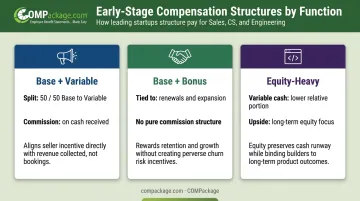
The Most Common Compensation Mistakes First-Time Founders Make
Waiting until there's a problem. Most founders don't think about comp philosophy until an employee complains or two people in the same role are paid very differently. Proactive structure is far less expensive than reactive firefighting — and SHRM research shows pay transparency alone decreases intent to quit by 30%.
Benchmarking against the wrong companies. Copying Google's comp structure without context leads to either unsustainable overpaying or a structure that doesn't fit your stage or culture. Market data is a tool, not a prescription. Interpret benchmarks relative to your own philosophy and constraints — a Series A startup in Pittsburgh is not competing with Meta for every role.
Treating comp conversations as one-time events. Early-stage companies that only revisit pay during formal annual cycles risk losing high performers who are underpaid relative to their actual contribution. Payscale found 65% of organizations proactively address severely underpaid employees during regular pay processes to improve retention. Most startups skip this step entirely.
Build in the flexibility to reward impact in real time, with documented justification so increases remain equitable across the team.
Frequently Asked Questions
What does initial compensation mean?
Initial compensation is the complete offer package made at hire — base salary, equity grant, signing bonus, and benefits. It becomes the baseline for all future raises and promotions, which makes it the highest-stakes pay decision you'll make for any employee.
Is $70,000 a good starting salary out of college?
"Good" depends on geography, industry, role, and total package. NACE reported the average starting salary for the Class of 2024 was $65,677, but for founders the real question is whether the offer benchmarks to the role, holds up against peer pay, and fits within a sustainable budget.
Is a 1.0 compa ratio good or bad?
A compa ratio of 1.0 means an employee is paid exactly at the midpoint of their salary range — generally considered well-positioned. A ratio below 0.8 may indicate the person is underpaid or underleveled, while a ratio above 1.2 can limit future raise headroom and signal a compression risk.
How much equity should early-stage founders give their first hires?
Most early-stage playbooks cap the first 10 hires at a combined 10% of the equity pool, with individual grants varying by seniority, role criticality, and timing. Model dilution scenarios before committing, because early equity decisions are difficult and costly to unwind.
When should a startup set a formal compensation philosophy?
Before the first hire. Even a simple one-page document prevents the inconsistency that creates internal equity problems later. Without one, every offer becomes a separate negotiation, and early hires end up with wildly different packages that are painful and expensive to reconcile.
How do you show candidates the full value of a startup offer when cash is limited?
Itemize every element of the offer — equity, benefits, flexibility, and perks — so candidates evaluate total value rather than base salary alone. COMPackage lets you generate a detailed total compensation statement that makes the complete picture tangible, without needing a dedicated HR team to produce it.